

ISLAMABAD: The European Union (EU) has offered assistance to Pakistan in the implementation of National Action Plan on countering terrorism.
The offer was made at the fourth EU-Pakistan political counter-terrorism dialogue held on Tuesday under the framework of their five-year engagement plan.
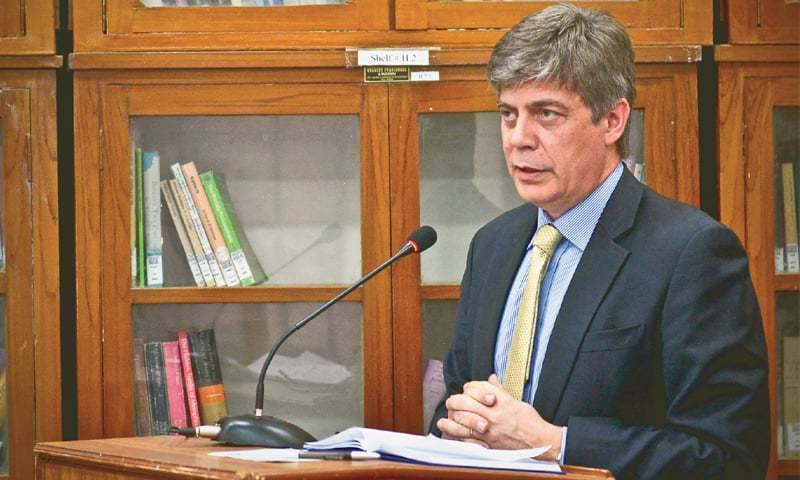
“The EU is ready to work with Pakistan especially after the Peshawar school incident and the recent wave of sectarian attacks. We have made some proposals, but Pakistan has to take the lead in the implementation of steps against extremist violence,” EU Ambassador Lars-Gunnar Wigemark told Dawn after the meeting.
Take a look: EU opposes removal of moratorium on death penalty in Pakistan
The EU delegation urged Pakistan to tackle sectarian violence, saying it was becoming more deadly.
The Foreign Office said in a statement that “the two sides exchanged views on the ongoing EU-Pakistan cooperation on issues pertaining to counter-terrorism and agreed to explore ways for further strengthening this relationship”.
The Pakistani delegation was led by Additional Secretary Tasnim Aslam, while the European External Action Service’s Managing Director for Multilateral Issues Mara Marinaki headed the EU delegation.
Reservations on military courts, executions reiterated
The EU is interested in cooperating with Pakistan against terrorism financing, money laundering, extremist violence and improvised explosive devices. For this, it intends to enhance intelligence sharing, besides extending help to build the capacity of law-enforcement agencies and improve the criminal justice system.
The EU team reiterated its reservations on setting up of military courts and lifting of a moratorium on execution of death penalties.
The European Union recently sought permission for observing the proceedings of the military courts set up to prosecute terrorism suspects, but the government is yet to respond to the request.
The Pakistani side at the talks tried to allay EU concerns about military courts, assuring the visitors that fair process would be observed and the accused would have the right to appeal.
It contended that the courts had been set up as a matter of expediency; otherwise there would be no difference in the procedure of trial.
The two sides also agreed to cooperate at multilateral forums, in particular at the United Nations’ Global Counter-Terrorism Forum.
Published in Dawn February 26th , 2015
On a mobile phone? Get the Dawn Mobile App: Apple Store | Google Play