0
0

UNITED NATIONS, Sept 19: The UN General Assembly on Friday overwhelmingly passed a resolution calling on Israel to drop its threat to “remove” Palestinian leader Yasser Arafat.
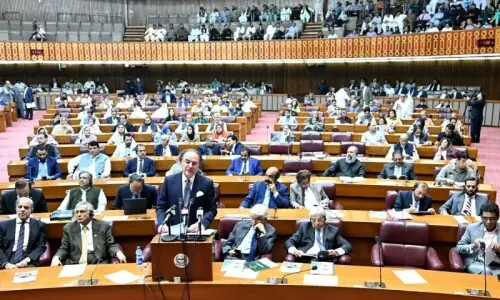
Three days after the United States vetoed an almost identical measure at the Security Council, the assembly adopted the resolution with a vote of 133 in favour and four against. Fifteen nations abstained.
The US and Israel both voted against the resolution, which was changed by the European Union during Friday’s emergency debate to include mention of both Palestinian suicide attacks and Israeli targeted killings.
In Jerusalem, an Israeli government spokesman said the resolution was “meaningless.” Assembly resolutions are not legally binding like those of the council, and cannot be vetoed.
But the US used its council veto on Tuesday to block a resolution criticising Israel for planning to drive Arafat into exile.
US ambassador John Negroponte said that resolution was “unbalanced” because it did not condemn Palestinian militant groups, and on Friday he took aim at what he called the UN’s “pattern of one-sided recriminations.”
“I regret that the United Nations will not send a positive and unified message to support the peace process,” he said.
Both Israel and the US say Arafat has undermined the Middle East’s “road map” peace plan and US President George W. Bush on Thursday urged the Palestinians to oust him as their elected leader.
“Mr Arafat has failed,” Bush said. “The people of the Palestinian territory must understand that, if they want peace, they must have leadership that is absolutely 100 percent committed to fighting off terror.”
In the halls of the General Assembly — where Bush will come next week to ask the world body for international help in Iraq — nation after nation spoke up Friday against the Israeli threat and the US veto at the council.
Elfatih Mohamed Ahmed Erwa, the UN ambassador from Sudan, which currently its chairman of the UN’s Arab bloc, said the United States “could have sent a positive signal” by not vetoing the first resolution.
Dan Gillerman, the Israeli UN envoy, said Arafat’s leadership had been a “tragedy” for the Palestinian people. “He represents the Palestinians’ dark past rather than the bright future they could have,” Gillerman said.
The Palestinian representative, Nasser al-Kidwa, said that Israel had failed to abide by law and that the government of Israeli Prime Minister Ariel Sharon was “a threat to the stability of the region.”
“Will the international community find the collective will ... to ensure respect for international law?” al-Kidwa said.
The so-called Quartet — the United States, United Nations, European Union and Russia, which drafted the road map plan — will meet on the sidelines of the UN general debate that begins here on Tuesday.
The Palestinians see the barrier as an Israeli attempt to pre-empt the boundaries of any future two-state settlement, but Israel insists it merely aims to prevent infiltrations by attackers and has no political significance.
Until the building of the 350-kilometre barrier is complete, Israel has vowed to dismantle “terrorist infrastructure.”
Meanwhile four Palestinians and three Israeli soldiers were wounded on Friday during the second consecutive day of a massive army sweep for militants in Jenin.
Ground troops surrounded a house in the town’s eastern Wad Ezzedin neighbourhood and exchanged heavy rounds of fire with Palestinian gunmen inside.—AFP