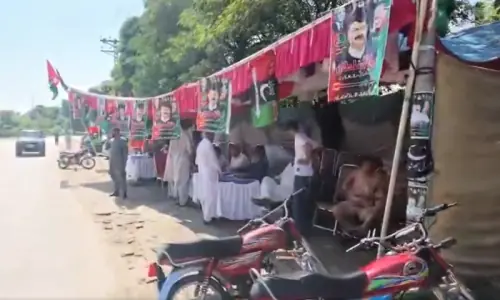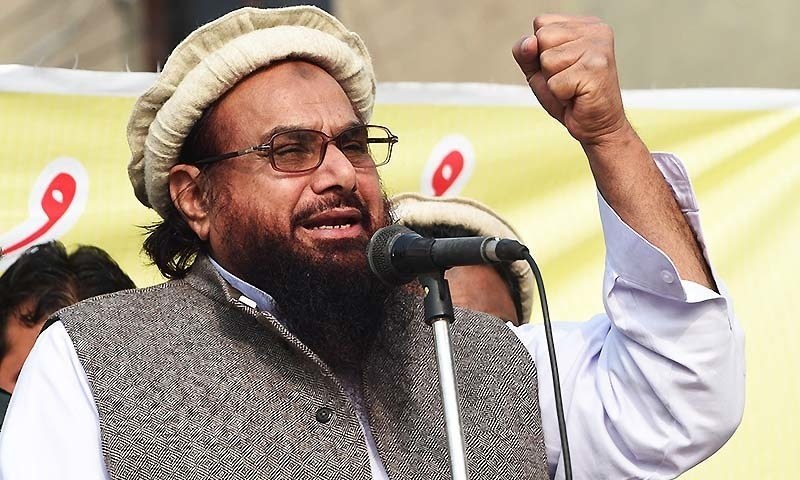


MURIDKE: It is listed as a terror outfit by the UN and its chief has a $10 million US government bounty against him, but Jamaatud Dawa operates freely across Pakistan, testing Islamabad's new resolve to tackle militancy.
Pakistan vowed to end its tolerance of so-called “good” militants after a Taliban massacre at a school in Peshawar in December killed 153 people, the worst terror attack in the country's history.
The government's list of 60 or so banned organisations features the Pakistani Taliban and secessionist rebels from Balochistan province, but the state has long shied away from action against groups considered useful for fighting abroad in India or Afghanistan.
International powers including the US and India consider Jamaatud Dawa (JuD) to be no more than a front for Lashkar-i-Taiba (LT), the militant group blamed for the 2008 Mumbai attacks that left 166 people dead.
But JuD denies any link to violence, and within Pakistan the organisation enjoys a high degree of popularity for the work of its charitable arm, particularly after natural disasters.
Following a UN Security Council resolution, Pakistan said it had frozen the group's assets after the Mumbai attacks — an undertaking it has repeated in recent weeks.
Also read: Banned or not?
But at JuD's headquarters, a sprawling high-security complex nestled among rice fields in the town of Muridke, north of Lahore, little seems to have changed.
Doctor Akhtar Hussain, a wizened old man with a long grey beard and a broad smile, heads the Al-Aziz Hospital in the heart of the complex which also houses schools where boys and girls study both JuD and official government textbooks.
JuD has set up a network of health and education facilities across Pakistan, including five hospitals, 200 dispensaries, ambulance services and 250 schools.
When AFP visited Al Aziz hospital, elderly women were lining up in a white corridor for eye tests.
“Laser eye surgery is free,” said Hussain. Further ahead, two dentists worked their way through their daily quota of 40 patients each.
The cost of treatment for a root canal is 50 rupees (50 US cents). “It is a fraction of the price. In a private hospital I would pay at least 1,000 rupees,” said patient Rana Khaliq-ur-Rehman.
Explore | Footprints: JuD's show of strength
After an earthquake or floods, JuD's relief wing, the Falah-i-Insaniyat Foundation (FIF), is often among the first aid groups on the ground.
JuD leader Hafiz Saeed — on whom the US has placed a $10 million reward for information leading to his capture — is often seen in the front line handing out food.
Despite the bounty, he also leads a high-profile public life and regularly delivers fiery anti-India speeches. He led thousands of supporters in a rally in Lahore last Thursday to mark Kashmir Day, under the eye of a heavy police contingent outside the city's high court.
“The politicians don't understand our problems, but the Jamaat does and helps us,” said Saddam Sohail, a 25-year-old builder who is hostile towards neighbouring India, like most JuD followers.
“When the US says JuD are terrorists, it makes my blood boil,” added Ghulam Sarwar, a 55-year-old farmer.
Humanitarian 'shield'
Founded in the 1980s to fight Soviet forces in Afghanistan, LT reinvented itself in the 1990s for “jihad” in Kashmir, the Himalayan territory that India and Pakistan control in part but claim in full and have fought two wars over.
Today, once again, the LT is sending fighters to Afghanistan's eastern Nuristan province, according to Afghan officials cited in a UN report.
LT recruits most of its members in Pakistan from its heartland in central Punjab province, where the level of education is higher than the national average, according to a study on the lives of deceased fighters published by the West Point military academy.
For Arif Jamal, author of a recent study on JuD, the popularity of the outfit rests on its stance on Kashmir and its charitable work, two elements that distinguish it from the rest of the main jihadist groups operating in Pakistan.
Its charitable wing is like a “shield” which protects JuD, Jamal told AFP.
Take a look | Footprints: Vacuum left by the state
“They have fundraised more through charity than other means and they recruited more people through charity than other means,” he said.
JuD's position on the Kashmir conflict — regarded even by many moderate Pakistanis as a just fight against Indian oppression — means the military “don't consider them as a terrorist group”, Jamal said.
Even politicians privately opposed to the organisation will never publicly speak out against it.
“Unless Jamaatud Dawa spins out of their control, I don't think they will ever target it, and that I don't see happening in the near future,” Jamal said.