0
0
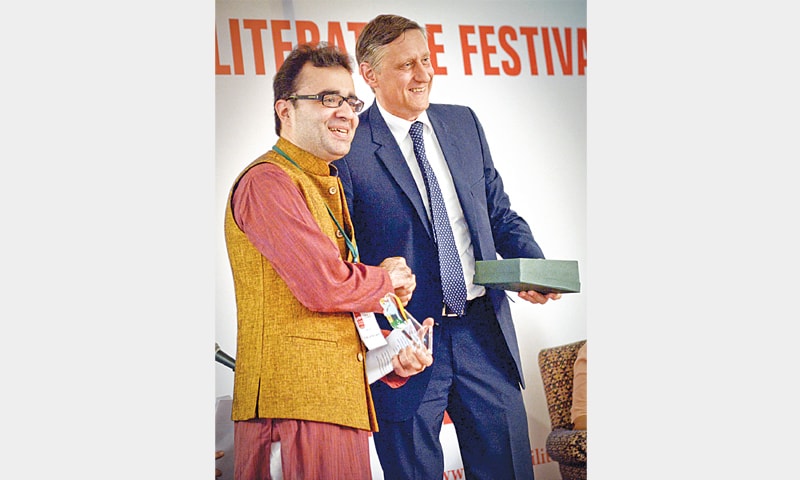

KARACHI: There were two joint winners of the The Karachi Literature Festival Peace Prize 2015: Ziauddin Sardar for Mecca and Ali Usman Qasmi for The Ahmadis and the Politics of Religious Exclusionin Pakistan announced on Saturday at a local hotel where the festival is under way.
As Ziauddin was not in town to receive his prize, fiction writer Kamila Shamsie received it on his behalf.
Later, Dawn spoke with Ali, a history professor at the Lahore University of Management Sciences, on the subject of his book.
Asked if his book could contribute to peace and harmony in the world, he said: “Through the book I am trying to make an argument that it is still possible for citizens to have their rights regardless of their race and ethnicity.”
Talking about access to resources while researching for his book, Ali said: “I was fortunate to have stumbled into a part of Punjab Archives that had declassified records of the inquiry commission of 1953. I used that a lot. Other records of 1974 were being declassified and were being put online. So, I had access to all these resources, which helped me in writing the book.”
When asked to explain his remarks in his acceptance speech about the sameness of the Jews in Nazi Germany and that of the Ahmadis in Pakistan that led to their persecution, Mr Qasmi said: “During the 1930s in Nazi Germany, the Jews were an affluent class, they spoke the same language, looked like the rest of the Germans, they were well assimilated into German society, their sameness became a problem.
“So to make them different, the Nazis made them wear insignia, a cap, so as to distinguish them from the others, to make them different. And this is what I meant in my speech when I said this is the same hypothesis that we can apply for the Ahmadis in Pakistan. They too look the same, their cultural and religious traditions are the same and the motivation is treat them differently and this can be created through violence because there is no other way. My fear is that some day they will be forced to wear insignia just like the Jews in Nazi Germany to mark them different.”
Mr Qasmi is currently working on the biography of Majlis-i-Ahrar. His book on Shia history, culture and politics in South Asia, he says, will be out in a couple of months.
Published in Dawn, February 8th, 2015
On a mobile phone? Get the Dawn Mobile App: Apple Store | Google Play