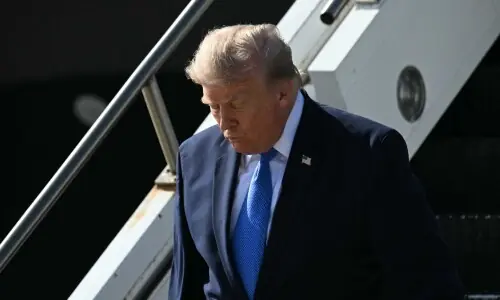
On January 26, President Barack Obama will be the chief guest at India's 66th Republic Day celebrations.
His presence at the birthday party of the world's largest democracy, just four months after Indian Prime Minister Narendra Modi's visit to the United States, is highly symbolic.
The visit is also expected to ramp up bilateral cooperation on economic growth, energy and climate change as well as address important differences such as intellectual property rights and civil nuclear liability law that pose a hindrance to taking the cooperation to the next level.
However, the larger goal that the United States would be pursuing here is to convince India to join a coalition of democracies to balance China's rise. Although it won't be publicized, this topic will likely be ever-present in their private conversations.
Deng Xiaoping's opening up of China's economy in 1978 began China's full integration into the global economy and normalized its diplomatic relations with other countries.
The resulting transformation of China's economy allowed it to ultimately challenge the supremacy of the United States.
China seeks to be the preeminent power in the Western Pacific and consolidate Asia into an exclusive bloc.
Although China's military capabilities are not formally equal to those of the United States, it still is capable of inflicting sufficient damage to increase the cost of a conflict to the United States to an unacceptable level.
In 2012, the Obama administration announced that it was going to be intensifying its focus to the Asia-Pacific in a policy popularly known as the “rebalance to Asia”.
The objective was to address the fact that the balance of powers in the Asia-Pacific region shifted in China's favor following the 9/11 attacks and the US war on terror.
The policy signaled that the US would be refocusing its interests and resources toward the Asia-Pacific region by investing and developing new capabilities, strengthening existing alliances and investing in key partnerships.
This “concert of democracies” strategy involved courting democracies in the region to manage the uncertainties caused by a rising China.
Currently, it is unclear whether there will be any formal version of a policy such as the Quadrilateral Strategic Dialogue (QSD) that was unveiled in 2007 by the Japanese prime minister, Shinzo Abe.
But what is clear is the bilateral relations between Asia's maritime democracies – India, the United States, Australia and Japan – are stronger than ever. These four countries interact regularly at a military-to-military level as well share intelligence regularly.
The United States' “rebalance to Asia” was always going to be complicated because of the special nature of the US relationship with China.
While the United States and China compete on geopolitical and military terms, they are also deeply dependent on each other economically.
To add to the complexity, China has slowly but steadily replaced the United States as the largest trading partner for almost all the Asian states, and many of these states consider China as an important vehicle for their future growth.
Thus, the United States and its allies in Asia find themselves in a difficult situation: they want the United States to protect them from any Chinese aggression but at the same time also want the United States to be sensitive to Chinese interests.
There is no denial that the US presence in Asia provides stability and certainty to India. There is also increasingly less doubt that India finds comfort in a US-centric world order.
It is unclear if India has the capacity or the resources to address challenges posed by a rising China on its own or with the cooperation of its other allies.