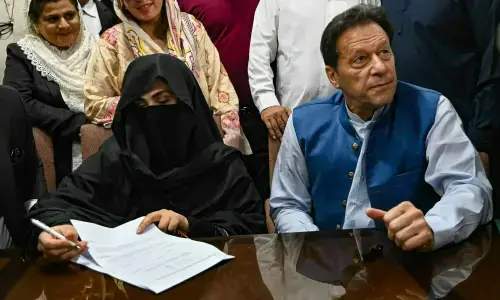
ISLAMABAD: The Islamabad High Court (IHC) on Thursday reserved its order on petitions seeking to declare the alleged solitary confinement of PTI founder Imran Khan and his spouse Bushra Bibi illegal after hearing detailed arguments from both sides.
Justice Khadim Hussain Soomro observed that the court would issue an order after examining the record and directed the parties to submit in writing any judgments they wished to rely on.
During the hearing, Adiala Jail Superintendent Sajid Baig, Islamabad Advocate General Naveed Hayat Malik and counsel for the petitioners Barrister Salman Safdar appeared before the court.
The advocate general argued that the petitions were not maintainable and maintained that neither Imran nor Bushra had been kept in solitary confinement. He said the prison authorities had instead provided them with facilities exceeding those available to B-class prisoners.
He submitted that, owing to security considerations arising from Imran’s political profile, he had been housed separately from other inmates, but such arrangements could not be termed solitary confinement. The jail authorities, he added, had complied with previous court directions by providing newspapers, books and other facilities.
Justice Soomro questioned the nature of the security arrangements and asked whether Imran had been extended B-class facilities.
The advocate general replied that he was receiving facilities even better than those prescribed for B-class prisoners.
Superintendent Sajid Baig informed the court that Imran had been provided more than 500 books so far, besides daily newspapers.
He said the PTI founder was not confined to a single cell for 24 hours, explaining that he had access to a compound comprising seven cells where he could move freely during the day.
He further contended that the concept of solitary confinement required a prisoner to remain locked in a cell continuously, which was not the case.
The advocate general further argued that neither any court nor any competent authority had ordered solitary confinement for either Imran Khan or Bushra Bibi, and that the petitioners could not seek relief beyond what was prayed for in their petitions.
Barrister Salman Safdar disputed the government’s stance, arguing that his clients were effectively being subjected to prolonged isolation amounting to mental torture.
Referring to his meeting with Imran earlier this year on the Supreme Court’s directions, he said his client had complained of deteriorating eyesight, restricted access to lawyers, political colleagues and family members, and an inadequate supply of books.
He told the court that despite facing more than 300 criminal cases, Imran had not been allowed regular consultations with his legal team.
According to the counsel, a 65-minute meeting arranged in April following the intervention of the IHC chief justice was the first meaningful consultation after several months, during which most of the discussion centred on the alleged mental distress caused by prison conditions.
Justice Soomro asked whether the petitioner had supported the allegations through an affidavit. Barrister Safdar replied that he intended to address every aspect of the case through his arguments.
The counsel requested the court to appoint a panel of lawyers to inspect prison conditions, allow weekly telephone conversations between Imran Khan and his two sons, facilitate regular meetings with lawyers and family members, and direct the authorities to permit Imran Khan and Bushra Bibi to spend time together in accordance with prison rules.
During the proceedings, books sent by Imran’s family for delivery to the prison were produced before the court, prompting Justice Soomro to seek the list of the books.
Aleema Khan also addressed the court, alleging that her brother had received only three books since December and had met family members only a handful of times, mostly pursuant to court orders. She urged the court to direct the prison authorities to produce a complete record of meetings.
The advocate general objected to the issue of Imran’s eyesight being raised in the present proceedings, arguing that it was outside the scope of the petitions.
Justice Soomro, however, remarked that it would have been appropriate had the medical board’s report also been placed before the court.
Separately, the Adiala jail superintendent submitted a report denying that Bushra Bibi had been kept in solitary confinement or subjected to discriminatory treatment.
The report stated that the practice of solitary confinement had virtually ceased in prisons and that Bushra Bibi was being accommodated separately only because of security concerns arising from her status as the spouse of a former prime minister.
It said she had access to a spacious room, a separate courtyard and kitchen, could move freely within the designated area during the day, received regular medical examinations by female prison staff and was allowed to meet Imran Khan every Tuesday in accordance with prison rules.
After completion of arguments, Justice Soomro reserved the matter, observing that any judicial precedents relied upon by the parties should be submitted in writing before the court passed its order.
PTI ‘strongly rejects’ report
Meanwhile, the PTI “strongly rejected” the report submitted by Adiala jail authorities before the IHC.
“The reality is that Imran Khan has been subjected to extremely strict and extraordinary restrictions for a prolonged period. Regular meetings with his sisters and other family members have consistently been obstructed, and his right to visitation has repeatedly been restricted despite court orders.
“Likewise, Imran Khan has not been allowed access to his personal physician for medical examination and treatment, raising serious concerns about his health,” the party said in a statement.
The PTI further demanded the “immediate and full implementation” of all court orders, the provision of Imran’s constitutional and legal rights without discrimination, unrestricted meetings with his family members and lawyers, and an immediate medical examination by his personal physician.