19
19


Of all the widely used social media platforms, Facebook not only remains the most populated, but also the most controversial. When it comes to Pakistan , a particularly warped environment is developing.
It is a well-known fact that accusations of blasphemy in a country like Pakistan are tantamount to incitement of violence. Also well-known is the fact that Pakistan’s blasphemy laws prescribe a death penalty for blasphemy.
Yet in one recent instance, a Facebook page making a case (in Urdu) for the punishment of a Pakistani woman for blasphemy was reported by a large number of users, but Facebook refused to take action against the offending page with a standard response that the page had not violated the platform’s community standards.
Consequently, the page and its vile messages remained accessible for days.
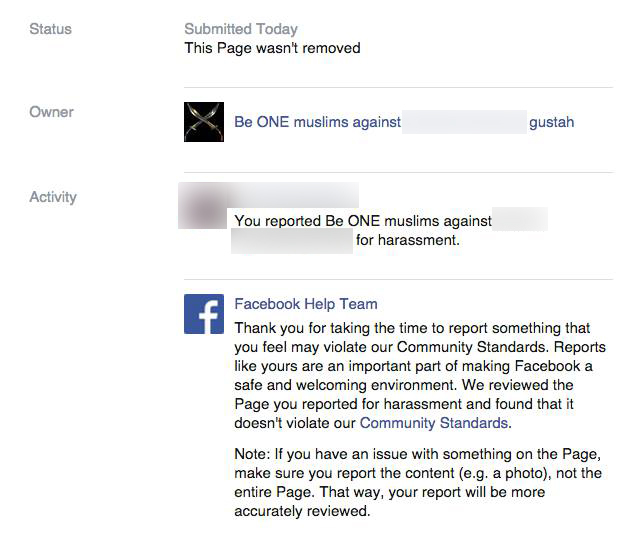 |
| Facebook's message when users reported the page |
In another case, an Islamabad-based female activist underwent severe harassment online, which included her being not only accused of apostasy (another grave allegation with potentially lethal consequences) but also having her private information leaked across the platform.
Predictably, all of her complaints against Urdu content were dismissed by Facebook.
Facebook has explained that its content control policy ensured adequate checks and balances, especially when it came to respecting local laws and traditions.
However, such a policy is highly problematic because in countries like Pakistan, local laws and traditions support human rights violations such as capital punishment, religious discrimination and persecution.
Also read: And now Facebook
Facebook's growing commitment to government authorities instead of its users' fundamental rights is thought-provoking, and exhibits how the influence of political economies is possibly at play.
Facebook’s latest transparency report – a document far from transparent in exhibiting specifics – makes this pro-censorship trend fairly evident.
Last week, in context of the unfortunate Charlie Hedbo attacks and rising intolerance against free speech, Mark Zuckerberg, CEO of Facebook, committed to building out of Facebook, a service where everyone could 'speak freely without fear of violence.'
In reality, how far such a commitment goes into being translated into actual practice is the real question. It appears that so far, amidst mind-boggling expansion, Facebook has not been particularly successful in securing freedom of expression or freedom from violence for its users.
Hamza's case
A recent example in this regard is the unjust censorship of a status updated by a local Pakistani celebrity, Hamza Ali Abbasi.
One may disagree with the argument presented in Hamza's message, but under no circumstances was the text in violation of Facebook’s community standards and asking to be deleted – an irrational move by Facebook’s censorship mechanism which Mark Zuckerberg accepted as a mistake.
Also see: The case of Pakistan's vanishing Facebook pages
Moving along the string of such ‘mistakes,’ Facebook has been known to actively censor content which does not violate its community guidelines. One would like to understand the rationale behind such behaviour. At best, it appears to be subjective judgment exercised by overburdened moderators who obviously have control over users’ content.
While Facebook makes content-censorship decisions either due to incompetence or the influence of powerful groups such as governments, users still waiting in line for justice from the corporation’s complaints management department question Facebook's lax response in helping those who are truly in danger of being persecuted through widespread incitement of violence or direct online harassment.
Aside from the earlier examples above, scores of pages and memes inciting violence against marginalised groups such as religious minorities or women continue to thrive in a country where mob justice is widely prevalent and legal systems are questionable at best.
 |
| A Facebook page inciting people to kill a minority group. |
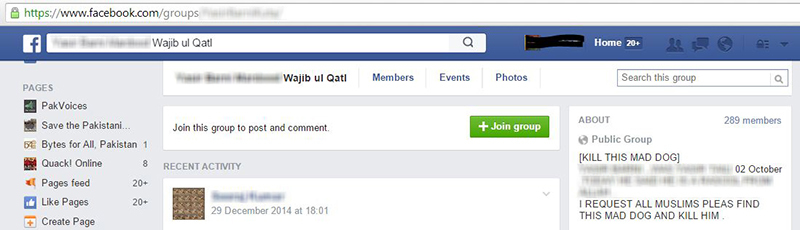 |
| A Facebook page inciting people to kill a man here declared to be an apostate. |
Speak freely...in Urdu
The situation gets progressively worse when the content is in local languages such as Urdu.
According to a study conducted by Pakistani activist group 'Bytes for All', Pakistan, at least 78 per cent of the hate speech observed on Facebook was expressed in Roman Urdu and Urdu script.
 |
| Another page declaring a religious minority as 'worthy of being killed'. |
This is an important statistic, because comparing it with the observed number of complaints resolved on Facebook, it raises the question of Facebook’s capacity in dealing with criminal hate speech in Urdu and other local languages. At several informal meetings, Bytes for All, Pakistan raised this issue, to which Facebook’s representatives claimed that the company had human resource trained for dealing with such issues. However, it is clear that something is not working.
Take a look: Online hate speech study launched
Despite advocacy and concerted efforts to flag the foregoing issues directly with Facebook’s top management, Facebook’s commitment to free speech and freedom from violence beyond words is still required.
Indeed, Facebook needs to demonstrate a level of responsibility more commensurate with its corporate size and stature if meaningful change is to be brought about.