

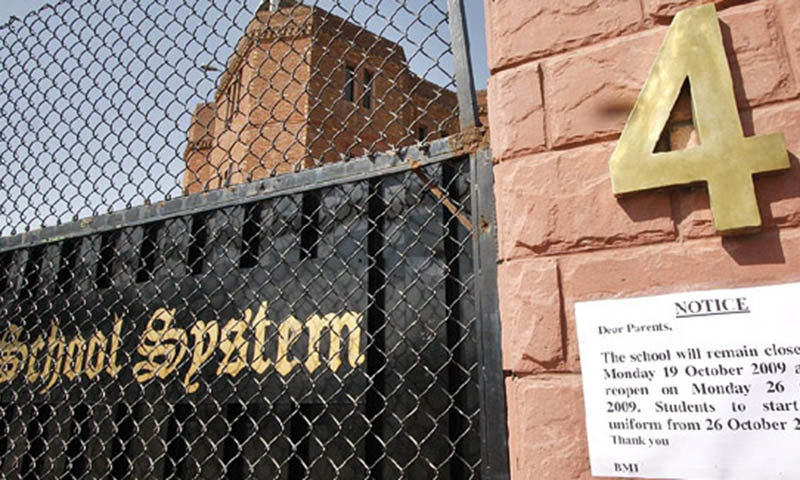


THE shadow of the Army Public School carnage hangs heavy, leaving students and parents, to say nothing of school and provincial administrations, unsettled.
The reopening of government-run and private schools has overwhelmingly been delayed by varying numbers of days (depending on when the winter vacations were originally set to come to a close) in different cities, and provincial administrations have asked schools to beef up security.
In Punjab, Khyber Pakhtunkhwa and the Islamabad Capital Territory area, schools and other educational institutions have been categorised according to the threat assessment as perceived by the authorities, and the standard operating procedures issued to them include raising boundary walls, topping them with concertina razor wire, hiring security guards and installing closed-circuit camera systems. (Balochistan and Sindh have for different reasons not yet undertaken such measures.)
Private-sector schools must arrange their own funding, and while public-sector schools have been promised some financial help, few — if any at all — have seen it materialise.
After the extended winter vacation, schools are now to open on the 12th, subject to their having met the new security protocols. But the situation does not look conducive to students being able to resume their academic activities.
With few institutions — barring some schools, colleges and universities that have ample financial resources — having being able to improve security, most complain of a lack of funds, insufficient time and question even the viability of the measures proposed.
Consider the fact that there are well over a 100,000 schools in Punjab alone, many without even the most basic of facilities and some that aren’t even registered with the government. Is it plausible to expect them to hire private security? Or for schools that don’t even have boundary walls — there are some 50 such institutions just in Islamabad — to now build them to required standards?
The issue is far too complex for the one-size-fits-all approach taken by the administration. No doubt, there is urgent need for educational institutions to improve security; another APS-style horror can simply not be contemplated. But institutions are well within their rights to ask what provincial and federal authorities are doing to also protect them, and keep attacks at bay.
Surely, the problem in its most basic iteration is this: until the state comes up with an effective and long-term strategy to contain the terrorism threat, and starts implementing it immediately, there is very little individuals and institutions can do to protect themselves.
Published in Dawn, January 6th, 2015
On a mobile phone? Get the Dawn Mobile App: Apple Store | Google Play


























