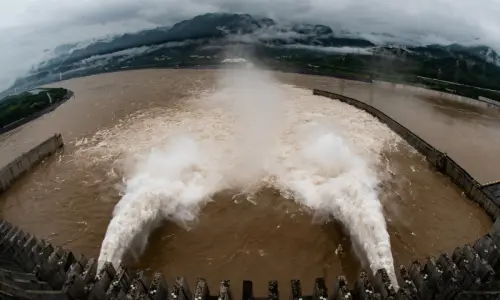
BEIJING: A multi-billion-dollar man-made river to divert water from China’s south to its parched north was opened on Friday, officials said.
The central route of the South-North Water Diversion Project, one of the most ambitious engineering projects in Chinese history, will carry water from central China to quench the thirst of Beijing and other areas.
The waterway “officially starts to flow today”, an official with the Office of the South-to-North Water Diversion Project Commission of the State Council said.
A total of 9.5 billion cubic metres of water — or one-sixth of the supply of the Yellow River, China’s second biggest waterway — will flow north every year from the Danjiangkou reservoir in Hubei province, state broadcaster China Central Television reported.
The route’s network of pipelines, canals and waterways is more than 1,400 kilometres long, and according to the official the first flows are expected to reach Beijing in around 15 days.
The massive project will supply water to more than 300 million people
Nearly $33 billion has been invested in the central section, which took 11 years to build and has forced more than 330,000 people to relocate, according to media reports.
The project’s eastern route, which uses the 1,400-year-old Grand Canal, began transporting water north from the Yangtze to Shandong province last year.
The Chinese government says the entire scheme, which will ultimately have three routes and a total cost estimated at $81 billion, will address a chronic shortage in China’s northern cities.
The massive undertaking dreamed up by former Communist Party leader Mao Zedong in the 1950s will supply water to more than 300 million people and countless water-intensive businesses.
Some provinces in northern China have less freshwater per person than the desert countries of the Middle East. Of the country’s total, water-intensive industries such as clothing and electronics manufacturing consume a quarter — a share the think-tank 2030 Water Resources Group expects to grow to a third by 2030.
The first stage of China’s south-to-north transfer brought water to the industry-heavy northeast, but it was barely useable when it reached Tianjin because it picked up pollutants and sediment while flowing north through polluted soil.
That has raised concerns about the latest phase, bringing water via a different, less polluted route.
Some experts have also voiced concern that the project’s extensive tapping of water from the Yangtze River and its tributaries may damage one of China’s most important waterways.
Some critics say the scheme’s success is jeopardised by declining rainfall in the south, while it will only temporarily sate demand in the north.
Published in Dawn December 13th , 2014