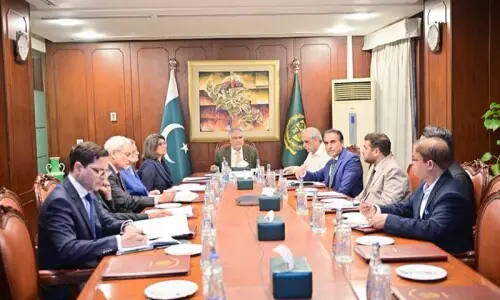
KATHMANDU: South Asian leaders huddled behind closed doors at a picturesque Himalayan hill station in Nepal Thursday to try to salvage some agreement from a summit paralysed by India and Pakistan's rivalry.
All eight South Asian Association for Regional Cooperation (Saarc) leaders expressed frustration on Wednesday with the slow pace of progress towards greater regional integration, which new Afghan President Ashraf Ghani called a failure of political will.
An Indian government source said Prime Minister Narendra Modi may hold informal talks with his Pakistani counterpart at the Dhulikel resort in the Himalayan foothills on Thursday morning, although even that remained uncertain.
Modi held one-on-one talks with every Saarc leader except Prime Minister Nawaz Sharif on Wednesday, with both sides saying it was up to the other to request a meeting.
“The idea behind the Saarc retreats is basically to create a relaxed environment in which leaders can speak freely. That's why retreats are there, “said the Indian official, who spoke on condition of anonymity.
“I think there will be a conversation (between Modi and Sharif).“
Analysts have blamed Saarc's failure on the mutual mistrust between Pakistan and regional powerhouse India, which has taken a more assertive stance toward its northern neighbour since the election of a new Hindu nationalist government in May.
The Indian Express said there were “visible cold vibes” between the two leaders, who did not even exchange nods on Wednesday, let alone shake hands, despite being only two seats apart for around four hours.
The leaders are hoping to salvage agreements on road, rail and power connectivity which some officials said were being held up by Pakistan.
But the Times of India said there was a fear among leaders in Kathmandu “of another unproductive Saarc summit”.
“It's not just Pakistan that plays a spoiler at Saarc summits, India too hasn't taken this regional grouping seriously enough in the past,” the paper said in an editorial.
“And other countries may just be tired of endless territorial quarrels between India and Pakistan usurping everything else at Saarc.“
Analysts blame the rivalry and poor infrastructure for the very low levels of regional trade among the eight Saarc nations — Afghanistan, Bangladesh, Bhutan, India, Nepal, the Maldives, Pakistan and Sri Lanka.
Trade between them has grown from under $140 million in 2008 to $878 million in 2012, but still accounts for less than five per cent of the region's total commerce.