0
0


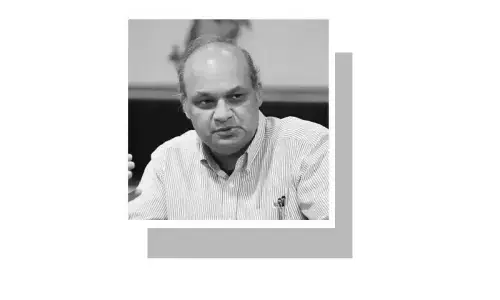
KARACHI: Dr Michel Boivin likes to use the phrase Sufi culture instead of the noun Sufism, which he says is a word coined by European Orientalists who couldn’t find an exact equivalent of the concept of tassavvuf. This he said while delivering a talk on Sufi culture through the lens of anthropology, organised to introduce his book Historical Dictionary of the Sufi Culture of Sindh at the Alliance Francaise on Monday evening.
Dr Boivin, a senior research fellow at the Centre for South Asian Studies, started off by telling his listeners that he hadn’t yet received his book so the event was a launch of a book without the book. He then shed light on the discipline of anthropology calling it a special methodology focusing on a number of matters based on field work (by visiting different places and interacting with people). It had two aspects, the first of which dealt with society and the other with culture.
Speaking on the spread of Sufism in Sindh, Dr Boivin said Sufi culture originated in the eighth century. It could be interpreted in many ways. Sufis were thought to be ascetics who lived in far-off places, such as deserts and savage territories. Things began to change when an Abbasid caliph tried to organise Sufism (he basically wanted to control the tareeqat) which resulted in the development of brotherhoods in the Muslim world. In that regard, the brotherhood of chaar yaar (four friends — Bahauddin Zakariya, Makhdoom Jahanyan, Farid Ganj Shakar and Lal Shahbaz) was significant.
Dr Boivin said Bahauddin Zakariya was settled in Multan. From here Sufism spread to southern Sindh and the first branch that reached the region was the Suharwardiya. Zakariya had many devotees, including Hindus. There’s a competition between Sufi orders and the four friends mentioned above belonged to different forms of the tareeqat. For example, Farid Ganj Shakar belonged to the Chishtia order, Makhdoom Jahaniyan to the Suhawardiya, but it’s difficult to ascertain what order Lal Shahbaz came from. At that point Dr Boivin showed images of Shah Abdul Latif and Sachal Sarmast, both holding musical instruments. It indicated the important role of music in their lives.
Dr Boivin then talked about the social function of Sufism in Sindh, concentrating on Sehwan, his main area of research. He first mentioned the processions taken out at Sehwan and reckoned they were important in terms of space and the itinerary that they followed — from the starting point to the shrine. The urs, he said, signified the Sufi’s merging with God. It lasted for three days, the first led by a Muslim and the second and third by Hindus.
Artefacts came next in the context of social function, in which the kashkol symbolised the Sufi’s ascetic nature. It was followed by the dhamal (trance dance) that gave a sense of continuity and space. To give credence to the argument, Dr Boivin put two images side by side, one of Ibrahim bin Adham and the other of Daman Faqir (taken in 2002) in a somewhat similar posture. To draw parallels between Lal Shahbaz and the Turkish whirling dervish dance, he told the attendees that Lal Shahbaz had a connection with Tabrez and died a year after Rumi. However, he said, there’s a lack of historical sources on the subject.
After that Dr Boivin shifted his focus to the cultural patterns in Sindh and highlighted architecture, music and poetry to define them. He claimed that the architectural heritage of the area in and around Sehwan was diverse and there’s a possibility that Sufism contributed to urbanism in the region. He showed an interesting sketch made in 1846 in which a Sufi lodge was seen next to the shrine.
Music, he said, was an important cultural expression of Sufism in Sindh. While the sama’a or qawwali more famous in Punjab belonged to the Chishtia order, in Sindh it was a different tradition of music. As for poetry, he argued, the goal of music was to sing poetry penned by the Sufis.
He ended his lecture by exhibiting photos of the title pages of Diwan-i-Dalpat (a collection of poems by a Hindu Sufi) and Sachal Jo Kalam published from Baroda in 1961.
Published in Dawn, October 28th, 2014