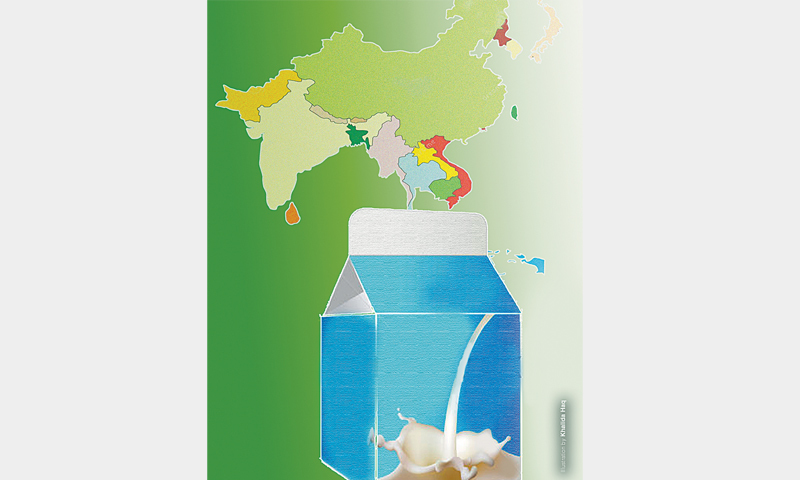
A recent report by a multinational has predicted a 36pc growth in global milk consumption over the next decade. According to the study, ‘A Global balancing Act; Dairy Demand & Supply’, this growth would mainly occur in emerging markets of Asia: demand in India will increase by 120pc, in China by 78pc, in Pakistan by 35pc and the rest of Asia by over 57pc.
The drivers of this high demand are listed as expanding population, increasing middle class, growth in gross domestic product (GDP) in these countries and changing dietary preferences as a result of general income increase.
The report also says that in the middle of the decade, global demand, for the first time in history, would overtake supplies, and the trend would continue — enhancing the gap between demand and supply each successive year.
The regional picture painted by the report should be a huge window of opportunity for Pakistan’s dairy industry domestically as well as regionally. The industry has seen a massive growth in the last five years in Pakistan attracting Rs20bn investment, according to some estimates.
The emerging regional market picture offers a huge window of opportunity for Pakistan’s dairy industry domestically as well as regionally
Now it would have domestic demand growing by 3.6pc annually and is expected to persist for the next one decade. Meeting this growth level should not be a problem for the industry because it has been growing at the rate of 10-15pc in the last few years, making it one of the most vibrant sectors of the economy.
The real challenge and opportunity would be the growth taking place in the region around Pakistan — China and India — both being lucrative and geographically close markets, yet tough competitors. However, if Pakistan industry can compete and claim some share, it can expand rapidly.
This should not be a problem, for the country has everything necessary for this — a huge and growing livestock population that can ensure abundant supply of milk. With better management and efficient marketing, Pakistan could have the fastest growing industrial base in the dairy sector.
Currently, the industry is expanding at a brisk pace but, by and large, a few oligopolies dominate the processed milk market.
That is where the policymakers should play their role and help new players enter the domestic market — increase competition and efficiency and enable the industry to compete regionally and internationally.
All fresh entrants prefer working with the same big players rather than developing their independent market share. On their part, the oligopolies have skewed the market in their favour by influencing policy decisions (like free import of skimmed milk), keeping the market prices higher on different excuses (beyond Rs100 per litter) and price of raw milk down (ranging between Rs45-60 in different parts of the country).
The free import of skimmed milk reinforced these oligopolies by allowing them to ‘manufacture’ milk rather than purchasing fresh milk on better prices from the farmers, thus deterring investment on livestock and breeds.
These imports have been used to keep prices low at the farm gate level.
Punjab, which is the proud owner of major herds of livestock, currently has some seven notified committees with gross overlapping of members and mandates.
Most of them are headed by the same investor, with many government nominees as their members, and unable, or unwilling, to improve the situation. This policy confusion needs to be done away with to bring transparency both at policy and execution level.
Aiming for the regional market should not be the aim of the industry alone; the government needs to actively participate. It should facilitate the sector by creating more players and developing businesses across the borders.
It is argued that the country has all the required wherewithal for dairy products to compete with the world, as is being done by the poultry sector.
Official intervention is necessary to take care of the developing situation. For example, the Russians have banned dairy products from the European Union after the Ukraine crisis. Now, the fear is that the EU would dump skimmed milk around the world, making milk manufacturing technically easier and financially more lucrative.
Given the chance, the private sector is bound to pounce on the opportunity and create more problems for domestic dairy development and industrial diversification.
Published in Dawn, Economic & Business, October 13th, 2014