0
0
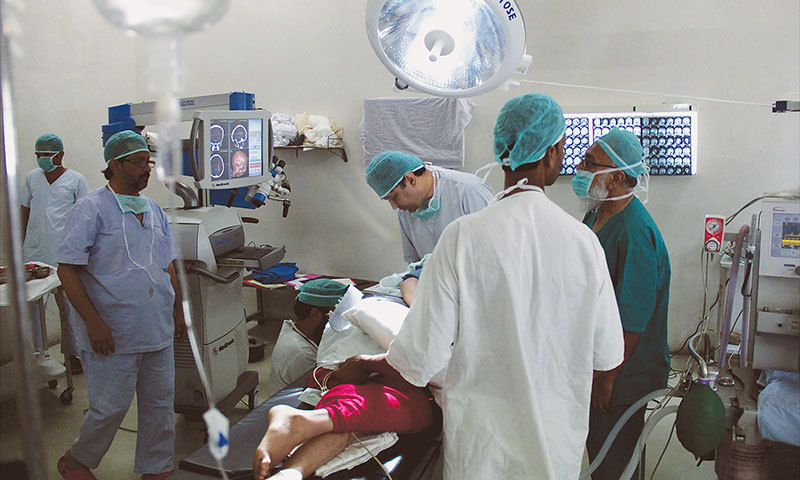

KARACHI: The neurosurgery department of the Jinnah Postgraduate Medical Centre (JPMC) faces serious funding and staff constraints to make its new intensive care unit (ICU) operational and continue the use of neuronavigation, a modern surgical technology that has recently been introduced at the department, it emerged on Sunday.
The JMPC, according to sources, is one of the few hospitals in the country and the first hospital in the public sector in the province using this advanced surgical technology. So far, six patients have been successfully treated with the help of this method.
“Neuronavigation helps a doctor see a patient’s anatomy in three dimensions and accurately locate a specific area in the brain or spinal cord with the aid of diagnostic images,” said head of the JPMC neurosurgery department Dr Raza Rizvi, adding that neurosurgeons at the hospital had treated five cases of brain tumour and one of fractured spine with the help of the technology.
“It brings 100pc accuracy and precision in case handling and the expert can remove the tumour without damaging the normal brain structure,” he pointed out.
Despite making a leap in its efforts to improve treatment methods, the use of equipment at the hospital has been handicapped by funding issues.
“A single kit for the device costs about Rs50,000 and is recommended to be used only for one patient. We, however, are unable to follow this guideline as the hospital faces a serious shortage of funds. The solution we have found is to sterilise the kit for use in other patients,” he said while explaining that kit sterilisation didn’t affect the device’s accuracy.
According to the JPMC staff, the neurosurgery department had been shifted to the new Rangoonwala building last year, after remaining unutilised for three years. When the building was finally utilised, the warranty period of the latest neurosurgery equipment installed there had already passed.
The department building has visible cracks that, as the staff explains, are not due to poor construction material but rather are the effect of twin bomb blasts that had hit the hospital’s emergency section in 2010.
Currently, it has the largest capacity to admit patients suffering from neurological ailments in Karachi; right now all beds are occupied at the wards having 120 beds but space is extended to accommodate 160 patients. More than 100 patients report at the outpatient department daily while a similar number of patients arrive at the trauma section, a separate facility in the building.
“The patient burden at our department, like other facilities at the hospital, is huge. Two to three trauma surgeries are conducted daily at the hospital whereas over 80 planned surgeries are done every month,” said Dr Rizvi.
The department, the doctor says, is unable to operate its ICU due to staff shortage but if funding is made available private staff can be hired.
“Staff shortage is a major obstacle; it has crippled our efforts to expand our services,” he said, adding that the entire hospital faced serious financial issues since devolution.
Published in Dawn, September 1st, 2014