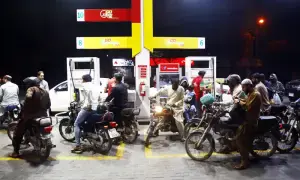
KARACHI: With the city roads playing host to more than 3.5 million vehicles every day, many wonder how the ever-growing number of cars, motorbikes and commercial vehicles are being regulated by a mere 3,200 traffic officials across the metropolis, where the riders and drivers have scant regard for traffic rules.
The figures provided by the Sindh excise and taxation department and the Karachi traffic police suggest a huge gap between the number of vehicles — increasing at a staggering pace — and traffic officials who, an official said, should be at least 10,000 for the ‘messed-up’ traffic system.
“Currently there are 3.6 million registered vehicles running on Karachi roads,” said Muhammad Shoaib Ahmed Siddiqui, director general of the Sindh excise and taxation.
“If we break down the numbers, there are some 1.25 million cars and 450,000 commercial vehicles. The rest, which makes up more than 50 per cent of the total registered vehicles, are motorbikes.”
Being the business capital of the country and a port city, Karachi is home to the largest number of vehicles than any other part of Pakistan, but it has no dedicated traffic police force.
A top official said the city traffic was regulated through 3,200 officials hired for the Sindh police.
“There is no separate recruitment system for the traffic police,” said additional inspector general of police Ghulam Qadir Thebo, also looking after the city police chief office since May 2014. “The recruitment is actually meant for the Karachi police but then some of them after training are dedicated to the traffic police. Right now we have some 3,200 traffic police officials and this number is definitely much lower than the required strength.”
He said the Sindh government had been requested for separate recruitment for the Karachi traffic so they could be repurposed as a dedicated force to control the movement of vehicles, likely to touch the four million mark within a year.
“In recent correspondence with the Sindh government, we have requested them to design a programme which may lead to the establishment of the traffic police force,” added Mr Thebo ‘expecting’ a ‘positive response’ from the provincial authorities on his proposal.
While explaining the operational mechanism, a senior official said he had deputed a 700-strong force — under his command — in two eight-hour shifts. Covering routes, including those dedicated to heavy traffic, he has to leave some crucial traffic intersections unmanned most of the time owing to the lack of manpower.
“We should learn from the Punjab traffic system where the government has established an institution called traffic wardens services,” he said. “We have some 3,200 officials and the authorities there [Punjab] recently hired some 3,000 traffic wardens setting graduation as the minimum education criterion for applicants. The traffic regulation system was overhauled few years ago in Lahore and that must serve as a good idea to follow for other cities in general and Karachi in particular.”
Published in Dawn, August 15th, 2014