THE handling of the predicament of Pakistanis seeking asylum in Sri Lanka these days has come in for much criticism by human rights advocates. We as a nation are in a state of conflict and it is not surprising that the current circumstances have resulted in a number of people, including the displaced, seeking refuge in neighbouring countries or those not too far away such as Sri Lanka.
Displacement is our colonial legacy. The great divide of 1947 saw millions of people in the subcontinent crossing the border from either side to seek refuge in India and Pakistan. Such was the state of affairs back then that the movement was termed a fait accompli and there was little debate on it, though some state mechanisms to cope with the massive cross-border influx were installed.
The decade-long Afghan war that began in the late ’70s also saw Pakistan becoming one of the largest hosts of Afghan refugees. This situation continues even today. True, there are some xenophobic elements in the country that oppose the presence of refugees in Pakistan. But still, over 1.5 million refugees from Afghanistan continue to live in Pakistan under a special status granted to them.
While we continue to be one of the largest refugee recipient countries, without ratifying the United Nations 1951 Refugee Convention, our very own displaced people are finding life difficult in countries in which they are trying to claim asylum status. These unfortunate people are being ‘refouled’ or facing deportation by states which have in fact ratified the international refugee convention.
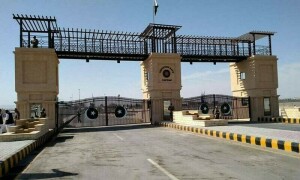
State authorities close their borders for many would-be ‘refugees’.
‘Non-refoulement’ is the cornerstone of the international refugee law. The principle, which lies at the heart of the 1951 Refugee Convention, puts strong emphasis on a state not to forcibly return refugees who are knocking at its doors in the belief that they will be safe and secure there. Such refugees are fleeing persecution at home and are seeking the support of a number of international treaties and conventions to reach safer shores.
The principle states that “no contracting state shall expel or return (‘refouler’) a refugee in any manner whatsoever to the frontiers of territories where his life or freedom would be threatened on account of his race, religion, nationality, membership of a particular social group or political opinion”.
Not only is the principle binding on states that have ratified the 1951 Refugee Convention, it also applies to non-member states as it is a preemptory norm of international law. Furthermore, this principle is backed by other international human rights treaties such as the Convention Against Torture and the International Covenant on Civil and Political Rights. These highlight its importance all the more.
State authorities on the other hand close their borders for many would-be ‘refugees’ or asylum-seekers or in some cases, as in the present one, attempt to deport the asylum-seekers giving out the usual reasons, such as security hazards, drain on the economy, health issues etc.
While it is the prerogative of the host government to deny entry to a certain group of people that wants to enter its territory, as a signatory to the 1951 Refugee Convention, it is obliged to protect the rights of those who are on the move for fear of persecution and that too which is well founded.
Many state authorities do have their own system of processing asylum claims in order to ensure that only those that have well founded fears are given refugee status. In the absence of such a system the onus lies on the office of the UN High Commissioner for Refugees to sift the wheat from the chaff.
The UNHCR has a well-established procedure to determine refugee status. It is one which is, on the one hand, rights-based, and on the other, fair and transparent so that bogus claims, including those by fugitives or by persons indicted and convicted for war crimes and crimes against humanity, are excluded. The fears of economic migrants — as Sri Lanka claims the asylum-seekers are in the present case — entering a host country are also well addressed through this status determination process.
Perhaps no other international law is shrouded in as much negative perception as the refugee law. Perceptions of the Sri Lankan authorities about Pakistani asylum-seekers as economic migrants or some people basing their claims on false reasons, ought to be based on evidence, for if there is none then asylum-seekers should be allowed to prove their status by having their cases processed under the refugee status determination procedure.
Until this is done, their right to seek refuge will continue to be denied and the states obliged to uphold the rights of these people through international commitments will continue to deviate from their obligations.
The writer was a Visiting Fellow at the University of Oxford for a course on Forced Migration.
Published in Dawn, Aug 10th, 2014