It is becoming increasingly clear that virtually no place in the country, be it rural or urban, mainstream or remote, offers even a modicum of safety for members of Pakistan’s religious and ethnic minorities.
The theatre of oppression is growing larger, the danger stalking ever more closely and the risk comes as much from out-of-control mobs as from those who target their quarry with precision — all the while the state behaves like a disinterested bystander. It has been only days since a rioting mob set on fire houses belonging to members of the Ahmadi community in Gujranwala, leading to deaths from suffocation and smoke inhalation.
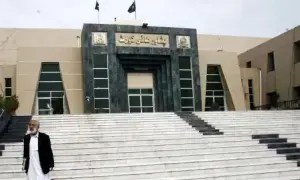
The state has much to answer for in terms of the treatment that has been meted out to this group of people, yet the Ahmadis are far from alone in their haplessness. On Wednesday, in Peshawar, a gunman opened fire on Sikh traders as they worked in their shops, killing Jagmohan Singh and injuring two other men.
Underscoring this intolerance towards minority faiths, after years of disinterest, the National Assembly, also on Wednesday, empowered the speaker to constitute a special committee to investigate excesses such as murder, kidnappings for ransom and other forms of attacks against Hindus in Sindh’s Umerkot district. Here, too, the latest incident of violence is only days old.
In fact, this community has faced so much hostility that there are reports of people fleeing across the eastern border. Whichever minority community dominates the headlines of the day as the victim of the newest atrocity — and hardly any group, be it the Christians, the Hazaras or even the remote Kalash, has been spared — this much is clear: the white strip in the national flag, that was meant to represent the country’s religious minorities, is bleeding.
What compounds the tragedy faced by these communities is the fact that in most cases the latter are as much the owners and inheritors of the land that falls within the borders as the majority population. The Sikh community of Khyber Pakhtunkhwa, for example, has been there for generations and there was space in earlier times for it to integrate with and be welcomed by its compatriots.
In recent years, however, as the area has been increasingly wracked by violence, many have had to flee places such as Tirah valley where they were being particularly targeted by militants and extremists. Clearly, even the provincial capital cannot offer them safety.
Is there a way out still from this vortex of religious and ethnic divisions, and the resultant violence? Yes, but the first step lies in the state going beyond commiserations and demonstrating its commitment to protecting the minorities through deed rather than word. Until the general air of hostility against ‘the other’ is cleared, the way forward will continue to be difficult to locate.
Published in Dawn, August 8th, 2014