1
1


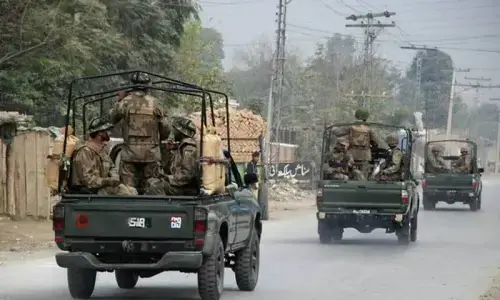
ON Friday, participants making their way to the Al Quds Day rally in Karachi were fired upon. And only a couple of days earlier, a lawyer — the son-in-law of a prominent Shia scholar — was targeted on a busy road in the city.
Karachi, beset with various gangs perpetuating their brand of violence, in particular offers little security against those bent upon using their own interpretation of faith to exterminate the ‘other’.
Karachi: Senior lawyer shot dead in ‘sectarian’ attack
There are few that feel secure in this buzzing commercial metropolis, but those who possess names that easily give away their sect are more vulnerable than others. Educated professionals have been frequently hit in this sect-based violence — but those lower down the occupation ladder have not been spared either. In fact, the regular occurrence of sectarian tension — and not only in Karachi — has given it a sense of something permanent.
Once, not too long ago, an incident of sectarian killing anywhere in the country would have various groups of people up in protest and the government vowing to catch and punish the attackers. With time, and amid an increasing number of incidents of sectarian violence, government officials were gradually reduced to offering empty statements of solidarity with the targeted. Now, even this formality has been done away with.
Promises have lost their purpose because nobody believes them now and because they have not been accompanied by a plan of action. A momentary decrease in the acts of targeted killings has the government heaving a sigh of relief, but even when an improvement in the situation is noted, the city and provincial administrations can hardly claim credit. This is so because there are no official plans on the table to combat the menace of sectarianism, not even those typical ones which look good on paper but are extremely hard to implement.
In the past, there would at least be some elementary discussion about the dangers an administration was exposing the people to when it failed to control hate speech. More than occasionally, there would be a call from somewhere for combined efforts towards religious harmony, and if the speaker chose to be more specific, there would be questions asked about the divisive curriculum taught at schools including religious seminaries. If these questions have become infrequent, that is in aid of the government officials who must always look concerned but do nothing. Protest against such killings must be revived.
Published in Dawn, July 28th, 2014