0
0

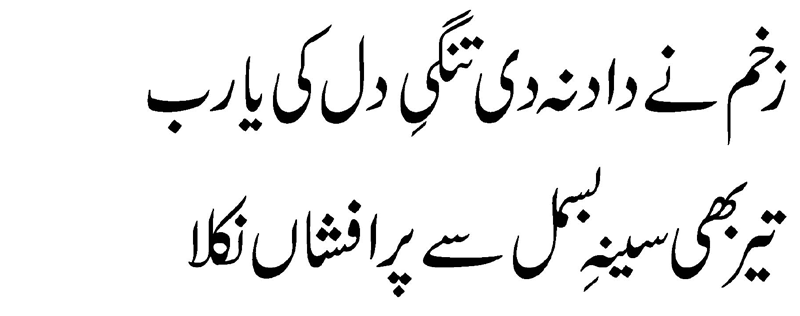

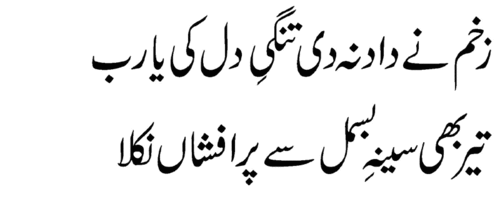
THIS verse was composed in 1821:
 |
Something throbbed in my breast, but
What I thought was a heart,
Turned out to be the point of an arrow
Seenah stands for heart, chest, breast; paikan for arrow head; khatakna for to throb, to rankle.
In the process of selecting she’rs for the mutadavil divaan, Ghalib sometimes plucked she’rs from two ghazals in the same zamin and created one ghazal. This act of cherry picking she’rs gives us an opportunity to understand what the exigencies of selection versus rejection were. I quote below the she’r that I think Ghalib preferred over the one under discussion here because both are about arrows and hearts.
 |
The rejected she’r is less complex and the bunching together of lekin and akhir is jarring and out of place. I have shown in my comments that there are smoother and better she’rs on this theme of heart, wound, arrow etc.
In classical Urdu (and Persian) seenah and dil are synonymous but can be nuanced as they are in this she’r. Although the she’r reiterates the axiom all humans are the victim of love, it rises above the commonality of the subject by the deft use of idioms. I want to draw attention to khatakna, a very Indic verbal expression fitting snugly in Ghalib’s hyper Persian vocabulary. How did the speaker in the poem find out that the heart was an arrowhead? Here again we have to marvel at the use of “nikla”. The chest was opened and the arrowhead was discovered. The heart was actually an arrowhead.
Musahafi and Atash have perhaps surpassed Ghalib in their manipulation of “dil” and “nikla”. But they were experts, with tremendous experience and equally powerful talents. Atash was a shagird of Musahafi. Also, they were essentially poets specialising in the native Urdu idiom as against Ghalib who was grafting a lot of Persian on Urdu.
Musahafi hum to yeh samjhe thai keh hoga koi zakhm
Tere dil mein to bahut kaam rafu ka nikla
(Musahafi, I had imagined it to be a mere wound But it turned out that your heart needed a lot of darning)
Bahut shor sunte thai pahlu mein dil ka
Jo cheera to ek qatrah-e khun na nikla
(There was much tumult about the heart beating in my side When it was opened, it contained not a drop of blood).
The writer is Associate Professor in the Department of Middle Eastern and South Asian Languages and Cultures at the University of Virginia. She is currently writing a commentary on the mustarad kalam of Ghalib.