0
0
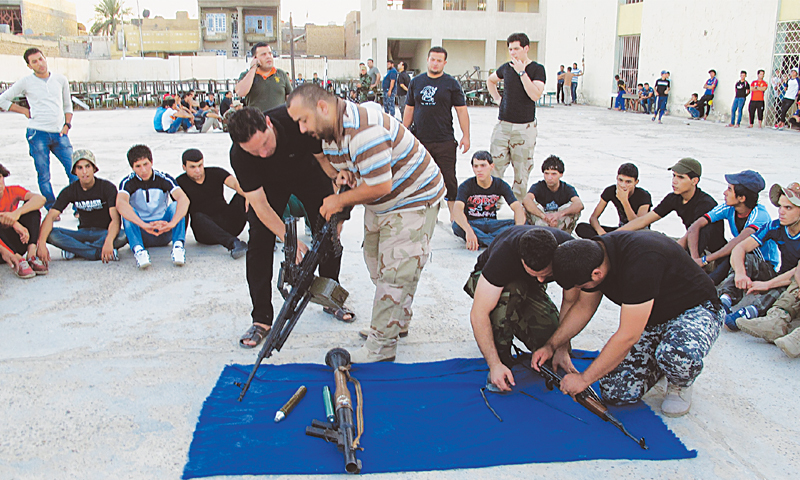

BAGHDAD: Iraq’s prime minister fired top security commanders on Tuesday in a major shake-up as fighting approached Baghdad in a militant onslaught that the UN warned risked breaking the country up.
A relative calm in Baghdad — ostensibly as militants have focused on their northern assault — was shattered by a string of bombings that left 17 people dead, while the bodies of 18 soldiers and police were found near the city of Samarra, shot in the head and chest.
More than a week after militants launched their lightning assault, Prime Minister Nuri al-Maliki dismissed several senior security force officers, including the top commander for Nineveh province in the north, the first to fall in the offensive.
Maliki also ordered that one of the officers he fired face court-martial for desertion.
Iraqi premier sacks security commanders
The dismissals came after soldiers and police fled en masse as insurgents swept into Nineveh’s capital Mosul, a city of two million people, abandoning their vehicles and uniforms.
And as officials trumpet a counter-offensive, doubts are growing that Iraq’s security forces can hold back the militant tide. After taking Mosul, militants captured a major chunk of mainly Sunni Arab territory stretching towards the capital.
The offensive has displaced hundreds of thousands of people and sent jitters through world oil markets as the militants have advanced ever nearer Baghdad leaving the Shia-led government in disarray.
Officials said on Tuesday that militants briefly held parts of the city of Baquba, just 60 kilometres from the capital.
They also took control of most of Tal Afar, a strategic Shia-majority town between Mosul and the border with Syria, where the Islamic State of Iraq and Al Sham (ISIS) also has fighters engaged in that country’s three-year-old civil war.
The overnight attack on Baquba, which was pushed back by security forces but left 44 prisoners dead at a police station, marked the closest the fighting has come to the capital.
In Tal Afar, militants controlled most of the town but pockets of resistance remained.
Further south, security personnel abandoned the Iraqi side of a key crossing on the border with Syria, officers said.
Syrian rebels opposed to ISIS, who already controlled the other side of the Al Qaim crossing, were then able to seize the Iraqi side as well.
Elsewhere, a cameraman was killed and a correspondent wounded while covering the unrest, their television channel said.
The swift advance of the militants has sparked international alarm, with UN envoy to Baghdad Nickolay Mladenov warning that Iraq’s territorial integrity was at stake.
“Right now, it’s life-threatening for Iraq but it poses a serious danger to the region,” Mladenov said. “Iraq faces the biggest threat to its sovereignty and territorial integrity” in years.
The violence has stoked regional tensions, with Iraq accusing neighbouring Saudi Arabia of “siding with terrorism” and of being responsible for financing the militants. The comments came a day after the Sunni kingdom blamed “sectarian” policies by Iraq’s Shia-led government for triggering the unrest.
The prime minister of Iraq’s autonomous Kurdish region said it would be “almost impossible” for the country to return to how it was before the militant offensive, and called for Sunni Arabs to be granted an autonomous region of their own.
Senior Sunni and Shia political leaders, including Maliki and his rival parliament speaker Osama al-Nujaifi, jointly issued a televised statement pledging continuous dialogue and promising to preserve the country’s unity.
Alarmed by collapse of the security forces in the face of the militant advance, foreign governments have begun pulling out diplomatic staff.
Published in Dawn, June 18th, 2014