



 0
0

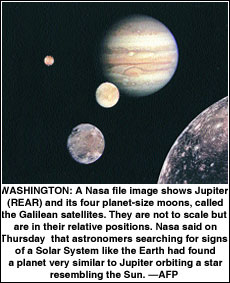 PARIS, July 3: A hunt to find a twin to our Solar System has uncovered the most intriguing match so far, astronomers said here on Thursday.
Ninety light years away lies a star similar to our own Sun, circled by a giant planet that closely resembles Jupiter in its location, they said.
“This is the closest we have yet got to a real Solar System-like planet, and advances our search for systems that are even more like our own,” team leader Hugh Jones of Britain’s Liverpool John Moores University, told a conference here.
However, no-one should let their sci-fi fantasies run away with them.
There is no evidence yet that the planet is habitable — and even if it is, our current rocket technology is so primitive it would take us at least one and a half million years to get there.
The exciting star, HD70642, is located in Puppis, a constellation of stars that make up the stern of the Argo Navis, the ship used by the Argonauts of mythology.
The planet is about twice the mass of Jupiter and orbits HD70642 about every six years, whereas Jupiter takes a dozen years to go around the Sun. In equivalent terms to our Solar System, the planet is about halfway between Mars and Jupiter.
The discovery is part of a loose-knit programme to sniff out “extrasolar” planets.
So far more than 100 of these phenomena have been detected since 1995, and each new piece of information is helping to build a picture that is remarkably varied.
The latest discovery is intriguing because of the planet’s similarity to Jupiter, especially its location relative to HD70642.
This raises the possibility that in closer orbit are rocky planets that — who knows? — may be Earth-like, although it would be difficult to detect the smaller “wobble” they would exert on the star.
But advances, in sensors and mathematics, are being made all the time in this new frontier of astronomy.
“It is the exquisite precision of our measurements that lets us search for these Jupiters — they are harder to find than the more exotic planets found so far,” Alan Penny, from Britain’s Rutherford Appleton Astronomy, said.
“Perhaps most stars will be shown to have planets like our own Solar System.” —AFP




























