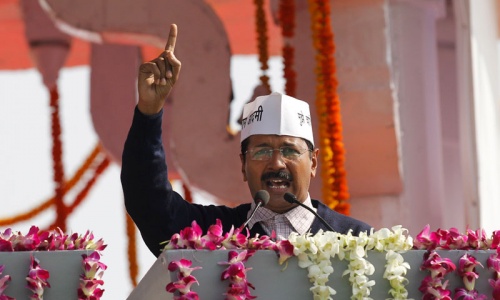
Provincial Pakistani bureaucrats occupy bigger and more lavish offices than the one out of which operates Delhi chief minister Arvind Kejriwal. No golden nameplate adorns the door of his third-floor office in the Delhi secretariat. A functional, almost nondescript, number plate (‘A-301’) is affixed to the top of the door.
Though the room is well-insulated and receives no draught of the icy Delhi wind, Kejriwal’s head is swathed in his trademark blue muffler, covering his ears and most of his hair except for the widow’s peak.
He rises to his feet and smiles warmly as a group of Pakistani journalists is ushered into his office. (They have been spared the inconvenience of three security checks, including what appear to be ominously thorough pat-down searches.)
When he is congratulated on leading his one-year-old anti-corruption Aam Aadmi Party to unexpected but spectacular success in the December elections last year, the smile gets broader, though he does not let go of his characteristic meekness: “Sab Allah ka shukar hai. Hum to bahut chhotay log hain.” (All the success is due to Allah’s blessings. We are very small people).
He may be small in the literal sense of the word – at five feet four inches he isn’t particularly tall – but Kejriwal is no longer an Aam Aadmi and has shown a remarkable propensity over the recent months to take on the biggies of Indian politics.
Hours before he received the journalists’ delegation, he addressed the national council meeting attended by AAP volunteers from across the country and named with obvious relish allegedly corrupt leaders against whom his anti-graft party candidates would compete in the upcoming Indian elections, due in May.
News television channels showed Kejriwal trying to smother a sarcastic smile and say: “I have drawn up a list of (dishonest) politicians of the country. If by mistake an honest politician is mentioned in the list, please do let me know!” As the audience broke into peals of uncontrollable laughter, he went on to read out the list that included Congress party leader Rahul Gandhi, Samajwadi Party supremo Mulayam Singh Yadav, Bahujan Samaj Party chief Mayawati, Union ministers P. Chidambaram and Sushilkumar Shinde and former Bharatiya Janata Party chief Nitin Gadkari.
In a brief but animated conversation with Pakistani journalists, Kejriwal explains why he named those politicians. “There are four reasons. We are against corruption among politicians. We are against their criminalisation. We are against their commercialisation. And we are also against dynastic politics.”
What piques Kejriwal most, he says, is the reluctance of successive governments in India to weed out corruption. This reluctance, he notes with dismay, is shared by parties across the political spectrum. “The first anti-graft bill was introduced in India in 1968, the year I was born. Then nothing – really nothing – was done to take up that legislation. It took the central government 40 years to pass that law. We will pass the anti-corruption law on Feb 16 though our government was formed in Delhi only on Dec 28 last year,” he says, beaming.
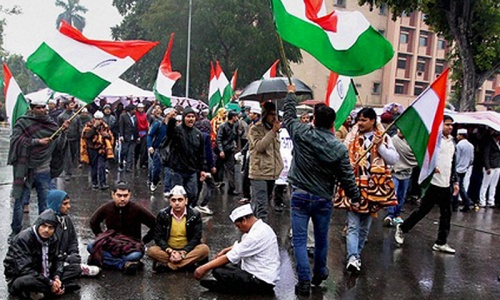
Kejriwal may be happy with his political and legislative track record, but there is no dearth of his critics in Delhi who have taken a dim view of the manner in which he has conducted protest politics since the AAP swept to power last month. An ABP-News Nielsen opinion poll shows that 50 per cent of the respondents feel that Kejriwal should not have staged night-long sit-ins against the Delhi police over a row involving the law minister, Somnath Bharti.
As Kejriwal seems to have a persistent cough, a member of the journalists’ delegation asks him if he caught a chill when he slept – his head wrapped in the ubiquitous blue muffler – on the streets of Delhi on a freezing, foggy night some days back. Smiling sheepishly, the chief minister shakes his head.
Other members of the delegation are keen that he shares with them his thoughts on the India-Pakistan peace process. “I have never visited Pakistan before. I have not studied India’s relations with Pakistan,” says the former civil servant with disarming candour. “But I want India to have peaceful relations with all the countries of the world.”
When pressed to say something more insightful – more newsy – on India-Pakistan relations, he concedes: “To be honest, it is really outside my remit. You should ask the central government.”