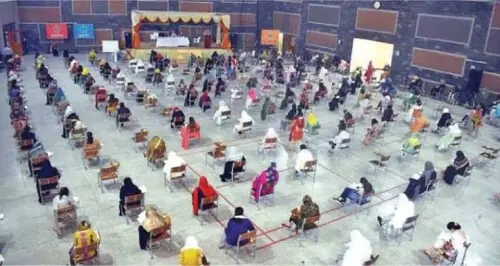
KARACHI: “More people were inspired to follow the Islamic tradition through the epics rather than through chronicles,” said Azfar Moin while discussing the religiosity of the Mughal Empire and its rulers at a session with Kamran Asdar at The Second Floor.
Moin has authored The Millennial Sovereign: Sacred Kingship and Sainthood in Islam and his writing focuses on early-modern South Asia and the Islamic world, with special emphasis on the first millennium of Islam that occurred at the end of the 16th century.
It was Akbar who influenced the first Islamic millennium and portrayed himself in messianic forms. He is considered most relevant in this context particularly because he treated all religious constituencies as equal and to do so he had to be above all religions. Moin said: “The body of the king had to be made sacred before all religions could be treated the same.”
The manner in which Akbar exalted his being and declared himself as sacred varied from that of his son, Jahangir. Timur, founder of the Timurid dynasty, was considered one of the first major Muslim conquerors after the Mongols, and was given the title of Sahib Karam out of reverence. Later, many kings, including Akbar, adopted this title.
According to Moin, religion for kings had a very different interpretation and they almost always had a separate religiosity than the common man. “They claimed to be Muslim but also wanted to distance themselves from the Islam of the average Muslim,” he said. Similarly, Akbar tried to manifest himself in the qualities of Timur, and those led to his forming a religious cult.
Speaking about the textual references on which modern religion is based, Moin lamented that how many of such texts were no longer widely read. A very elite textual tradition existed, which included astronomy and astrology, which required a higher degree of knowledge. However, studying of such texts diminished greatly with the decline of the early modern empires. Moin also highlighted how the oral tradition was sidelined.
”While rethinking the Mughal period, there was a shift from Akbar and Jahangir” in terms of manifesting divinity and sacredness. It was in the time of Jahangir that messianic imagery was incorporated into art. Whenever he had a dream worthwhile, instead of writing it down, he would have it painted. One such example is of the painting “Jahangir’s Dream” that shows the Shah of Iran submitting to Jahangir. Most of the paintings, said Moin, were influenced by Biblical references and Christian iconography. In an interview, Moin had elaborated how “this didn’t mean that they had turned Christian, but that they were Jesus-like in their sacredness”.
Asdar and Moin then steered the conversation to the rise of the Sufi culture and Sufi saints. Moin talked of how Muslim kings derived divinity from the shrines of patron saints. “With no Khalifa available, saints and their shrines were looked to,” he remarked. Across Iran and Central Asia, the presence of shrines grew physically with rituals enacted there.
He cited the example of how the shrine of Moinuddin Chishti in Ajmer became popular only after Akbar chose it to derive his divinity from. Though this remark did not sit well with a few in the crowd, Moin stuck to his claim and went on to elaborate how “South Asian historiography grants too much to local traditions” and not enough to historical fact. Shrines went on to become the centre of political autonomy, and they became a target of enemies.
The session was replete with in-depth analyses of the anthropology of religion and art and how Islamic politics was shaped by Sufi motifs. This may be considered as a relatively new perspective on Islam and its religious and political development in South Asia and Iran.