0
0

As I write this, General Musharraf is on a nine-day visit to the United States. Frankly, even a close relative would start getting on my nerves if he stayed for that long. But obviously, America is a big country and the Americans are a hospitable people...
In an unusual bit of global symmetry, the Indian PM is currently in China, although the purpose of the two visits is completely different: while Musharraf has gone to be patted on the back and given sundry goodies for his role in the 'fight against terror', Vajpayee wants to see at first hand why his country has been left so far behind by China, considering that India was seen as the emerging economic giant of the Asian mainland in the fifties.
But although India has been overtaken by China, it has made significant economic progress nevertheless: with foreign exchange reserves of $82 billion, it has told the developed world that it no longer wants foreign assistance, and all loans and grants should be given directly to NGOs.
Pakistan, on the other hand, still needs its begging bowl although we seem to be getting greedier: the recent pledge of three billion dollars made by President Bush to Pakistan at Camp David was greeted with cries of derision by the opposition in Pakistan who maintain that far greater largesse should have been forthcoming for our role against Al Qaeda and the Taliban.
I think it was the famous American film director Stanley Kubrick who said: "Big states behave like gangsters while small states behave like prostitutes".
Preceding General Musharraf to Washington was the Indian deputy prime minister, Mr L.K. Advani. Both of them were in London simultaneously last week where they traded broadsides from a distance of a few furlongs in Central London. These comings and goings to world capitals by South Asian movers and shakers give them yet another opportunity to wash their dirty linen in public. Pakistani leaders abroad repeat the 'referendum in Kashmir' mantra while Indians reiterate the 'cross-border terrorism' charge. Meanwhile, leaders and editorial writers in the foreign capitals where this duet is being performed urge the two countries to sit down and sort out their differences like mature adults.
But over five decades later, the family squabble is just getting shriller despite the divorce obtained in 1947 at the price of so much blood and misery. After enduring so much strident propaganda from both sides, a few things have crystallized: first, India is not going to agree to a referendum in Kashmir; secondly, Pakistan cannot force it to do so, nor will the international community insist on such a step; next, the entire political class in Pakistan has latched on to the issue so fiercely that it cannot now let go; fourthly, both countries are far more concerned about the land than the people of Kashmir; and finally, the leaders of both countries will continue to waste billions on this unending stalemate.
A new factor to have emerged since the late eighties is the uprising in Indian-occupied Kashmir. While there is a significant outside element fuelling the violence, there is no doubt that local anti-Indian sentiment is helping to sustain it. When Indian politicians demand that Pakistan halt its support for 'cross-border terrorism', they offer no quid pro quo.
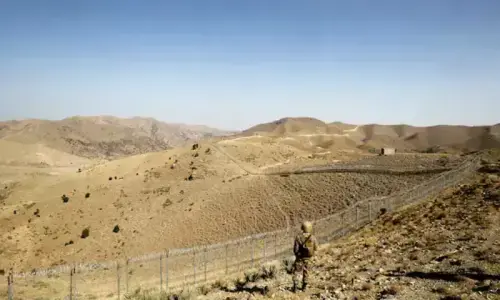
For Pakistan, this is a low-cost proxy war that ties up around 400,000 Indian troops, so it is difficult for Gen Musharraf to persuade his army colleagues as well as gung-ho politicians that it is in Pakistan's advantage to cut off all movement of Kashmiri jihadis across the Line of Control.
But a brand new element may help break this deadlock. China has long been a keystone of Pakistan's diplomatic and military posture. Although its support has not been as unconditional in recent years as it once was, we have counted on Beijing as our staunchest friend.
With Vajpayee's successful visit and the signing of nine agreements as well a joint declaration, it seems that India's relations with China have finally emerged from their decades of stagnation and bitterness that followed the 1962 war between the two countries.
Given the influence Beijing enjoys in Islamabad, it is just possible that Chinese leaders will be able to convince President Musharraf to follow their example and put Kashmir on hold and normalize other aspects of bilateral ties with New Delhi.
This will not be easy for Gen Musharraf to sell to many Pakistanis: currently the religious opposition parties are up in arms over the LFO as well as the open-ended support he is giving the Americans in their war against Al Qaeda and the Taliban.
A further U-turn, this time over Kashmir, will rob the jihadis of a role and their militancy and rage will turn inwards. But this militant force unleashed by Zia, has to be confronted at some point and reined in if Pakistan wants to rejoin the rest of the world and emerge from its self-imposed isolation.
These are turbulent times with the concept of pre-emptive war having replaced the whole edifice of collective security so carefully built up over the last five decades. Nations need to tread carefully lest they be consigned to the 'axis of evil'.
Empty rhetoric and shrill ideological bombast are no longer substitutes for a sane, cautious foreign policy. In short, Pakistan needs to undertake a drastic review of the path it has been following and take a long, hard look at the world outside.
The problem is that far too many of our policy-makers are bogged down in the past and are incapable of recognizing the rapid changes taking place around them. Our religious leaders seek to lead the country back into a medieval past and have no idea about the dynamics of the world we live in.
Uneducated in every sense of the word, they have bullied, browbeaten and bulldozed all opponents who have attempted to use reason and rational thought in political discourse. In pushing their agenda, they have been aided and abetted by the army which has sought to evolve a common dogma that unites the nation.
In the event, it has succeeded only in dividing the country: first, East Pakistan went its own way; now ethnicity, religion and sect are the bases for exclusive identities.
It is clear that our leaders do not possess the maturity and awareness of the larger world to seriously address the issues of our times. To varying degrees, they are stuck in their own narrow grooves, prisoners of tired, irrelevant ideologies.
Hopefully, in their own self-interest, foreign statesmen will be able to more appropriately and realistically focus the minds of these small-minded politicians and generals.