



 0
0

Metro Mailbag
 Snags in flyover
Sir,
The efforts of the city nazim for providing signal-free corridors are commendable. However, the flyover and the U-turns opposite Askari-IV on Rashid Minhas Road have serious snags.
After negotiating the U-turn under the flyover, it is problematic and hazardous to enter the gate of Askari-IV. The fast moving traffic, which is heading in the direction of Sharea Faisal, does not permit vehicles to immediately take a left turn for entering the gate. In all fairness, one more flyover is required to be constructed to make the existing flyover a dual carriageway. For the time being, traffic lights should be installed intelligently and sensibly to control and regulate the traffic under the flyover, so that it moves safely and smoothly in all directions. Moreover, speed breakers are now essentially required – as are cat’s-eyes – to slow down the speed of the traffic coming from Jauhar Morr and Nipa.
MAJ (retd) S.M. ARIF HASAN
Karachi
Institute timings
Sir,
My daughter is pursuing her BBA at a private institute in Clifton. The class timings are such that the last class ends at 9pm. My daughter reaches home at about 10pm.
Under the present worsening law and order conditions in Karachi, it is very frightening to find that girl students of around 18years remain at the institute up to 9pm. If my daughter is a few minutes late, my spine starts to shiver. The campus is located at a secluded, deserted place, with street urchins roaming around.
For the safety of the girls, I strongly request the institute’s administration to kindly review the timings and ensure that the classes end during the daytime, latest by 2pm, so that these girls reach home by 3pm, as is the case with other institutes.
MOHAMMAD ALI KHAN
Karachi
Solution of civic problems
Sir,
Through your esteemed paper, I invite the attention of the authorities concerned, particularly Mr Mustafa Kamal, the city nazim, towards the civic problems of Jaffer Housing Society, Malir. The residents of the society are facing great hardships because of non supply of drinking water, defective drainage system, insanitation and uneven roads and streets.
Access to clean drinking water and cleanliness are basic needs, but the inhabitants of Jaffer Society have been deprived of their fundamental rights for many years, even though the society consists of more than 1,800 houses.
In this connection, the city nazim is very earnestly requested to kindly consider these stated problems on humanitarian grounds and arrange to resolve them.
S.M. ESSA NAQVI
Karachi
Stray dogs
Sir,
The residents of localities near the Quaid’s mausoleum are indeed privileged to have an excellent spot where they can have a refreshing brisk morning walk and also exercise.
However, it is regrettable to note that there are many stray dogs wandering around the mausoleum during this time. This makes life very difficult for early morning joggers.
I look forward to positive action from the authorities concerned in this regard.
GHULAM HAIDER VAJID
Soldier Bazaar
DHA’s drainage system
Sir,
After 40 years of its creation, the DHA Karachi’s administration and the Clifton Cantonment Board realized the absence of an effective rainwater drainage system in the DHA, and that too after the roads and streets of the area were flooded and remained flooded for a long time due to the rainfall during the last few years.
It was claimed – as always – by the DHA/CCB that the rainwater drainage system would be completed before the next monsoon season. Now, after the passage of two monsoon seasons, almost all the important roads and streets of the DHA have been dug up or are being dug up and cement slabs have been fixed on some of the roads and streets, with holes for the passage of rainwater.
The space on both sides of the slabs has not been carpeted, with the result that besides hardships being faced by drivers, the dust is slowly filling up the drainage lines due to open holes in the cement slabs. It would ultimately choke the drainage lines and lead to the failure of the system. It is not understood why carpeting work is not being undertaken, which should have been started immediately after the slabs were fixed.
Perhaps the DHA and Cantonment Board managements need complete reorganization and representation of the majority civilian population through the democratic process. The residents of the DHA are pinning hopes that with the induction of democratically elected governments in the centre and the provinces, the obsolete British Raj Cantonment Board Act would be amended/replaced suitably to make it more representative of the civilian residents (through elections), who form the overwhelming majority of the DHA’s population, and the nomination and appointment system in the board/governing body of the DHA and Cantonment Board would be abolished.
SHAUKAT RIZVI
Karachi
Lengthy load-shedding
Sir,
I want to ask why the KESC continues such lengthy load-shedding in our area (Soldier Bazaar), which begins from 9.15am and lasts up till 4.50pm. Sometimes the electricity is restored for only five minutes, only to punish the honest consumers.
The KESC management has proved themselves careless and shameless in doing so and in return charging more than two or three times the amount in the power bills.
ASHFAQ SHARIF
Soldier Bazaar
city@dawn.com
Veneer of security
 I was on my way to my parents’ house when I discovered that the driver was taking all sorts of zigzag turns instead of taking a straight route. What’s up? I inquired. We were a mere five minutes away from the house, so why was the driver going through all these different lanes?
I was told that every lane near the house had its own barrier constructed. Each barrier is to remain closed at all times, even for the residents of that lane. There is only one barrier which will be opened. Hence, to reach their own house, people have to take all kinds of turns to get to the open barrier.
But what is going to happen with the school vans? My sister later informed me that the first day of the implementation of the barrier rule witnessed school vans leaving without bothering to take the alternative route to pick up the students. However, it was agreed thereafter to have the barrier opened for two hours in the morning.
The construction of gates and barriers all over the city is by no means a current phenomenon. However, what is definitely new is the barrier being closed at all times. One can argue that this stringent security measure only benefits the residents of the lane in question: they should ideally not complain even if they have to bear any inconvenience.
However, are these barriers going to achieve their purpose during times of trouble? It is all very well to keep out everyone when there is peace. But when faced with a gang of armed thieves, for instance, a barrier and a guard can’t really do much.
But then many Karachians argue that the presence of closed barriers and armed guards is a source of comfort to them – even if the sense of security is only psychological. With the cases of robberies and thefts increasing by the day, the sense of insecurity has risen to such alarming proportions that Karachians willingly put up with all sorts of daily inconveniences in order to have some reassurance that their homes and valuables are protected.
This trend also illustrates the level of mistrust in the law-enforcement agencies: apparently Karachians have given up on the fact that the robberies are going to stop any time soon. What they can do is take care of their own security and they are doing just that.—Hafsa Ahsan
Lunar show
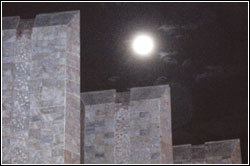 Karachians always seem to view celestial events with some curiosity. However, when it comes to sighting the moon, the citizens of this city – much like the rest of their compatriots – eye the heavens even more keenly just in case the men of the cloth don’t get it right.
However, this past Saturday night, many a Karachian was gazing skywards for altogether different reasons. The full moon sat gracefully in the crisp winter night sky, looking down resplendently upon an admiring city. It looked awfully large and appeared to have a yellowish tinge.
When this sky-gazer contacted Dr Shahid Qureshi, head of the University of Karachi’s Institute for Space and Planetary Astrophysics, he revealed the scientific reason why the moon looked so big.
He said the moon has a highly elliptical orbit and the point when the Earth’s satellite is closest to its centre of attraction is called the perigee. Hence the reason the moon looked so huge and so close was that on the night between Dec 12 and 13, at 2.45am, the moon was closest to the earth.
The ISPA head said this was the closest the moon had been to the earth in 10 years. The next perigee will be some time in 2014, when the moon will be even closer, 50km closer to be exact. So mark your calendars!—Badr
Forging a balance
It is quite true that during the two Eids – Eidul Fitr and Eidul Azha – many Pakistani expatriates, especially those working in countries close by, such as the oil-rich Persian Gulf states, try to rush back home and celebrate the festivals with their families.
Despite the relative peace and quiet and maintenance of order in these states, the pull of family – especially during the holidays – is too strong for lonely expats, particularly those who work abroad without their families. Hence those who can afford to hop on a jet-plane for a short flight across the pond to be with their loved ones do just that.
A close friend, who arrived in Karachi the day before Eidul Azha from the Red Sea port of Jeddah where he works, compared the experience of celebrating a Saudi and Pakistani Eid.
He appreciated the city government’s efforts in removing offal and other animal waste, which is a by-product of the sacrifice of animals. He noted that the efforts were initiated during the watch of former city nazim Niamatullah Khan, and the present nazim kept up his predecessor’s efforts. However, he observed that the question of cleaning streets, alleys and by-lanes after Eid did not arise in Jeddah and other Saudi cities.
How come? Are the Saudis less religious than their Pakistani counterparts? Not quite. The thing is, a majority of people in Saudi Arabia go to centralised abattoirs. Hence, they fulfil their religious obligation while there is no mess on the streets. People either buy their animals at the abattoir (which eliminates the ‘show and tell’ that is so ubiquitous here, in essence defeating the purpose of the sacrifice), or pay an amount to charity organisations to purchase animals on their behalf.
Also, an interesting aspect of Eid in Saudi Arabia is that unlike Pakistan, where a large number of citizens live below the poverty line, in the desert kingdom, where the standard of living is higher, many people choose to donate all the meat to charities, who ship it off to needy Muslims around the world.
Another friend said that in Tehran and other Iranian cities, the faithful also preferred to go to centralised abattoirs. These are just two examples. If other Muslim countries – who are arguably stricter in enforcing the tenets of the faith than us – can come up with solutions to fulfil religious obligations and yet keep their environments clean, why can’t we follow suit?
One noticed several advertisements in the press this Eid from various municipal bodies of Karachi urging citizens to perform sacrifices at specific locations so as not to bloody up the roads. One hopes this trend catches on in the city by the sea.
Interestingly, despite all the offal, violence over hide collection and unbearable smell emanating from rotting entrails, my friend would still trade in his Saudi Eid for a Karachi one any day of the week.—QAM
Compiled by Syed Hassan Ali
karachian@dawn.com



























