Blame VIP culture for poor police performance
OFFICIAL records show that crime rate has been rising in the Islamabad Capital Territory despite increase in the city police’s budget every year.
What the records don’t tell is why it is so. Inquiries made by Dawn revealed that most of the police department’s money and effort go into protecting the VIPs and providing them protocol.
Their security counts most with the 10,000-strong Islamabad police force. Fifty-seven per cent of them are detailed to look after the VIPs, numbering a couple of thousands, and 13 per cent perform traffic and intelligence duties.
Only 3,000 policemen are left to protect the remaining one million ordinary citizens of the city and to fight crime.
It should come as no surprise that even though the city has been under the cover of “high alert” since January, with security forces deployed everywhere, heinous crimes did not abate. Almost the same number of crimes were reported in the first seven months of this year as were last year.
But no harm came to the VIPs - except to Hammad Raza, a Supreme Court official, who was brutally murdered in May at the height of the judicial crisis. Otherwise, government mandarins, diplomats and members of parliament who count for VIPs were well protected.
That was some productive use of the budget of around Rs2 billion of the capital police for this year.
What share the 11 police stations of Islamabad, and the 3,000 policemen detailed there, got from the budget is not known but it could not have been more than 30 per cent of the total allocation.
The police division and its personnel are supposed not only to protect the lives and property of Islamabad residents but also to investigate crimes of murder, robberies and kidnapping which sap their energies and resources.
Islamabad police don’t have modern equipment and facilities to fight crime. Its dependence on other government agencies and departments decreases its performance. Over-stretched and over- burdened, the policemen perform half-heartedly and inadvertently afford criminals greater freedom of action.
In the first seven months of this year, 2,642 cases were registered with the police, compared to 4,333 in the whole year of 2006. The figure in the previous years was 3,778 in 2005; 3,579 in 2004; 2,746 in 2003; 3,125 in 2002 and 3,438 in 2001.
This year 73 murders had been reported till end of July. The police solved some cases, mostly the high profile cases like the murder of the additional registrar of the Supreme Court Syed Hammad Raza.
But scores of other violent deaths were added to the long list of “blind murders” gathering dust in police headquarters.
Murder cases have been rising since 2004 when 74 murders were reported. The figure rose to 81 in 2005 and 90 in 2006.
There were attempts at murder too - 79 in number in the current year, 143 in 2006, 110 in 2005, 89 in 2004, 113 in 2003, 71 in 2002 and 113 in 2001.
Police also recorded 54 cases of kidnapping and Zina during the current year against 89 in 2006; 74 in 2005 and 64 in 2004.
Statistics showed that 83 fatal and 69 non-fatal accidents occurred in Islamabad during the first seven months of this year. Comparative figures for 2006 were 138 and 161 and 154 and 160 for 2005.
Property related crimes such as robbery, burglary and theft also went up in the capital city during the current year, causing concern among people who feel insecure even inside their houses.
In all 126 robberies, including 13 dacoity, 87 burglaries and 101 thefts, had been reported this year to police till July. Last year 230 robberies, 160 burglaries and 223 theft cases were reported. Theft of vehicles surged this year. Till July 289 cars and 16 motorcycles had been either snatched or stolen in the city.
Police recovered 41 cars and four motorcycles, not because of any great effort but by sheer chance during routine checking.
Last year citizens had lost 333 cars and 138 motorcycles to thieves, and 273 cars and 151 motorcycles the year before.
Of Persian and other weird things
 AT one time in the Indo-Pakistan subcontinent Persian was the language of intelligentsia and all those who were well versed in it were not considered educated or refined. Persian was the language of the Mughals. When the sun set on Mughals and the British started shaping the history and geography of this part of the world according to their wishes, they discarded Persian and slowly it was pushed out to make room for an alien language, English, which haunts us even today.
The decline of Persian in this subcontinent was planned and executed by the British. Though in the beginning there was some zeal for Persian among the rulers and especially the Asiatic Society of Bengal encouraged the oriental studies by publishing a number of important Arabic, Persian and Sanskrit books, later the study and promotion of oriental studies was frowned upon and Lord Macaulay, the champion of English colonialism and imperialism, held oriental learning in great contempt and emphatically opposed it.
Finally, in 1835 Persian was replaced first with the vernacular and then with English. Persian remained the language of the courts till 1844 though, when it was replaced by English and vernacular. British linguistic imperialism was aimed at transforming the cultural complexion and mentality of their subjects and it did work according to the plan.
It was not only the colonial rulers that favoured English. Some locals too demanded English. But the majority of such people was Hindu as they saw a chance of upward social mobility and access to power through learning English while Muslims, who had ruled over the subcontinent for centuries, at that time were mostly anti-British. With its decline, Persian became Greek to the masses and the wonderful treasure nurtured through centuries was squandered. It is not only a historical phenomenon but also a cultural and national tragedy.
Today talking about Persian or our cultural and literary legacy would look weird but there are people who value the glorious cultural and literary traditions that illuminated the world for centuries. And they do whatever they can to preserve such heritage.
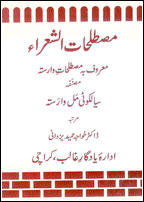
Idara-i-Yadgar-e-Ghalib, Karachi, has been publishing scholarly and research works since its inception. The latest in the list is Mustalaht-ush-Shuara, also known as Mustalaht-i-Warasta, a dictionary of Persian words, idioms and expressions used in poetical and literary works. Edited, annotated and translated by Dr Khwaja Hameed Yazdani, a scholar of repute based in Lahore, the Persian dictionary was originally compiled by a Hindu scholar named Sialkoti Mal Warasta, named so because he was born in Sialkot (Punjab). Dr Syed Abdullah in his book, Adabiyaat-i-Farsi Men Hinduon Ka Hissa, has mentioned Warasta’s other works too.
After tracing the history of Persian lexicography in the subcontinent in his preface to the book, Prof Dr Moinuddin Aqeel informs us that though completed in 1782, the book could not see the light of day till 1854 when it was first published from Lucknow.
Its second and third editions, according to him, were published in 1899 and 2001 respectively. The third one was edited by Dr Shahroz Shameesa and published from Tehran, keeping in view the previously published editions and manuscripts of the dictionary.
Dr Yazdani has done a wonderful job by editing this important but little-known dictionary. It was not an easy job as he had to go through a large number of dictionaries and divans of Persian poets. The editing is immaculate and the erroneous entries made in some previous editions are not repeated. The long bibliography speaks volumes for his back-breaking labour.
Dr Yazdani has mentioned in his foreword that the book is among the ones Allama Iqbal was fond of. An important feature of the book is that with every entry explanatory citations from the works of great Persian poets have been given. An Urdu glossary at the back of the book makes it even more useful.
— drraufparekh@yahoo.com
| © DAWN Group of Newspapers, 2007 |