



 0
0

Sindh police: what has changed?
 Last week the Sindh Police department welcomed its new Inspector-General, who hails from Punjab. After assuming his new role as IG Sindh, Major (Retd) Zia-ul-Hassan Khan made a few statements which were ‘interesting’ for want of a better word. After receiving a guard of honour, he summoned the higher/top officials at his office and urged them to “follow the rules and regulations laid down by the Sindh government,” among a few other basic instructions like working towards improving the image of the Sindh police, reducing crime, etc, etc. Strange, that high police officials need to be told to ‘follow rules’ and reduce crime! One presumed that not just ‘following rules’ but seeing that others followed them would be the police force’s mandate.
The reshuffle in the police department — especially regarding the new IG Sindh and the transfer of the DIG operations — is being seen in some quarters as an effort of reconciliation of sorts after the May12 debacle in which the police force was rendered impotent. The proposal of dividing Karachi into three zones headed by three different DIGs is a long standing one and even if it is implemented now (though one wonders about its timing) it will have a long way to go before it gets any result by way of controlling crime.
As for the new IG coming into Sindh from Punjab, he would do well to come up with more tangible measures to control Karachi’s law and order rather than follow up on reshuffle orders and issue superfluous statements like, ‘there should be an immediate reduction in crime’. Do we presume that the previous IG’s role was to increase crime?
The newly transferred DIG Operations who moves in from the Criminal Investigation Division maintains that the current proposed transfers are not related to the May 12 debacle.
And despite these frenetic goings-on in the Sindh police department — related or not to May 12 — crucial concerns linger on. What will happen to the May 12 investigations, especially those cases registered against the MQM? How exactly will the transfers help in maintaining the law and order situation? Will the ‘set of three DIGs’ (if the three-zone proposal comes into effect) be able to assert themselves if God forbid another May 12-like scenario arises? Won’t these officers be subservient anymore to the government’s allies who still mainly control key Karachi positions?
After taking on his new position, the IG Sindh also declared an increase of Rs1,000 in the salary of police constables. In this day of inflation does he truly believe that a Rs1,000 increase will better the living conditions of a man’s family of say, five, and deter him from earning more through bribes? Just to prove the point, there is a case of two days ago when a traffic constable stopped a driver for allegedly turning left on a red light and then let the driver go by saying, “there is a Rs200 fine for this but just give me Rs100 and get on your way.”
The police reshuffle — even if it is routine procedure — is being seen as a strategy of sorts to shift focus off the terrible performance of the force on May 12 under the earlier IG Niaz Ahmed Siddiqui (who was incidentally the acting IG at the time) and his CCPO, Azher Ali Farooqi. In actuality it is nothing besides new roles for old faces. The police and other ‘forces’ must be reminded continuously that any eyewash manoeuvres will in no way appease the citizens, the media or the victims of May12.
The increased share in the Sindh budget allotted for law and order also has a double-edged implication. While it might be an attempt to placate the citizens that the government is taking concrete steps to provide security, it may also be used to appease top police officials to make them more ‘suggestible’ to government/agency whims in case of future May 12-like scenarios.
Whatever may the underlying meaning/implication for the heightened activity within the police force be, one word of advice — in pure goodwill — to the new man in and to the higher authority that has appointed him: at present you are dealing with a citizenry which is neither dumb nor is in an amenable mood. The situation is so critical that even power riots need to be handled with kid gloves. And silly statements like, “street crimes must be reduced,” are simply needling the citizens, besides stating the obvious.
city@dawn.com
Vanishing traces of Potohar heritage
The excerpts have been taken from Fauzia Minallah’s forthcoming book Glimpses Into Islamabad’s Soul.
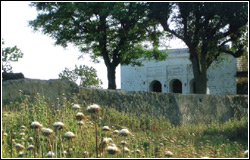 Mehra Beri, Sihala and Chauntra - three small villages situated in the Sector E-10 - are the custodians of some of the rich heritage of Potohar. But these villages like other villages of Islamabad are under threat from the ‘development process’.
Very soon bulldozers will enter this undeveloped sector, and this particular area of Potohar will loose even more traces of its heritage.
On a small mound in Sector E-10 sits a serene little mosque, rich in history and relics from the past. One can see it from the busy Margalla Road between F-10 and E-10.
Its walls are not made of modern bricks, but rather stones, very similar to those one finds in the old houses of Saidpur village.
Near its entrance is a well, which bears a marble plaque with the name of the owner, Khan Mohammad Khan, son of Mahdo Khan, the numburdar of Moza (village) Sihala, engraved on it.
As it is dated 1953, at that time little did Khan Sahib know that this area of his ancestors would transform right in front of his eyes.
The mosque has carved windows with metalwork used in the artisanship. The most interesting feature of the mosque is its carved wooden pillars in the small veranda.
The shape of the wooden beams of these pillars is reminiscent of the famous wooden pillars from Swat, NWFP, and indicates the Gandhara influence.
Although these pillars have some carving, it is not as rich as the one found in the Swati woodcarving. On the other hand, one witnesses beautiful carvings of scrolls and foliage found in Gandhara art, on the borders of the small wooden windows and the main door that leads to the inner section of the mosque.
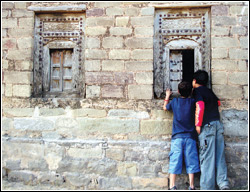 The windows are in dilapidated condition whereas the door is in good shape, painted green and combines woodcarving and iron masonry in the artisanship. The floor of the courtyard has maroon and white tiles with designs of ‘Mehrabs’ as used on prayer mats.
It seems as if this was the family mosque of Khan Mohammad as there are five graves in the courtyard. Four of them are unmarked, two seem very old while one relatively new, has a marble tombstone and indicates the identity of the deceased brother of Khan Mohammad Khan, Haji Lal Khan and son of Mahdo Khan, who died in 1967.
One experiences a feeling of sublime calm while sitting in the courtyard of the mosque. From the elevation one could see at a distance people harvesting wheat fields, mud thatched houses with milkmen and their buffaloes, children grazing their goats and magnificent old Pipals, Banyans and other indigenous trees such as Shisham, Kikar, Toot etc., with the Margalla hills in the background.
It is sad that the people of Sihala and neighbouring Mehra Bheri villages, for whom this land was inherited by preceding generations, will leave this area very soon. Their fate was sealed in President Ayub Khan’s time.
While one can only wish these rural and cultural touches remain in Islamabad, at least some of the original residents had the right to stay in their ancestral abodes.
However, this is not a possibility for the people who happen to be in the E-10 area, as this is where we will have the new General Headquarters of the Army.
One can hope that the old mosque is spared demolition and preserved for future generations, as a respect for the lost heritage of the original inhabitants of this area.
The grand old trees can be easily incorporated in parks and green areas by developers of the E-10 area, and these are at least six in number.
| © DAWN Group of Newspapers, 2007 |



























