After Monday’s Judgment
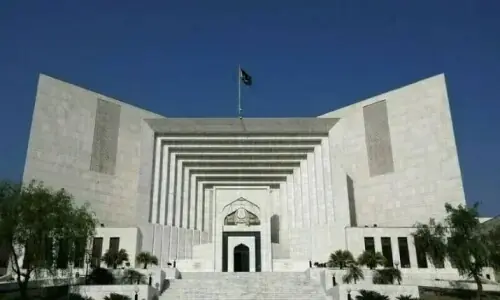
WITH the Supreme Court now seized of the matter, the legal aspect of the battle surrounding the presidential reference against Chief Justice Iftikhar Mohammad Chaudhry seems to be getting clearer. Both sides claimed victory on Monday when the apex court stayed the Supreme Judicial Council’s proceedings against the “non-functional” Chief Justice and — accepting the government’s plea — proposed a full court to decide the petitions challenging the SJC’s composition and other related matters. The atmosphere in the Supreme Court on Monday was charged and one lawyer seemed worked up but was allowed to give vent to his feelings. Mr Justice Javed Buttar perhaps summed up the emotive situation when he said that some people had come to the court with some “aspirations”, and he requested all sides to assist in the dispensation of justice. That advice should hold good for the legal fraternity as well, for ever since the Chief Justice was summoned by President Pervez Musharraf, made “non-functional” and a reference was filed against him in the SJC there have been tensions and turbulence all around.
There were reasons, of course, for the entire country, especially the legal community, to be shocked by the presidential reference and the treatment meted out to the Chief Justice of the Supreme Court. Subsequent rallies throughout the country in favour of Justice Chaudhry and the unfortunate incidents, including baton charges, scuffles and rowdyism, plus the government’s own gaucherie in handling what indeed were spontaneous expressions of public anger took the focus away from the courtroom. The issue became highly politicised when most political parties joined the fray, thus strengthening the government’s charge that a purely legal issue had been turned into a political one. For its part, the government has not helped matters. The attacks on media offices by the police and the arrest of a large number of political activists, some of them lawyers, only tended to aggravate the situation on the streets and added to the politicisation of what essentially was a legal issue.
With the issue now going to the Supreme Court’s full bench, it is time all sides sobered up. Let the presidential reference and related matters — which, as the apex court’s orders says, involve “unprecedented, important constitutional and legal issues” — be decided according to law and the Constitution. Courtrooms and not streets are where legal and constitutional battles are resolved. As the highest judicial body in the country, it is the Supreme Court which will decide the issues and deliver what indeed will be a landmark judgment. We plead with the legal community, political parties and elements, intelligentsia, human rights groups and the media to work collectively for lowering tensions so as to allow the Supreme Court to conduct its proceedings with dignity and grace and finally settle the issue according to the law of the land. A few rallies are still on the cards, and in the nation’s biggest city the demonstration planned by a political party for Saturday is to coincide with Mr Chaudhry’s arrival in Karachi and the oath-taking ceremony at the Karachi Bar Association. We hope all sides will maintain exemplary discipline, and no untoward incident will be allowed to queer the pitch. It is also time lawyers throughout the country paid attention to their clients, many of whom have felt frustrated because of the suspension of work in most courts at a time when there is already a huge backlog of cases.
Ill-health & low productivity
IT IS strange that it has taken so long for the specialists in the World Economic Forum to understand the link between health and productivity. In its global competitiveness report, the WEF has identified health as one of the most important factors in Pakistan’s low ranking in the competitiveness index. Economists and health professionals in Pakistan have known this all along, though the government in its wisdom has chosen not to do anything about it. The pervasive impact of the poor health of the people on the economy not only takes the form of heavy expenditure in the health sector, it also translates into high absenteeism at work places, inability to cope with work and lethargy that robs people of their motivation and interest in life. How can such a person be expected to be productive? Moreover, a good health delivery system also helps in poverty reduction and is basic to a humanitarian approach.
The problem is that the government has gradually disengaged itself from its responsibility of providing healthcare to the people. While primary healthcare, which is universally recognised as the people’s right, has been neglected, tertiary care has also been allowed to go by default to the private sector. Supply of potable water, public hygiene, preventive medicine, anti-malaria and tuberculosis campaigns, environmental protection and other similar issues are basic to the primary health of the people and do not really cost much. But they are low down on the list of the government’s priorities. This neglect has a profound impact on the health of the people which suffers badly causing the cost of healthcare to escalate. Paradoxically, life expectancy in Pakistan has gone up in the last several decades because of the success in checking killer epidemics that at one time took many people’s lives. This has only prolonged life but not improved the health of the people. As for tertiary care, it has been left in the hands of doctors and quacks with the people being expected to fend for themselves. It is time a feasible health policy was drawn up and the various issues prioritised. The problem is not simply one of low funding but poor management and corruption as well.
Taliban’s ban on music
THE Taliban are hardly known for tolerating others’ opinions. If they believe music is un-Islamic, even if there is authoritative religious verdict to the contrary, they will make sure that no one listens to it. Their hatred for all forms of recreation is well known, and for some time they have been warning music shop owners in the tribal areas of dire consequences if they continue to sell tapes or CDs. The final blow came on Monday when they banned the sale of music and even listening to it in public places or on buses in North Waziristan. They did it in their usual threatening manner, forcibly removing tape players from buses or destroying CDs. That they have no legal right to order such prohibitions means nothing to them, nor does it seem to affect the government which looks the other way whenever the Taliban try to impose their notions of Islamic laws. Because the government has needed the local Taliban’s cooperation in apprehending foreign militants, it has yielded a lot of ground to them on many issues, including what is Islamic and what is not. In the last few months, one has heard of men being ordered to be beheaded on suspicion of their being spies, music or barber shops being blown up, girls being prevented from going to school and other equally appalling do’s and don’ts.
In their bid to establish their version of an Islamic state, the Taliban have violated several laws, for which they have yet to be taken to task. The government’s inaction only emboldens them. This must stop. No one has the right to enforce religion in this manner. It is the government’s responsibility to maintain law and order in North Waziristan and no one else’s. Any failure to do so will have grave consequences.
Factors of imbalances and anomalies: A pre-budget discourse — II
THE most important consequence of the process economists call globalisation has been the significant change in the structure of global finance in recent years. There has been a dramatic increase in private capital flows to the developing world and this has changed the role of official finance in the process of development.
Developing countries at Pakistan’s stage of development now have greater access to international capital and financial markets than was the case in the 1970s and 1980s. In that respect they are less beholden to the good wishes of policymakers in the world’s rich countries.
In other words, for the first time since the development of the world’s developing countries came to be addressed systematically, those who depend on external capital for investment are a little more independent of government policies in the developed world.
This was also pointed out by Dr Ishrat Husain in an article in a recent issue of this newspaper. Contrary to the impression of many economists in the country, he suggested that today Pakistan is less vulnerable to the changes in the policies of the donor community than was the case, say, in 1965 when the United States stopped the flow of aid to punish Islamabad for going to war with India and again in 1989 when it put Islamabad under sanctions for persisting with its efforts to develop a nuclear arsenal to counter the threat from India.
In these changed circumstances, economic policymakers have to show a different type of vigilance to obtain full benefit for Pakistan from the ready availability of certain types of external capital.
There is no doubt that Pakistan is still not the favoured destination for foreign direct investment from western sources. However, significant amounts of money have begun to come into the country in the early 2000s from the Arab world. The Middle East, flushed with liquidity after a sharp rise in the price of oil, is the main source of finance.
Also of significance are the large amounts of remittances being sent by people of Pakistani origin living and working outside the country. These two sources of finance are behind much of the economic boom that Pakistan is currently experiencing. Is this boom good for the country’s long-term economic development?
To answer this question we should step back a bit into recent history and recall that in 2003 the country’s economic authorities began to encourage growth by loosening both the fiscal and monetary stances that were adopted from 1999 on under the influence of the IMF.
Spending from the budget was increased and interest rates were lowered to the point where they were below the rate of inflation. The economy responded vigorously as expected since it had been starved of capital for three years. Led by consumption, the GDP picked up smartly and the boom was on its way.
This was further aided by the privatisation of the banking sector and the newly invigorated banks began to compete for clients by offering all kinds of inducements to those who were creditworthy to borrow mostly for consumption. There was a speculative explosion in the real estate market and the sales of cars, motorcycles and consumer durables increased enormously.
For three years now, the production of cars and motorcycles by the companies assembling these products or partially manufacturing them has increased at rates several times more than the increase in the output of those products that enter the export markets. An important consequence of the current economic expansion is that it has led to a sharp increase in imports without a corresponding increase in exports. This has led to a significant deterioration in trade balance. It has also done very little to create employment.
The stock market is also booming. On April 30, this newspaper reported that the KSE-100 Index touched a new record by achieving the level of 12,370. This was 34 points higher than the previous record established last year. Some of this increase was attributed to investments made by foreign investors.
By one calculation they are reported to have invested $600 million in the stock market, equivalent to one per cent of the free-float market of $60 billion. It is clear from all this and much more that the current boom in the economy is primarily driven by consumption; not consumption by a large segments of the population but by a small economic elite.
Since the products they purchase and the investments they make don’t generate many jobs and thus their impact doesn’t trickle down to the lower income segments of the society, the economy’s rapid expansion is benefiting primarily the rich.
There is considerable controversy in the country about the impact the rapid GDP growth has had on the incidence of poverty and income distribution. The government maintains that the incidence of poverty has declined significantly in the last five years, by about 10 percentage points. Other knowledgeable observers maintain that there has been some decline but it was less impressive than claimed by the government. They believe that the price deflator used by the government does not fully represent the changes in the purchasing power of the poor. By using a price index more reflective of the effect on the poor, they argue, it is clear that the poor have done less well than the government believes.
Such a controversy is not unique to Pakistan. There was a raging debate in India in the 1970s when the impact of the green revolution on poverty and income distribution was being investigated in that country.
The Congress government, then in power, maintained that the rapid increase in the output and productivity of the agricultural sector in places such as Punjab and Haryana had benefited the poor while a number of analysts concluded that the benefits went mostly to the well-to-do.
We had a controversy of our own. In some work done in this area by me led me to argue that small and medium sized farmers were the main beneficiaries of the green revolution in this country. Not only that, I also concluded that given the way the green revolution technology was used in the country it was more labour-intensive than suggested by people such as the late Hamza Alavi, a sociologist who sharply differed with my conclusions. Alavi argued that most benefits from the green revolution went to the rich farmers.
The point of reliving that debate is that the controversy surrounding the poverty and income distribution impact of the Ayubian model of economic growth concerned the extent of the trickle down from productive activities.
Today, what is being debated is the consequence of a consumption-led expansion of the economy. On the basis of what I said above, such an expansion is not likely to be job-creating to an extent that the impact on the poor would be very large. In so far as the effect on income distribution is concerned, even the government admits that there has been some deterioration.
There is another aspect of the foreign capital flows that are fuelling economic activity that needs to receive the attention of the policymakers in Islamabad. A significant proportion of the money that is being invested in the country is going into activities that will generate income for the investors in rupees which they will convert into foreign currency to pay their own suppliers of credit – the bond holders. This will add additional burden to the already difficult balance of payments situation.
What is, therefore, required is a sharp correction in the course being followed by the makers of economic policy working out of Islamabad. They need to focus their attention on the development and growth of the sectors that can create more jobs for all segments of society than just for those who work for the rich or supply goods and services demanded by the rich. The sectors that should receive favour from the government should also produce sizeable export surpluses.
If such a correction of the current course was to be made, the government would begin to give attention to four sectors and activities: high-valued added agriculture, small scale engineering, modern services including tourism, and trade and commerce. Some of this has begun to happen but the initiative has come from the private sector and the driver behind it is domestic consumption, in particular the more affluent segments of society.
The products entering the market, for instance, from the rapidly expanding food-processing industry are meant for the tables of the rich and the well-to-do. They are priced not to reach the general population and very few of them are entering the export market.
In order to enlarge the scope of this sector the government needs to step in with investments in research and extension aimed at this part of agriculture and in creating a physical infrastructure that would help the farmers to get their products, most of which are perishable, to the markets, both domestic and foreign.
The government can do several things to help these sectors to grow. I will use two examples. First, it should invest in research and development aimed at increasing the productivity of high value added crops. A few years ago, Jeffrey Sachs made himself famous in academic circles by postulating that geography and location were important determinants of growth. He suggested that the countries located in the tropics or near to them were not favoured by nature and, therefore, had lost to those in the temperate regions.There is some substance in this argument. However, there are few countries in the tropics that have had success in producing fruits and vegetables for export. These few used public policy to that end and earned large dividends. Pakistan has the endowment to do this but the government will have to work with diligence to produce the required results.
Second, public investment must also favour the sectors that need support. A few days ago I read a report in the newspapers according to which Rs1.1 billion were to be invested in a traffic “mixing bowl” at Islamabad’s zero point to improve the flow of some 25,000 cars that use this intersection everyday.
Did the planners subject this outlay to rigorous cost-benefit analysis and social accounting to determine that this was high priority for the country compared to, say, farm to market roads? These are then the types of issues that need to be addressed rather than debate minor points about the changes in budget policy.
The government’s attention needs to be focused on producing growth that can provide for the poor and give the economy resources with which development can be sustained. The excitement generated by the pre- and post-budget season is not warranted any longer. The government’s attention should be focused much more on the areas of public policy that have greater consequence for generating growth and alleviating poverty.
(Concluded)
| © DAWN Group of Newspapers, 2007 |