0
0

Dangerous buildings
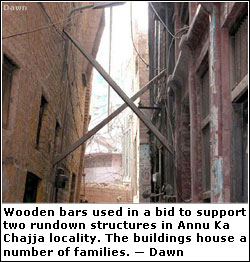 ABOUT 25,000 to 30,000 people are living in dangerous buildings of old Multan but those responsible for their safety have turned a deaf ear to the problem, feigning ignorance when some buildings are just standing on wooden pillars between two structures.
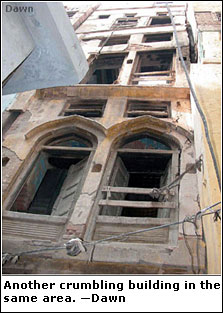
A survey conducted by various towns of the city has picked out about 800 residential buildings that are highly dangerous, with nearly cent percent chances of crumbling in the rainy season.
The government has the responsibility to take steps to ensure public safety when a building is found dangerous. The City District Government Multan (CDGM) has the responsibility to deal with run-down structures as well.
The survey of dangerous buildings had been conducted by various town nazims a few weeks ago on the direction of chief minister Pervaiz Elahi, and its report was sent to the Punjab secretary (local buildings) but no action was taken as yet.
The oldest and the most dangerous buildings are located in Mumtazabad Town and, according to the survey, the number of such buildings is about 600 out of which about 400 are in Union Council No. 44. A resident of Annu Ka Chajja, UC-44, said, “We know it is very dangerous to live in these buildings but we have no other option. Most people living in these buildings are labourers who earn their livelihood on a daily basis. We are not living in these potential tombs willingly but it is our economic necessity that has forced us to live here.”
He added: “We are living in these buildings with children and obviously lives of all of our family members are at risk and any mishap can happen any time while the government authorities are sending notices one after another but they do not understand our helplessness.”
He stressed the need for providing financial help to the people who are living in these buildings so that they can construct their houses.
An old woman said, “We are all in a boat that can sink any time, our life is a nightmare and the government must find a solution to this.”
 She said, “The government authorities are offering loans to us for building alternative houses but they are not realising that when we are unable to earn our daily livelihood how can we pay the large amounts of loan and its interest.”
She said the attitude of the authorities concerned was careless and they might be waiting for any incident to take some step regarding the matter.
UC-44 Naib Nazim Basharat Ali Qureshi said, “On the one hand we have sent many notices to evacuate the buildings and, on the other, we have invited the attention of government authorities several times to the seriousness of the matter, but all in vain.”
He said they had asked the tehsil municipal authorities several times to provide staff to raze the buildings but they didn’t appear to be moved at all. He said about 20 to 30 people were living in each of these buildings, some of them spread over only one marla. He said they had sent many requests to the authorities, including the chief minister, and even now “we are appealing them to take our requests seriously.”
UC-44 Nazim Akhtar Alam Qureshi said he had been asking for solution to the problem for the last five years but did not get any response from anywhere. He said if the government arranged only Rs200,000 loan without interest for each family of these buildings, he would convince the people to leave their houses.
Mumtazabad Town Nazim Mian Jamil Ahmed Sheikh said about 600 dangerous buildings were identified only in his town and the TMA had issued two notices to the people to vacate their houses, but they were not ready for it.
District Nazim Mian Faisal Mukhtar told Dawn that the CDGM could not afford the expenditure for resettlement of the people but “we offered to arrange loans from the house building department, but they are not ready to take loans.”
He said about 10,000 people had been living in these buildings and some of them had already vacated their houses.