



 0
0

The rising street crime
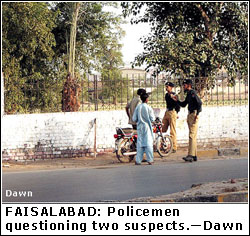 STREET crimes in Faisalabad are increasing with every passing day creating a sense of insecurity among the nearly seven million inhabitants of the city. The newly appointed deputy inspector general of police (operations), in view of the rise in crime has issued strict directions to his subordinates to control the menace.
Even a cursory look at the happenings of the last few days is enough to send shivers down the spine. Citizens are being mugged in broad daylight. But, why do the police personnel seem relaxed over the perplexing situation. Instead of taking practical steps only theoretical measures are being taken, which points to the apathy of the police.
During the previous local-body election, Faisalabad was granted city district status and scores of new posts of police officers were also created in a bid to run routine matters smoothly and evolve a comprehensive crime control mechanism. One considered the new postings as a harbinger of change but it did not help to control crime.
In 2001-02, the district received Rs303 million against 5,749 posts. However, this amount had been enhanced during the financial year 2005-06 against 6,021 posts. Nevertheless the increased allocation did not help to stop the sharp rise in crime. The Punjab police registered 14,584 cases in 2001, 20,306 in 2002, 19,977 in 2003, 21,100 in 2004 and 21,951 cases last year. Crimes against persons in 2001 were 2,345, which last year stood at 3,936. Another term that the police use as a shelter is miscellaneous crimes that also indicates a rising trend during the period under review as 2,176 crimes were registered in 2001 while last year the figure was 3,528.
However, how many cases of mobile, motorcycle, cash, gold and purse snatching that were reported had not been mentioned in the record forwarded to the provincial government. The district police claimed to have arrested 118 criminals, including some gangs involved in mobile snatching and other street crimes since Jan 1, 2006. But, the citizens are much worried about the rising trend of mobile snatching. Kutchery Bazaar is known as a hub of cell phone sale and purchase, including new and used ones. It is believed that most of them are snatched. Reportedly, one can sell one’s mobile set without any proper identification, increasing the trend of cell grabbing.
A couple of months ago, various banners were displayed on the direction of the then DPO Mohammad Amin Wains, restricting the trade of used mobile phones. The practice continued for a few days and now again routine dealing has gripped the market, a serious blow to the police 'mechanism’ for crime control. Exploiting the flaws in the police control system, sources said, the criminals intensified their drive of mobile snatching. This situation left no option for the police but to adopt a novel method of crime control as few FIRs were being registered.
People wonder about the performance of sections of the law enforcement agencies and think that most of their members are hand in glove with criminal elements. Sources said that in meetings police officers try to pacify the rulers quoting the crime rate of cities of developed countries.
Zahid Chohan, a textile businessman, said the rise in street crime exposed the foolproof security arrangements of the district police. “We are seeing more rise in street crimes because an effort of Mohafiz Squad induction has also proved a dud.” He said incidents of robberies, motorcycle, car, purse and mobile snatching were increasing with every passing day putting a question mark on the police performance and reforms being introduced by the regime involving billions of rupees.
Police sources said that a letter had been dispatched to all the town police officers by the DIG, who before the upgradation of this post was known as DPO, in which he expressed his anguish over the escalating trend of street crimes.
The Punjab Assembly members associated with the opposition parties a couple of days ago also took a serious view of the increasing crime rate in the province and vented their ire against the negligence of the officials concerned. However, on the other hand, treasury benches are busy in bench thumping over the control of crime rate owing to resolute policies.
A police officer, requesting anonymity, said all investment in the police department and introduction of reforms would go down the drain unless political interference is stopped. Politicians want to see favourite SHOs in their constituencies and this practice has marred the progress of the department. He said several competent officers were still waiting for their postings at suitable places where they could perform their duties without any political interference. However, they have not succeeded in getting appointments because they have no relations with political figures or connection with any party or influential family.
He said one could see a number of police officers with political affiliation. In view of the situation, how could a district police officer reprimand his subordinates over the rising crime rate or devise a comprehensive strategy to arrest crime rate in his jurisdiction? To save their skin, the DPOs had to issue directions on various issues, which were nothing but file work. It shows how deep rooted is political influence, he added.
DIG operations Aslam Tareen told Dawn that it is true he directed his subordinates to control street crimes in their respective areas. “We are going to chalk out an excellent security plan to save the lives and properties of inmates.”



























