0
0

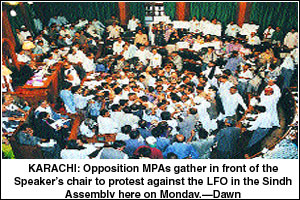 KARACHI, June 16: Amidst an unprecedented opposition uproar, with a woman member making a bonfire of the budgetary documents, the Sindh Finance Minister Syed Sardar Ahmad tabled on Monday a provincial budget of Rs 104.28 billion for the next fiscal year.
The budget, first to be presented by the PML- Q-led coalition government with Muttahida Quami Movement as a major partner, shows an operational surplus of over Rs 1.36 billion on the revenue side.
The revenue receipts are projected at Rs 90.91 billion and revenue expenditure have been budgetted at Rs 89.54 billion.
The budget also incorporates a total development outlay of Rs 14.73 billion that includes Rs 11 billion annual develolpment programme (ADP), Rs 2.43 billion foreign aided projects and Rs 1.30 billion Drought Emergency Relief Assistance (DERA).
The budget is silent on how the ambitious development programme of Rs 14.73 billion will be financed. The first volume of the budget documents on its last page make this riddle clear as it proclaims that “provincial contribution and funding of oversized SPDP will be subject to availibility of resources”.
On the distribution of development funds, Mr Sardar Ahmad said the provincial finance commission had been set up late and the distribution would therefore remain unchnaged at 70 per cent for districts and 30 per cent for the provincial government. The commission is expected to give its award before September 30 next.
The minister announced the creation of 24,000 jobs because of the Rs 11 billion ADP investment in the next fiscal year. He declared that the 03-04 budget was tax free and offerred many reliefs. Property tax was being devolved to the Taluka Town Municipal Administration level.
The minister announced a 15 per cent increase in the salaries and pensions of government servants from next month in line with the federal budget decision. He also announced an increase in the allowances of Sindh assembly members who will now get emoluments equal to those of members of the Punjab Assembly.
The budget has provided relief for widows, minors, orphans and disabled persons and retired federal and provincial servants who are property owners. For them, the limit of tax exemption has been increased from Rs 10,000 to Rs 24,000 gross annual rental value. Houses built on 120 square yards with a covered area not exceeding 900 square feet have also been exempted from tax. Previously this exemption was for houses on 100 square yards with 600 square feet covered area. The ceiling on exemption on residential flats with a covered area of upto 350 square feet has been increased to 600 square feet.
Property owners of houses built on 400 square yards in calamity areas in R-Division of Karachi and coastal areas of Badin and Thatta districts have been been given one year remission. A major relief has been offered to educational institutions, hospitals, clinics and dispensaries where property tax been reduced by 50 per cent.
The minister also announced reduction on the bed capacity tax for hotels to a uniform rate of 25 per cent from 60 and 70 per cent. A big slash has been applied in the infrastructure cess on gold by bringing it down to 0.125 per cent from 0.5 per cent.
Adjustments have been made in stamp duty rates. Auction of property on court order or revenue authority will need now three per cent stamp duty instead of five per cent. Gift deeds will carry a three per cent stamp duty. Similar downward adjustments have been made in oral gifts.
Owners of 16 acres of irrigated farms and 24 non-irrigated farms are now exempted from levy of agricultural income tax effective from next kharif. The minister also announced a cut in rent of buldozer of 90 horse power to Rs 125 per hour. Bulldozers of 120 horse power will be rfented at Rs 175 per hour.
But much to the regret of Syed Sardar Ahmad, not a single word could be heard in the press gallery while he struggled helplessly to deliver his budget speech for about 22 minutes. It all started after the speaker declined to let opposition leader Nisar Khurho and others to speak on a resolution that demanded judicial probe into the murder of Raziq Khan, a former Sindh Assembly speaker. No sooner Mr Khurho had read out his resolution, the speaker presented it before the house and got it approved. He then went ahead with the day’s business of budget presentation.
Before the minister could utter a word, opposition members left their seats and assembled before the treasury benches. Many opposition members stood on their seats shouting, “Go Musharraf Go” and “No Musharraf No”.
In his budget speech, the minister reviewed the outgoing fiscal year during which almost all government projections were knocked out. Total revenue expenditure during 02-03 was budgetted at Rs 84.80 billion but increased to Rs 86.71 billion in the final counts showing growth of Rs 1.90 billion. Recenue receipts dropped down to Rs 84.24 billion in the current fiscal year as against original estimate of Rs 84.90 billion.
This drop in Sindh’s revenue is despite the fact that its share in the divisible pool during 02-03 increased to Rs 37.57 billion from the original estimate of Rs 37.09 billion. Direct transfers on account of royalty, excise and surcharge on oil gas also increased to Rs 19.72 billion instead of the original estimate of Rs 18.85 billion. However the compensatory grant in lieu of abolition of zila tax and octroi was cut down to Rs 8.88 billion as against original projection of Rs 10 billon.
The government also revised downward the development outlay in the current fiscal year which the minister announced was cut down to Rs 12.26 billion from Rs 14.48 billion.
As was done in the federal budgets for last three years, the new budget offers an increase in ratios in comparison to the downward revision of all the major accounts to show that increases for the next year are impressive.
The minister expects transfer of Rs 41.82 billion from the federal divisible pool, Rs 24.08 billion on account of straight transfers from royalty, excise and development surcharge on oil and gas and Rs 10.87 billion compensatory grant. He estimates a 16 per cent rise in transfer of resources from Islamabad.
He listed a number of factors including a cut in Sindh’s share of irrigation water that impeded economic activities in Sindh which resulted in a fall of provincial revenue to Rs 11.73 billion. He now expects provincial revenue to grow upto Rs 14.14 billion in 03-04.
He called 02-03 a year which witnessed great turmoil in the political and administrative arena. He blamed ‘fledgling district’ governments for limited capacity of development funds utilization.
However, he said that the government paid more attention to the priority sectors such as health, education, water supply and public health.
Some of the salient features of next year’s development programme is the creation of a provincial border force for which Rs 10 million have been allocated. Another sum of Rs 5 million has been given for feasibility of development of Gorakh hill station.
The Sindh Provincial Cooperative Bank is also being revived for which a token amount of Rs 13 million has been kept in the budget. This bank was rendered bankrupt by the feudals who obtained loans but never paid back. The Sindh government has now cleared Rs 30 million liabilities.
The Board of Revenue and the excise and taxation department are being restructured for effective generation of resources. Property tax is being devolved to the taluka level.