0
0

Threats to Iran, Syria
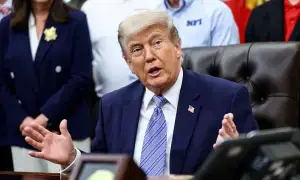
AMERICA and Britain still do not see the need for a ceasefire in the Middle East, even though the whole world wants an end to the hostilities immediately. At a joint press conference at the White House on Friday, neither President George Bush nor Prime Minister Tony Blair spoke of a ceasefire. While the American president emphasised the need for a multinational force to be in place “quickly”, the British prime minister sidetracked the issue and instead chose to warn Syria and Iran of “the risk of increasing confrontation”. President Bush said a multinational force would help speed up the delivery of relief goods, enable the displaced persons to return home and re-establish the Lebanese government’s writ in the country. There is no doubt that an international force can achieve all this, but must the slaughter go on and civilians be subjected to bombing and rocketing while diplomats work out the nitty-gritties of deploying a peace force on the Israeli-Lebanese border? Could not the details be worked out after a ceasefire had been effected and further death and destruction in both countries stopped?
The funniest part of Mr Blair’s advice to Syria and Iran was that they should behave as “proper and responsible members of the international community”. Truly speaking, if there is a country in the Middle East, or perhaps in the world, which should be the recipient of this gratuitous advice it is Israel. No country in the world has behaved so recklessly, irresponsibly and callously and which glories in shedding human blood as Israel. It has waged wars on all its neighbours repeatedly, taken territory from Egypt, Jordan, Syria and Lebanon, annexed the Golan Heights and Al Quds in violation of international law, and was forced to leave south Lebanon in disgrace after 18 years of resistance from Hezbollah. It is still in occupation of the Gaza Strip and the West Bank, where in defiance of various UN resolutions it has attempted to bring about a demographic change by force to alter these territories’ Arab-Islamic character. Its record of targeted assassinations, its attacks on houses killing civilians and its repeated massacres of Palestinians constitute a story unto itself. The massacres at Sabra-Shatila and Jenin are a reflection perhaps less on Israel and more on those who have given it a carte blanche to rule the occupied territories and bully its neighbours through force. The murder of UN observers the other day by Israel is just one example of its utter disregard for human life and sacred institutions. Let us recall here Israel’s attack on USS Liberty, killing 34 and wounding 173 Americans, during the 1967 war, and the Israeli rocket attack that massacred over 106 women and children at the Qana refugee camp in Lebanon in 1996. It was not a mistake, for an Israeli drone flew over the camp before the rocket struck. The video tape of the drone’s flight, recorded by a UN observer, mysteriously disappeared.
What Mr Blair hinted at is too dreadful to visualise. An attack on Syria and Iran will turn the Muslim heartland — from Afghanistan to Lebanon — into a war zone and will produce consequences that will be horrifying for the world in general and America and its proconsul in the Middle East in particular. Instead of trying to chasten Syria and Iran, Washington and London should try to rein in their bully boy in the region and work for an immediate ceasefire to save human lives in Lebanon and Gaza.
Looming energy crisis
POOR planning is the primary problem. Demand for electricity currently outstrips supply by some 3,000MW and it is estimated that the shortfall will rise to 5,000MW in two years. While demand has been growing in excess of eight per cent a year, generation capacity is only 10 per cent more than what it was in 1999. This, despite the fact that a massive shortage had reportedly been predicted as early as 2002. The situation, as it now stands, is critical. Even if work were to start today, the required power projects will take at least five billion dollars and five years to complete. Lack of infrastructure is not the only problem. Additional generation is dependent not just on new power plants but also on an uninterrupted supply of inputs. Oil-fired thermal plants are increasingly unviable in these times of skyrocketing crude oil prices. Not surprisingly, the additional 7,880MW of capacity that the government hopes to create by 2010 includes 4,860MW generated by gas-fired plants. Since domestic output alone cannot sustain these facilities, large-scale import of natural gas will be the only feasible option. This, in turn, hinges on three international gas pipeline projects — Iran-Pakistan-India, Turkmenistan-Afghanistan-Pakistan and Qatar-Pakistan. Of these, two are still at the preliminary discussion stage. While all three projects are officially still on the table, the first two remain elusive because of geopolitical exigencies. The Qatar-Pakistan venture, initiated as long ago as 1990, also remains hazy despite some groundwork.
So what are the prospects? Large hydro-power projects remain mired in political controversy as well as the debate over their impact on the environment and the people they will displace. Even if consensus is achieved and work gets underway, commissioning will still be a distant prospect. The nuclear option, rife in any case with safety issues, will not be made available to Pakistan in the current climate. The country’s vast coal deposits can be tapped to produce large amounts of relatively cheap power but at the risk of serious environmental damage. In this scenario, it is important to accelerate moves to harness renewable sources of power such as the wind and sun. The set-up costs may be high but that is where the future lies.
Beyond gender-bias laws
CLOSE on the heels of President Musharraf’s declaration regarding the need to amend the Hudood Ordinances according to the true spirit of Islam comes Prime Minister Shaukat Aziz’s statement expressing the same view. There has been some progress in this regard as indicated by the release of women imprisoned for different crimes. However, more needs to be done to alleviate women’s suffering. It is not enough to amend or repeal laws that are oppressive of or discriminatory to women. Along with it, social customs that relegate them to the position of second class citizens must also be addressed. For women to feel truly emancipated, they must be economically and socially empowered and feel that the law is on their side, not working against them. Ideally, the repeal of the Hudood Ordinances will be the first step towards giving them quality of status. It must be supported by a consensus among all sections of society, particularly the hitherto dormant intelligentsia that has a valuable role to play in this regard.
Mr Shaukat Aziz boasts of how far women have progressed under his leadership, with a female State Bank governor and more women pilots in the air force and PIA. This is only one side of the coin. It is also in this government that women were not allowed to vote in Dir and horrific crimes against women were — and are — committed. Women cannot even marry of their own choice without the fear of their husbands being slapped with false cases of kidnapping. The women parliamentarians the government is proud of inducting in large numbers in assemblies often complain of being sidelined by their male colleagues. There is much that needs to change in terms of women’s rights and interests, and for that the government must move beyond changing and repealing controversial laws.
Transatlantic tensions over Lebanon
IT looks set to be an autumn of transatlantic discord. Three years after they parted ways over the US-led Iraq war, policymakers in Washington and several major European capitals appear headed for more strain and acrimony over the escalating Israeli-Lebanon conflict.
The transatlantic rift — focusing on whether, when and how to end Israel’s massive offensive against Hezbollah in southern Lebanon — has still not exploded into an outright diplomatic confrontation similar to EU-US finger-pointing during the Iraq war. At the time, US Secretary of Defence Donald Rumsfeld raged against the weakness of anti-war “old” European states — a reference to France and Germany — while praising the dynamic “new” central and eastern European countries which were backing America’s invasion of Iraq.
In return, France and Germany refused to take part in the US-led “coalition of the willing” against Iraq and continued to criticise US policy in the Middle East for many months afterwards. The split between the EU and the US over the current Israel-Lebonon conflict is not as visible — at least not yet — and is certainly not being highlighted by either side. But the signs of transatlantic strain are growing.
Divergences between the US and its key European allies over Israel’s military assault and how best to stop the fighting in Lebanon were evident at the Group of Eight (G8) meeting in St Petersburg in mid-July. At the talks, chaired by Russia, US President George Bush consistently refused to urge Israel to show restraint or to press for an end to hostilities as demanded by other G-8 nations.
Significantly also, while President Bush raged against Syrian and Iranian backing for Hezbollah, other G-8 leaders did not make any specific reference to the two countries in their final statements. Since then, the divide seems to be getting wider. While the US remains staunchly behind its Israeli ally, most governments in Europe have stepped up demands for an immediate ceasefire and are pressing for the swift deployment of international troops in southern Lebanon.
In another clear split with Washington, several EU leaders have denounced Israel’s “disproportionate” use of force and voiced alarm at the mounting death toll and the damage to Lebanon’s infrastrucure. EU officials have also warned that Israel’s actions are weakening Lebanon’s democratically elected and pro-western government.
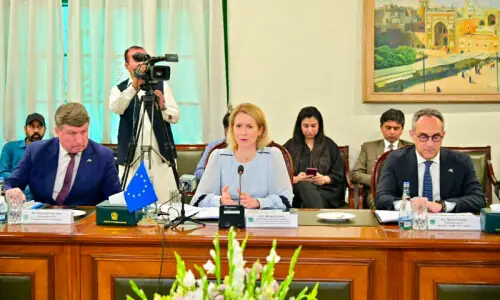
Transatlantic differences were once again spotlighted at the international conference on Lebanon held in Rome recently. Under US pressure, the top-level meeting abstained from calling for an immediate ceasefire in the region — but endorsed the idea of a peacekeeping force “under a UN mandate.”
“The killing of innocent civilians must stop — and it must stop now,” EU External Relations Commissioner Benita Ferrero-Waldner told the meeting while Finnish Foreign Minister Erkki Tuomioja — whose country holds the current EU presidency — pointed to “increasing frustration in Europe at the lack of progress in achieving a ceasefire and coming to grips with the causes of the conflict.”
The EU’s calls for an immediate ceasefire contrasted with the repeated insistence by US Secretary of State Condoleezza Rice that agreement on an “enduring” peace must be in place before the parties are called to stop fighting.
“We have to have a plan that will actually create conditions for a ceasefire that will be sustainable,” insisted Ms Rice at the Rome meeting.
Her tough line was immediately criticised by French Foreign Minister Philippe Douste-Blazy who told reporters he regretted that delegates could not issue an appeal for a quick ceasefire. France had wanted to call for an “immediate cessation of hostilities,” but Ms Rice successfully pressed for more cautious wording, indicating that work would begin “immediately for the cessation of hostilities,” said Douste-Blazy.
After the meeting, the Finnish presidency of the EU denied that the Rome gathering had given Israel a green light to continue its operations in Lebanon and suggested that Israel’s interpretation of the international crisis talks was “totally wrong.” The strong message from Finnish foreign minister Tuomioja came after Israel’s justice minister, Haim Ramon, said that divisions among world leaders meeting in Rome could be seen as “permission” for Israel to continue its offensive.
Italian Prime Minister Romano Prodi also pointed out that the “position expressed by the conference cannot be interpreted as an authorisation.” German foreign minister Frank-Walter Steinmeier insisted the Rome emergency talks had signalled “just the opposite,” as all its participants “wanted to see an end to the fighting as swiftly as possible.”
While most European governments have made no secret of their opposition to US, and Israeli, policy, British Prime Minister Tony Blair, sticking to his role as America’s closest and most fervent European ally, has so far refused to call for an immediate end to the fighting. Blair’s meeting with President Bush in Washington on Friday was dominated by the Lebanon conflict, with the British leader apparently pressing for US backing for an urgent ceasefire as part of a UN Security Council resolution to be voted next week.
According to reports, London and Washington have been circulating a text of the draft resolution which suggests a two-phased procedure to restore peace in the region. The first phase would involve a ceasefire deal between Israel and Lebanon with a small international force deployed on the border while Israeli troops withdraw from the country. The second stage would see a larger force of up to 20,000 UN-mandated troops disarming Lebanese militias — mainly Hezbollah — and helping the Lebanese army to take control of the country’s southern border.
However, Paris — currently holding the presidency of the UN Security Council — has prepared a competing resolution of its own. The French draft calls for an “immediate halt to the violence” and “a handover of prisoners to a third party enjoying the trust of the two belligerents.” It also foresees the deployment of international troops in support of the Lebanese army and a buffer zone on the Israel-Lebanon border, press reports say.
France has said it is in principle willing to participate in a peacekeeping force for Lebanon under a UN mandate. However, both Germany and Britain have ruled out contributing troops to the operation. Meanwhile, France is opposing Nato leadership of the force.
Foreign Minister Douste-Blazy has argued — as has EU foreign and security policy chief Javier Solana — that the force should not be composed of just western armies to prevent a cultural conflict with the Arab population. He has also said that Lebanese forces should be trained by international troops to take over the role of policing the border area, adding that a purely military solution could not solve the Hezbollah issue. The French foreign minister also demanded that Iran play a “stabilising role” in the region.
The outburst of transatlantic tensions comes barely a month after the US and the EU joined forces at a meeting in Vienna to demand a change in Iran’s nuclear stance and warned the Hamas-led Palestinian government to recognise Israel. At the time, EU and US officials talked warmly of turning over a new page in their relationship and beginning a strategic partnership to deal with global hotspots. The EU stopped its earlier tough talk on making the bloc a “counterweight” to the United States.
Washington’s change-of-heart in dealing with its European allies was no surprise. Having ousted Saddam Hussein, US policymakers soon realised that stabilising Iraq would require European help, both in the form of financial assistance and more troop contributions. Changed circumstances in Europe — including the election victory last autumn of German Chancellor Angela Merkel who put improved relations with the US on top of her agenda — meant the EU was ready to respond warmly to the US overtures.
Transatlantic differences over the Middle East are compounded by the collapse of World Trade Organisation (WTO) talks.
Although WTO director general Pascal Lamy has urged countries to stop engaging in a blame game over who is responsible for the collapse, the EU says Washington derailed the talks by failing to offer deeper cuts in subsidies paid to farmers while the US has targeted Brussels’ failure to ease access to its agricultural market for foreign goods.
“Surely the richest and strongest nation in the world, with the highest standards of living in the world, can afford to give as well as take,” said EU trade chief Peter Mandelson in reference to the tough US stance on farm support. Mandelson has also pointed to a “fundamental” disagreement with the US on trade liberalisation.
Diplomats on both sides insist that despite current tensions, transatlantic harmony rather than acrimony remains the name of the game. However, for the moment at least, such statements appear to reflect wishful thinking rather than reality.