0
0

Reducing the debt burden
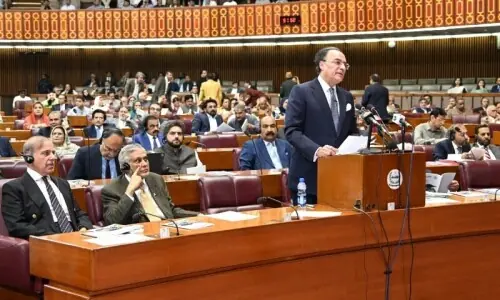
The three-day meeting of the Pakistan Development Forum in Islamabad last week was unlike the pledging sessions dominated by announcements of the donors of the past.
This session for a comprehensive review of the economy by the donors and top officials of the Pakistan government, was more like a pleading session with one ministry after another making its case for large funds for the next five to 15 years. The ministries spoke of the great plans they had for the future and of the terrible consequences of not coming up with such outlays.
Of course, the lion's share of the development funds for the immediate and near future was claimed by the ministry of water and power, with Aftab Sherpao as the vocal minister, for development of the crucial water and power sector for the next 15 years.
World Bank vice-president for South Asia Proful C. Patel gave top priority to the development of infrastructure for not only the greater economic growth of Pakistan but even to maintain the existing levels of production, industrial as well as agricultural.
He defined power as the "growth sector" as on the availability of power would depend not only the existing levels of economic output but also future investment, including foreign investment.
It is also a sector marked for its heavy losses due to massive theft of power, mala dministration and gross waste. He placed the operational loss of this sector at 1.4 per cent of the GDP.
While that is upsetting for the experts, the common man knows the KESC now loses 40 per cent of the power it produces after that the figures at one time had touched almost 60 per cent, and the WAPDA's loss is over 30 per cent, if not more, although it claim's a lower figure.
What that, in effect, means is that an honest consumer pays not only for what he consumes but also what his neighbour steals, and he is usually a very resourceful person. He can waste a large amount of power, too, as he does not pay for that.
Earlier it was said that the World Bank was raising its assistance level to one billion dollars a year from around 600-700 million dollars. The Asian Development Bank's assistance had also come to that level. Evidently such enhanced assistance plus the stepped-up US aid in return for our cooperation in the US war on terror is not enough to meet our vast needs.
It was also stated that the World Bank had come up with a package of 10 billion dollars for ten years for the water and power sector, but President Musharraf had rejected that. He wanted larger assistance for a shorter period and not at the high World Bank rate but at the concessional rate of 0.7 per cent service charge of its IDA arm.
But now we have to wait to see who or which consortium will pick up the very large bill presented for water and power projects at the Pakistan Development Forum which has a total of 56 billion dollars, including 20.4 billion dollars for five large dams, not excluding the Kalabagh dam. In terms of rupees the infra-structure development would cost Rs. 3,248 billion - more than six times the tax revenues of the state.
The World Bank vice-president says it appeared that Pakistan was on the verge of facing a water and power crisis. And yet there seemed to be no action plan or time-line target presented by the government to meet the crisis. He sought separate briefings on the two sectors to be able to look more closely into the situation and determine the extent of assistance needed.
The situation is so bad the new chairman of WAPDA, Tariq Hamid, says WAPDA needs Rs 116 billion to reduce its systemic losses by even 6 per cent. Evidently enormous amount of money is required to plug the large leaks in the system.
The question is: how much of this Rs. 3.25 trillion will be invested by Pakistan and how much should come through external borrowing? The budgetary deficit has come down to 4 per cent of the GDP this year, and is expected to go down to 3.5 per cent next year onwards. So it has more funds than before to invest on development, particularly on the crucial water and power sector.
The deficit is usually met through domestic borrowing which supplements external borrowing. But domestic borrowing has still a heavy interest rate. So the government has to depend more on its own budgetary savings, which is negative now to the extent of 4 per cent of the GDP.
The servicing cost now is Rs 256 billion which is equal to half the tax revenues of the country. This amount has to be reduced so that more funds could be diverted to development. Because of the improved budgetary position the prospects of this happening is improving all the time.
How much of the sales proceeds from the privatization process, particularly of the large units like PSO and PTCL, can help to reduce the debt burden remains to be seen. Lower debt and less funds for debt servicing could mean more funds for development of a non-refundable kind and a stronger economy. That is what we should be striving for now.
World interest rates are low or the lowest now, but is rising slowly and may rise faster as the recovery of the world economy picks up momentum. So what will be the terms of the loans we are to get from the World Bank, the Asian Development and other donors? Loans on IDA terms are not available when the amount involved is very large and spread over a long period. So while we are getting rid of very costly loans we should not be going for costly loans, if we can help it.
Large loans invested on development projects should be able to repay by themselves without state subsidies. The exception can be the outlay on the social sector like girls' education and public health.
It should not become necessary for the state to tax the people heavily to repay the loans, while they did not benefit by the manner the development expenditure took place without adequate development. Poverty reduction outlay could also be an exception.
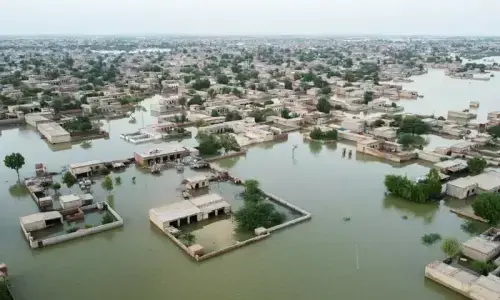
The WAPDA chairman has presented a grim picture of the water crisis, and worse is to come. He says per capita availability of water which was 5,600 metres in 1951 has dropped to 1,360 metres, and is expected to fall to 1,000 metres by the year 2012 which will make Pakistan the country marked for acute shortage of water.
Already the problem is acute in the cities like Karachi where water has a high level of impurities even when it is tape water. The threat to those who get tanker water at a far higher cost is worse.
In respect of other key areas of the infrastructure communication secretary Iftikhar Rashid says Pakistan needs 9.9 billion dollars for development of important highways in the next 18 years. He says Rs 3 billion would be needed per year for the upkeep of the road network in the present condition and Rs 35 billion over the next five years to improve the network.
And the railways secretary Khursheed Alam told the Forum that the transport sector's inefficiency alone cost the country Rs 320 billion. The country could become the transport hub for the outside world if Rs 72 billion could come in for investment.
The World Bank representative says when it comes to the water sector several factors were important. First the money has to be spent on the approved projects, then the water should reach the small farmers from the irrigation system and finally the farmers should be able to make the best use of water.
If instead the big farmers get water as their farms are at the mouth of the canals and the small farmer gets too little, and the excess water misused by the big farmers cause water-logging and salinity, that large investment would have been misspent, and the people would suffer.
The World Bank also says that key services often fail the poor people. It says "broad improvements in human welfare would not occur unless poor people receive wider access to affordable better services in health, education, water, sanitation and electricity."
But in the feudal heartland of South Asia it is difficult for the poor to have his share of access to basic facilities while the feudal lords want to have it all.Now Mr Sherpao wants 20.4 billion dollars for five dams including Bhasha dam - 5.9 billion dollars, Kalabagh dam - 5.4 billion dollars, Skardu dam 6.5 billion dollars, Akhori dam 1.6 billion dollars and Munda dam one billion dollars.
He wants 16 billion dollars more to generate 9,000 MW of hydel power over a period of five to ten years and also a short term loan of $ 5 billion for transmission and distribution of power and rural electrification. He thinks $3 billion is needed in the near future to build new canals and 3.8 billion dollars for improving the irrigation system and $2 billion for drainage.
After such heavy borrowing if water still does not reach the small farmers because of feudal intervention that will be too tragic. How can the system prevent such maladministration or mis-governance and waste? And how can it keep such vast expenditure beyond the clutches of corruption when several of the ministers have been charged with corruption or maladministration by the National Accountability Bureau and they had been facing trial?
The large dams which will bring vast areas under water and uproot many millions from their homes are a major issue. There is a great deal of opposition to large dams from top experts in the world as spotlighted during the World Dam Day observed around the world recently.
Kalabagh dam is a political issue in Pakistan, with the small provinces opposing that, but it is technical and human issue. In Pakistan many victims of large dams displaced from their homes decades ago have not been rehabilitated yet.
It is not difficult for the government to borrow large sums of money these days because of the important role it is playing in the war against terrorism. But the issue is how to make the best use of those funds that effectively benefits the people and helps in fighting poverty.
The parliamentary committees are not effective in checking corruption or ensuring good governance or in making the services produced by heavy external borrowing available to the masses. The result has been an increase in poverty all round to the extent of one-third of the people and large scale unemployment.
These are the days of increasing globalization and falling national tariffs. Pakistan has to make its export products more competitive in terms of prices as well as quality. Cheap and steady supply of power is an essential ingredient of this system and there can be no compromise on that.
The issue now is: how do we achieve what we need at a minimum cost and maintain the system at a low cost to remain competitive around the world. How do we prevent corruption, misgovernance and gross waste in the production and export systems? We cannot continue in our old ways any more.
Terror as a weapon of occupation
BAGHDAD: In London, they unfurled a protest sign on Big Ben, in Rome a million demonstrators filled the streets. Here in Iraq, there were no such spectacular markings of the one-year anniversary of the invasion - a sign, the BBC speculated, that Iraqis are generally "pleased" with the progress of their liberation.
Yet driving around Baghdad on Saturday, the eerie quiet felt more like a sign that symbolic anniversaries are an unaffordable luxury when the war they are supposed to be marking is still being waged. Several demos were planned for Saturday in Baghdad but cancelled at the last minute - a response to three days of rapid-fire attacks on Iraqi and foreign civilians.
On Friday, an anti-occupation march designed as a show of unity between Sunni and Shia Muslims was much smaller than organisers hoped, and no wonder: less than three weeks ago, 70 people were killed in an horrific attack on the same Shia mosque where demonstrators were meant to gather.
US occupation chief Paul Bremer chose the day of the planned protests to predict that more such "major attacks" were likely "when you have masses of Shia together". Those who dared to show up glanced around nervously, while armed men lined the streets and rooftops.
Just two months ago, the mood here was distinctly less tentative. In January, more than 100,000 Iraqis took to the streets of Baghdad and Basra to reject the US plan to appoint an interim government through a complicated system of regional caucuses, and to demand direct elections.
Under intense pressure, Bremer was forced to scrap the caucus plan. For a brief moment, it looked as if Bush's empty talk of bringing democracy to Iraq might just become a reality - because Iraqis seemed determined to seize that power despite their occupiers' best efforts.
Now, after a month of terror and steady assertions from "experts" that Iraq is on the verge of civil war, much of that boldness has retreated. Which is precisely why they call it terrorism: it sends people from the streets into their homes, replacing courage with fear, self-reliance with dependency.
There are rare exceptions, such as the recent Spanish elections, when populations seem to collectively decide to respond to horror with defiance. But more often, terror simply terrorises.
So who benefits most from the spreading fear in Iraq? According to Bush, the winners are faceless evil-doers bent on undermining Iraq's future democracy. And according to Bremer, this means that the attacks will continue as the June 30 handover approaches.
But this is not the word on the streets here. Twenty minutes after the bombing of the Mount Lebanon hotel last Wednesday, the rumours began to fly: it was the US, the CIA, the British ... If these conspiracy theories have traction, maybe it's because the occupying forces have so brazenly taken advantage of the attacks to do precisely what they accuse foreign terrorists of doing: interfering with the prospect of genuine democracy in Iraq.
When it was only occupation targets getting hit by the resistance, it made the occupation seem out of control, bolstering the argument that the US should pull out and hand over power to Iraqis or a more neutral international force.
But now that the targets have expanded to include Iraqi civilians, as well as foreign aid workers and journalists, the White House is attempting to make Iraqis seem riven with religious and ethnic hatreds, incapable of governing themselves. With doubt successfully cast on the prospects for democracy, and terror attacks minimising pro-democracy protests, Bremer is on the verge of accomplishing what seemed impossible two months ago: installing an interim government that is fully controlled by the US.
It now looks almost certain that Iraq's first "sovereign" government will be created by a process even less democratic than the abandoned caucus system: the US-appointed Iraqi Governing Council will simply be expanded in size. This body is so discredited here that it is called the "governed council".
Bremer has also managed to use the terror attacks to make sure that Iraq's next government will be able to do nothing but implement his orders. After the March 2 attacks on Shia, members of the governing council came under pressure to sign an interim constitution as a show of national unity and stability, despite previously strong reservations.
The document, signed two weeks ago, states: "The laws, regulations, orders, and directives issued by the Coalition Provisional Authority ... shall remain in force." These laws include Bremer's Order 39, which drastically changes Iraq's previous constitution to allow foreign companies to own 100% of Iraqi assets (except in natural resources), and to take 100% of their profits out of the country, paving the way for massive privatizations.
But defying Bremer's orders won't be an option after the "handover". The interim constitution clearly states that the only way these laws can be changed is by a three-quarters vote "by the Iraqi Transitional Government". According to the same constitution, that body won't exist until elections are held in early 2005.
In other words, on June 30, the occupation won't end, it will simply be outsourced to a group of hand-picked Iraqi politicians with no democratic mandate or sovereign power. With its new Iraqi face, the government will be free from the ugly perception that Iraq's national assets are being auctioned off by foreigners - and unencumbered by input from Iraqi voters who might have ideas of their own.
At the Economic Forum on Iraq conference held last week, Nassir al-Jadarji, a member of the governing council, assured potential investors that the deals made by these mandate-less politicians will be passed on to Iraq's future elected leaders. "Our policies toward investments will not change in any form," he said.
Some wonder why any company would even want to buy up pieces of a country as chaotic and dangerous as Iraq. Perhaps the real question should be: with the Iraqi people living amid so much chaos and danger, who is going to stop them? -Dawn/Guardian Service
BD: who cast the first stone?
The sky lit up with fire-balls amidst the deafening sound of gun-shots. The dark night was pierced by multi-coloured searchlight leaving no room even for a shadow to escape.
Simultaneously, microphones blared to announce that an indefinite curfew had been imposed on the unfortunate city of Dhaka. It was a full-fledged battle against invisible enemies. Nobody cared to count the dead. This happened about the midnight of March 25, 1971. The following day, on March 26, the independence of Bangladesh was proclaimed by word of mouth and through a clandestine radio broadcast. This was the beginning of the end.
It is not yet known who cast the first stone. Sheikh Mujibur Rahman's daughter and former prime minister of Bangladesh, Sheikh Hasina, claims that the announcement was contained in a hand- written press statement by the Sheikh himself.
Thereafter copies of the statement were distributed all over East Pakistan. On the other hand, General Ziaur Rahman's party, the Bangladesh Nationalist Party, maintains that it was the general who proclaimed independence.
It is one of those secrets with which Pakistan's chequered history is littered. It is not yet clear who drafted the Lahore Resolution which is a major historical document.
Chaudhry Khaliquzzaman and Nawab Ismail are said to be the two persons who generally drafted all resolutions of the All-India Muslim League. But none of them was present when the resolution was for the first time presented before the March 23 meeting in Lahore.
It is still believed by some that the term 'states' mentioned in the original resolution was a typographical mistake which was later corrected by Muslim League legislators in 1946. But were the legislators competent to amend a resolution adopted by the Muslim League Council? This is another story.
Similarly the authorship of Sheikh Mujib's famous Six Points is still shrouded in mystery. Several unconfirmed stories are in circulation. The text of the Six Points was amended several times as tension mounted in the unhappy relationship between East Pakistan and the central government.
The Awami League leaders insisted on maximum autonomy for the eastern wing. Even at that stage when a revolutionary situation was already in the making nobody talked of independence. Sheikh Mujib's famous speech of March 7 at the Race Course ground fell short of a call for independence.
But it would be presumptuous to think that the people of the former East Pakistan had launched a movement for the implementation of the Lahore Resolution.
The issue was never raised by the leading politicians of the eastern wing. They had their own grievances, some of which were genuine and should have been thoroughly examined. At a much later stage, however, the Lahore Resolution did provide an impetus to the people of East Pakistan in their struggle for independence.
When the people and the rulers were locked in confrontation and all top leaders of the Awami League had left for Calcutta where they had formed a government in exile, Sheikh Mujib chose to stay back in his Dhanmandi house. He waited for the Pakistan Army and offered no resistance. He was promptly arrested and taken to West Pakistan.
The widely reported famous dialogue between Zulfikar Ali Bhutto and Mujib further strengthens the argument that Mujib believed in the federal structure of Pakistan and sought constitutional remedy of the problem. When Bhutto informed the Sheikh (he had been in solitary confinement for a long time) that he (Bhutto) was the president of Pakistan, Mujib replied: "How can you be the president of Pakistan? I am the leader of the majority party." Till that moment, it can be argued, Mujib had faith in the unity of the country and did not know that Bangladesh had already emerged as an independent state.
Although Mujib was personally grateful to India for all the assistance that it had offered to his people in their hour of trial, in his heart of hearts, he nursed a feeling of bitterness for New Delhi. He had told some trusted journalists that he could easily achieve freedom with India's support, "but I would never go to a banya (trader)."
Even after liberation, there were fewer Hindu ministers in his first cabinet than were in the Pakistan days. The Indian army, after its victory, had plans for a longer stay in Bangladesh. But Mujib felt the pulse of the people who were opposed to the presence of the conquering army.
He rushed to New Delhi, met Mrs Indira Gandhi and expedited an early withdrawal of Indian troops. Even when National Awami Party leader Maulana Abdul Hamid Khan Bhashani had strongly advocated complete independence, the Awami League did not endorse his views. Maulana Bhashani had a much better understanding of the people's choice.
He knew that in this unpredictable situation, nothing less than independence would satisfy them. It was a struggle against the injustices meted out to the people of the eastern wing over more than two decades. It is a fact that they suffered neglect and apathy at the hands of those who wielded power in West Pakistan.
On one occasion when East Pakistan chief minister Ataur Rahman Khan returned from Rawalpindi, he told correspondents at Dhaka airport that he could not get approval for an important project from the central government "as it was easy to convince the minister but difficult to please the section officer." Such was the hostile relationship between the administrations in the two wings.
It was only during the brief period of General Yahya Khan that some measures were contemplated and taken for ameliorating the conditions of East Pakistan.The headquarters of several government corporations were shifted to Dhaka. A few promotions were made in the superior services cadre. But these measures were much too late and could not serve any purpose.
The army action of March 25 put the final seal on the fate of united Pakistan. It created a bitterness which was not easy to remove. In that hostile environment, it was impossible to think that the situation would improve with the help of any military intervention. Even at that time many sensible people had warned the authorities against taking harsh actions.
The situation needed political measures. Instead a harsh policy was devised. The only political step taken was to hold by- elections for the seats vacated en masse by the elected representatives of the people in East Pakistan. It was indeed a futile exercise as the voters completely boycotted it.
When a full-scale war began in December 1971, the Pakistan Army had to confront the entire population of East Pakistan. And those who did not join the "rebels" were termed collaborators by the new power wielders of the eastern wing and "Muslims of Indian origin" by successive governments in Pakistan.