0
0

Munshi Ibrahim — a vocal poet
MUNSHI Ibrahim, who died at his home village of Jinhan Soomro in Badin district on Thursday at the age of 69, was one of Sindh’s most committed and revolutionary poets. He had been bedridden for almost a month.
Ibrahim belonged to the group of poets and writers who either did not attend school or were dropouts. But this did not deter him from studying the issues, miseries and problems that confronted society, and for him life itself was the best school.
As a young man, he studied all form of Sindhi poetry — the formative, traditional, classical and modern. This gave him a wide outlook. As a witness to the political manipulations for creating One Unit, which many Sindhis felt was aimed at depriving their province’s identity, he joined the intellectual movement to oppose it. He did so not merely with his pen, but through physical participation as well, and was jailed like many other opponents of One Unit.
At that time the anti-One Unit movement was led by stalwarts such as G. M. Syed, Hyder Bakhsh Jatoi, Sobho Gianchandani, Shaikh Ayaz and Tanvir Abbasi. They were all penalized in one way or another.
Technically, Ibrahim was influenced by the classical form and style of Shah Latif but even as he took his cue from Shah, he followed his own path. He used the diction of ordinary people and simple indigenous meters. Instead of borrowed similies and metaphors, he drew characters from among the people to express his anger at political repression and economic exploitation. He did not indulge in obstructionism; instead he used very direct and purposive language to communicate with his simple-hearted people. It was this that made his poetry speak. In one of his poems he says:
Chha jot taim aeen chha jo tanno,
Miskeenan je mass te ghasnno,
Sardi garmi saanno saanno,
Poye bi ghar mien ann na danno.
(What timings and what their bindings, it is always the poor that work in every harsh season, but even then they do not have a single grain in their houses.)
But Ibrahim never advocated acceptance. He urged the people to struggle against the oppressive system:
Neir tore nikre weendi, thareli thoothane maan,
Dokhe ji aj dhap ache thi, tunhenje dane dane maan,
Bhagiya jagiya bhoona bhalare ja aj bhanoo bhagwanda,
Qahari tunhenje kot kerayan karan gadji kam kaah kanda.
(The bonded cuckoo will free herself by breaking the shackles. The masters of this graceful land have awakened, and will attack together to destroy your unjust system).
In the closing years of his poetic journey, he developed a universal approach condemning repression everywhere in the world.
Ibrahim had five anthologies to his credit reflecting his feelings of all phases of the life. These are: Dharti deen dharma, Dhanurey deenhan dhara, Paigham-i-mazloom, Goondar weenda guzri and Vigah ja varyam.
In the last years of his life, he was inflicted with multiple ailments and without assistance from any organization, he took to self-medication. Doctors advised him to go abroad but that was not possible because of the expenditure involved and all appeals for government help went unheard.
Three sons, four daughters and a large number of fans have been left to mourn Ibrahim’s death.
No let-up in people’s Hardships
THE six-hour-long inspection of federal departments by the Punjab governor, in Dera Ghazi Khan on July 31, did not fulfil the aspirations of the common people who are facing continuous hardships at the hands of employees and authorities of federal government departments after the establishment of district government.
The governor inspected at least nine departments — Khushali Bank, Zarrai Tarraqiati Bank, Passport Office, Baitulmaal, PTCL, Rural Development Project, MEPCO, Nadra and SNGPL.
After the launching of devolution plan the performance of these departments remained unchecked, causing various hardships to the people. It is a matter of concern that like the district police officer, heads of federal government departments also do not attend district council sessions to answer complaints made by the people and their representatives.
During the inspection of Khushali Bank, D.G. Khan, the governor could not meet the borrowers of micro loans because they were not allowed to meet him by the bank authorities as they (the borrowers) are not satisfied with the functioning of the bank. Maximum bank staff was brought from Multan branch/office, but credit officers could not properly explain their field work before the governor.
One of the borrowers told Dawn on condition of anonymity that with 20 per cent mark-up, micro credit schemes cannot be successful, and he is now in the clutches of Khushali Bank. With a loan of Rs 5,000 or Rs 10,000 on 20 per cent mark-up, who can break the vicious circle of poverty? It is on record that Khushali Bank has increased the problems of the poor borrowers instead of giving them relief.
Zarrai Tarraqiati Bank was also visited by the governor, where he met borrowers (selected by the bank management). He took interest in micro credit scheme for women which is being run under the bank authority. Allegedly, embezzlement of millions took place at Choti Zaireen branch of the bank. The regional office of the bank arrested hundreds of farmers in recovery cases while not a single influential was rounded up. Three institutions are dispensing micro loan, including the National Rural Support Programme.
The deputy engineer of SNGPL (Sui Northern Gas Pipeline) presented briefing to the governor. The latter expressed his dissatisfaction with the performance of SNGPL, Dera Ghazi Khan. Despite various complaints made by newsmen, the governor did not take action against the ineptness of the staff.
District Nazim Jamal Khan Leghari also pointed out the poor performance of SNGPL and the ignorance of MEPCO in the accomplishment of the schemes of the district government. However, the governor did not take any action against the authorities concerned.
The performance of other departments also did not satisfy the governor but he did not take any action against them either. The people were expecting that he would take immediate action against corrupt officials and heads of federal government departments. While precious time and money was spent on the six-hour-long official visit of the Punjab governor, neither corruption nor the hardships of the people could be reduced.
The people my college had
I HAVE been loaned a pocket book of great historical significance it is called “Government College Lahore: Almanac for 1939-40”. It has one hundred and thirty six pages or 34 pages of a regular book. But it is full of information about my old alma mater. The college had many clubs, all of which are being give below. I do so in the hope that those who read what follows will write back to me if they know anything at all of the people named here. The college had the following societies 64 years ago: Adult Education Committee: 1. Patron — The Principal 2. President — Mr Sirajuddin 3. Chairman — Mr Saadat Ali Khan Members: 4. Mr H B Richardson 5. Mr Muhammad Aslam 6. Dr P K Kichlu 7. Mr Sita Ram Gupta 8. Mr Abdul Hamid 9. Mr Muhammad Jamil Wasti 10. Mr Ghulam Mustafa Tobana Arabic: President — Dr Muhammad Sadruddin Vice-President — M Karim Bakhsh Secretary — Ghulam Jilani Joint Secretary — Rifat Pasha Sheikh Assistant Secretary — Mubarak Ahmad Biological: President — Dr Vishwa Nath Vice-Presidents — Sirdar Hardyal Singh Sodhi, Dr Jagjiwan Singh Secretary — Yog Raj Puri Assistant Secretary — R C Saluja Treasurer — Rajindar Paul Committee Members — G L Arora, R S Chopra Brett Philosophical: President — Mr Muhammad Aslam Vice-President — Mr Saadat Ali Khan Secretary — M M Ismail Committee — Muhammad Ishaq, P C Chaterji Dr V S Puri Incharge “Careers” Bureau Dramatic Club: President — Principal Vice-President — Mr Harish Chandra Manager of Wardrobe — Mr D P Gupta Stage Manager — Malik Sukh Dayal Dunnicliff Chemical: President — Bh S Mahan Singh Vice-Presidents — Dr V S Puri, Dr R K Bahl Secretary — Dhanpat Rai Naugpal Joint Secretary — P K Sobti Garret Physical Culture Club: President — Mr H A Soofi Secretary — Harish Chandra Vohra Joint Secretary — Gian Sagar Gupta Geographical: President — Mr A N Kapur Vice-President — Hira Lal Secretary — Abdul Hamid Lectures Secretary — Gajindar Singh Hindi: President — Pt Gauri Shankar Vice-President — L Duni Chandra Secretary — Brij Lal Chawla Assistant Secretary — Satya Pal Historical: President — Mr A R Khanna Vice-President — Om Parkash Mehra Secretary — Amrit Lall Miani Treasurer — K A Saeed Mathematical: President — Mr Vidya Chandra Secretary — Manmohan Das Majlis-i-Iqbal: President — Sufi Ghulam Mustafa Secretary — Muhammad Iqbal Joint Secretary — Mubarak Ahmad Masud Music Club: President — Mr Sirajuddin Secretary — Manmohan Krishen Old Boy’s Union: President — Th Hon Sardar Bahadur Sir Sundar Singh Majithia Vice-President — Mr Ram Parshad Khosla, I E S (Retd) Secretary — Mr S G Khaliq Persian: President — Dr Rashid Ahmad Vice-President — Sufi Ghulam Mustafa Secretary — Abdur Rashid Siddiqi Joint Secretary — Najibullah Punjabi: President — L Duni Chandra Secretary — Chiranjit Singh Assistant Secretary — Gurbaksh Singh The Ravi: Manager — Mr Sirajuddin Editor — H C Smith Joint Editor — M A Iqbal Assistant Editor — A Kumar Vernacular Editors — Manzurul Haq, Harbans Verma, Bawa Jasbir Singh Round Table Club: President — Dr Harnam Singh Vice-President — Ghanshyam Prem Nath Secretary — Ranjinder Nath Kapur Joint Secretary — Shah Zaman Treasurer — Syed Muhammad Hassan Wasty Rural Uplift Committee: Patron — The Principal Chairman — Dr V S Puri Members: Dr Harnam Singh, Mr S G Khaliq Sanskrit: President — Pt Gauri Shankar Vice-President — L Duni Chandra Secretary — Dharma Pal Assistant Secretary — Vishwambhar Nath Senior’s Club: Patron — Principal President — Mazhar Mahmud Secretary — Satish Chandra Loomba Treasurer — Malik Ahmad Hussain Assistant Treasurer — Sarup Singh Union Committee: President — Principal Deputy President — Malik Ahmad Hussain Vice-President — K K Grover Secretary — Manmohan Krishan Treasurer — Dr S L Ghose Members — Dr J B Seth, Mr Harish Chandra, Editor Ravi (H C Smith), Vice-President, Young Speakers’ Union (Prem Chand Duggal) Young Speakers’ Union: President — Mr M J Wasti Deputy President — Mr B Dhingra Vice-President — Prem Chand Duggal Secretary — Khurshid Ahmad Assistant Secretary — Safdar Puri Executive Members — A Bindra, Muhammad Afzal CLUBS: Ambulance Club: President — Dr Jagiwan Singh Captain — S D Dhir Secretary — Gurcharan Lall Athletic Club: President — Mr H A Soofi Captain — Murat Singh Secretary — Aqil Khan Badminton Club: President — Mr E C Dickinson Vice-President — Mr I M Verma Secretary — D V S Joneja Basket Ball Club: President — Mr S A Hamid Captain — Jogindar Singh Vice-Captain — Rashid Ahmad Secretary — M Tilani Bicycle Club: President — Dr S Chowla Secretary — K K Grover Joint Secretary — Manmohan Krishen Boat Club: President — Q Muhammad Aslam Vice-President — Mr D R Puri Captain — Shamsher Singh Secretary — Prem Kumar Boxing Club: President — Dr S L Ghose Vice-President — Dr R K Bahl Captain — Kapil Dev Secretary — S A Joseph Cricket Club: President — Dr Vishwa Nath Vice-President — Sufi Ghulam Mustafa “Tabassum” Captain — Azmat Hayat Khan Secretary — Nizamuddin Football Club: President — Mr H B Richardson Vice-President — Mr H A Soofi Captain — Gurdil Singh Gill Secretary — S M Hassan Garrett Physical Culture Club: President — Mr H A Soofi Gatka Club: President — Mr B D Chhabra Captain — Suraj Krishan Secretary — Dev Raj Dogra Gymnastic Club: President — Dr S L Ghose Captain — Amar Nath Amboh Secretary — Vidya Ratan Dhawan Hockey Club: President — Mr A R Khanna Vice-President — Dr V S Puri Captain — Daljit Singh Secretary — Riaz Kabaddi Club: President — Sufi Ghulam Mustafa Captain — Agha Amjad Ali Secretary — Dilbagh Singh Rifle Club: President — Dr Harnam Singh Vice-President — Kapil Dev Secretary — S B Shaw Joint Secretary — Dharma Dev Treasurer — M S Deva Rover Crew: President — Mr A N Kapur Senior Rover Mate — Kapil Dev Rover Scribe — Harbans Lal Swimming Club: President — Mr J B Seth Vice-President — Mr Karamatullah Khan Captain — Bakshi Trilok Secretary — Bal Raj Kapur Tennis Club: President — Mr Harish Chandra Vice-President — Mr L R Sethi Secretary — Sat Vir Committee — Narnarain Singh, Bakshi Trilok Members: Dr Harnam Singh, Mrs G Khaliq
Minding the grass when elephants make peace
THERE has been considerable speculation about why Prime Minister Atal Bihari Vajpayee and his Bharatiya Janata Party shunned any meeting with liberal Pakistani parliamentarians when they recently visited New Delhi, but gave the Jamiatul Ulema-i-Islam’s Maulana Fazlur Rahman a warm bear hug and lots of quality time.
Two reasons can be cited for this choice, which on closer scrutiny is not so absurd after all. The first can be found in the historical moorings of Mr Vajpayee and the maulana, while the second reason for their bon-homie appears to flow from the exigencies of the impending elections in India.
It has been a practice with Indian political parties in recent years to seek the electoral help of Muslim leaders from abroad to influence their flock here. Thus, in 1989, the then Iranian foreign minister, Ali Akbar Velayati, was quoted in an interview as saying Teheran wanted Rajiv Gandhi to win the elections that year. As it turned out, Rajiv Gandhi lost.
The view doing the rounds this time is that Maulana Fazl was summoned to influence his flock, the influential Muslims of Deoband’s Darul Uloom, to be flexible on the temple-mosque standoff in Ayodhya. The problem for Mr Vajpayee is that the ulema of the Deoband School have generally tended to support the Congress. But if parliament enacts a law on Ayodhya and the Muslims led by the Deobandis show “flexibility” instead of going into a fit of rage as they very often do, then Mr Vajpayee could emerge as the politician who was finally able to undo the Ayodhya Gordian knot and also reap the electoral benefits.
When pictures were flashed of the meeting between Maulana Fazlur Rahman and Mr Vajpayee, another thought crossed the mind. In a crucial way, both belong to similarly inclined ideological schools. Now, according to the records of the Justice Munir Commission, which debated the Ahmadiya issue in Pakistan, the Jamaat-i-Islami chief, Maulana Abu Ala Maudoodi, had said that non-Muslims in Islamic Pakistan should be declared zimmis. What about Muslims in non-Islamic states, namely India, he was asked. ”I should have no objection even if the Muslims of India are treated in that form of government as shudras and malishes (sic) and Manu’s laws are applied to them, depriving them of all share in the government and the rights of a citizen,” Maudoodi had said, according to Justice Munir. The then JUI president had concurred unequivocally with Maudoodi’s views, that Indian Muslims should be effectively declared second-class citizens in India.
Ironically, this is precisely what Mr Vajpayee’s revered leader of the revivalist RSS, Guru Golwalkar had said a few years before the Munir Commission. In his book “We or Our Nationhood Defined”, Golwalkar says Indian Muslims will be “wholly subordinated to the Hindu nation, claiming nothing, deserving no privileges, far less any preferential treatment, not even citizen’s rights.”
Clearly, this type of mindset that targets liberal space is an expanding phenomenon across much of South Asia, one that is usually spurred by the generous help of the state apparatus as well as from ascendant trends in the media. In fact I have a few liberal Pakistani journalist friends who will not hold a seminar on peace and democracy without involving representatives of the RSS and the JUI. Missing from their discourse are social activists and political groups who genuinely regard the standoff with Pakistan as a ploy to engineer hard-line rightwing constituencies in India. The less said about the outcome of these seminars therefore the better.
It was in the context of the Cold War that the late Julius Nyerere had said of the travails of the Third World that when two elephants fought, it was the grass that got trampled. When he was asked to update his aphorism after the end of the Cold War, he said: “When two elephants make merry, it is still the grass that gets trampled.”
When Maulana Fazl meets Mr Vajpayee it is time to rejoice. But it may also be a time to worry.
Many Indian filmmakers have made a fortune by demonizing Pakistan. So it comes as a whiff of fresh air when a young actor turns down a script because he disagrees with the mindless rage against Pakistan.
This is what Akshay Kumar has done. He says he has agreed to star in Ab Tumhare Hawaale Watan Saathiyon only after its director Anil Sharma promised to rid the film of rabidly anti-Pakistani dialogues, according to a published interview.
“I won’t mouth a single line against Pakistan,” Akshay Kumar said. “I told Sharma to clean out the anti-Pakistani dialogues or else I’d quit.” Akshay now proposes to insert a standard clause in his contract, saying he won’t make abusive remarks about Pakistan.
“Terrorists must not be equated with civilians. Let’s all condemn terrorism. But, please, let’s not look at all Pakistanis with suspicion and hatred,” Akshay said. “We have many fans from across the border. We cannot disregard their feelings just for a few cheap thrills on screen. I don’t think being a patriotic Indian means we should abuse another nation.”
Celebrating another Independence Day
ON the tenth day from now, we shall be celebrating our Independence Day. Dreadful indeed has been the wet spell this season, said to be the most devastating for many decades. Another few days of sobs and tears over the rain-wrought ravage, and it will be life as usual. We are not only great wasters but also, let us pat ourselves on the back, great survivors. No harm in looking at the less glum side of the prospect.
So much has been said and lamented about the rains, in season and out of season, that it is fast becoming a bore. We tend to see only up to our noses and, seldom if ever, beyond that not very distant point. That’s about as far as our sights go. Long laments are lavished on the damage to roads, bridges, culverts and what have you. Yes it is there. Why not ask for investigation to establish when these were constructed. Who the ministers in charge were? Who the contractors were? And how much was paid out?
Remember for a whole decade, we had four elected governments. How much of the ruin, we have on our hands today, can be traced back to that glittering decade? What is the return so far on the Motorway that Mr Nawaz started, then Ms Benazir halted work only to be resumed by Mr Nawaz-II? Most of the high rise residential colonies in Karachi are gifts from the Benazir government. Take a look at the main road in Gulistan-e-Jauhar. Why most of the public works are in such bad shape is about the most smelly political scandal of our country. The plunderers are allowed to get away. Only those for the moment in government are pilloried.
Until only a few weeks ago, all of us were in tears over three years of drought. That was a real disaster. No doubt about that. It was the nature that inflicted it upon us. Now we have the same calamity in reverse. Then it was drought; now it is the deluge. Neither the one was something hidden from us nor is the other unknown to us. If history repeats itself, so does the nature. Arguably, it is perhaps easier to fend against abrupt change in nature’s moods, than it might be to defend against history’s cataclysms. A dam here or a canal there is what is needed when water is scare, or to let it flow out when too much of it pours from the heavens.
Enough of rains. Now let us turn to our August 14, a Thursday it would be. What was it like in 1942? In a word, it was a marvel that the world could only wonder about. But, we were virtually beyond the stars. What of statehood did we have then? A ministry or cabinet — not yet complete even in name. By way of government and administrative apparatus, Pakistan was the only state of the day without much of this apparatus. About state treasury, the less said the better because not much existed that could go for treasury.
But, Pakistan was very much there, even if little of it more tangible than a spirit, a determination and dedication. For millions, who had set their first sight on Karachi, it was simply heaven on earth. By August 14 that unforgettable year, Karachi was already overflowing. It was like spring burst upon earth with all its colour, vigour and fragrance. How enriched one felt, for the moment supremely unmindful of how little the country had by way of the basic needs of a state. Do not forget, we did not have an army as one army has to be to come up to this designation.
Among the many things we were managing, famously without, one was total absence of corruption in whatever the set up we had to answer to the name of public administration. Karachi was clean in the most comprehensive sense of the term. It was not only recognized as the cleanest city in South Asia it was clean in spirit, generous in sentiment, and hospitable at heart. Nobody was going to the police station to register a complaint, let alone a crime.
Among the more heart-warming of flavours that filled the air over Karachi was an instant sense of belonging. Those who literally burst upon Karachi came from the remotest corners of this gigantic south Asian sub-continent. But once in Karachi, they felt absolutely at home. Nothing appeared out of the ordinary or unfamiliar or strange. Long lost friends suddenly bumped into one another’s open-arm embrace, unable to believe their eyes but the embrace was as transparently affectionate as one can ever imagine it to be in dreams.
The great deluge
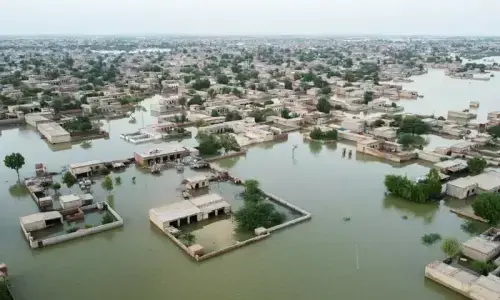
Where were you last Monday evening? This was the question of the week. Monday was the day of the great deluge when it poured and poured in Karachi to compensate for the years of drought that the city had lived through. And what compensation it was! The thoroughfares were submerged — a few almost by waist-high rainwater — and the traffic jams were probably the worst in the city’s history.
Sharea Faisal, the most important road which visiting dignitaries use from and to the airport, was among the worst hit. Some people spent hours wading through muddy water to get back home. A lady reached her home in Malir, which had been facing a power breakdown, at three in the morning after having roughed it out on the road for ten hours. Some passengers who landed at Quaid-i-Azam International Airport on Monday found that their journey had taken fewer hours in the air than the time they had to spend on the road trying to reach home from the airport.
Why was Sharea Faisal so badly hit? In fact, it had to pay the price of development — or rather unplanned development. The numerous flyovers that have come up in the last decade or so are the culprits. Their ramps virtually became torrents, emptying their swirling waters on the road with no arrangement to drain away the extra supply. Karachi is never prepared for rains.
The traffic police, who have the mystifying habit of disappearing from the scene when needed most, just could not be seen. Karachiites, who have suffered the woes of bad governance for ages, know how to take matters into their own hands and fend for themselves. They did it on Monday, but not always for the good of everyone. Many enterprising drivers crossed over the traffic island, and, imperilling their lives as well as those of others, drove for some time on the wrong side till they blocked oncoming traffic. Others locked their cars and walked away, not at all perturbed by the fact that their cars obstructed the flow of traffic.
The city Nazim described the havoc wrought by the rain as a natural calamity which can strike anyone. He was right, but the mark of good governance is how the authorities handle the crisis. In our case even three days after the downpour the roads remained flooded with water with the civic agencies not bothered about pumping it out. There was one exception though. Dr Ziauddin Ahmed Road was bone-dry the following day. After all, the chief minister’s house is on the road.
A new addition to the city’s entertainment scene is a swanky-looking cinema that has been built by the Seaview strip. This cinema should be warmly welcomed by Karachiites, who are often labelled as “entertainment starved”. (They are also water and electricity starved, but forget about that for a while as plenty of column space has already been taken up by civic woes).
The exterior of the building makes it look as though it was transplanted from some first-world suburb, with a Chinese restaurant thrown in. The outside walls are plastered with movie posters of some classics of western cinema. There is a “families and couples only” rule, supposedly to keep malevolent elements at bay. Looks like the single young men of this city have a pretty bad reputation, as reports of crowd rowdyism at pop concerts have been surfacing frequently in the press.
Though a little far from the centre of the city, especially for those living in the former district central, this movie house might be instrumental in rekindling interest in cinema and revive the tradition of family outings at the cinema.
Weddings should no more worry you. You can evolve a strategy which works. Those who are made to wait till midnight to eat a greasy dinner and reach home by 1.30am after weddings should be sympathized with.
The invitation card, of course, gives you the normal time for dinner but guests start arriving at 10.30pm. Then begin the ceremonies — Nikah, video-making and the unending rounds of shots for stills. Dinner is served at 11.30pm.
If it is not rukhsati or valima, there is singing and dancing, thus delaying the dinner to 1 or 2am. The guests reach home at 2.30 or 3am.
The strategy: if it is a working day, extend your working hours well into the evening to do things that you normally do not get time for — like clearing up the drawers, or catching up on your reading.
At 8.30pm, head for your favourite restaurant where, eating slowly, you derive sadistic pleasure from the plight of those who would be kept hungry till midnight.
After dinner, take a little walk and then head for the wedding place. By the time you are there at 10pm, some people have arrived; the hosts themselves are absent.
By 10.30pm, the hosts have arrived, and you are on the move, making sure that the host and the hostess see you. Then with an envelope in your hand — you know what it contains — you confront the hosts, who are usually absent-minded and have many things on their minds. After the usual greetings and congratulations, hand in the envelope, and your job is finished.
The hosts get busy with other things and other guests, and you manage to slip away. By 11 or 11.15pm you are home.
Let the procedure be standardized: stay put, whether you are in the office or at home if it is a Sunday. Do not go to the wedding place early. Have your dinner at home or a restaurant of your choice, watch the 9pm news, have a cup of tea, do a little walking, reach the wedding place by 10pm or so, linger on, hand in the envelope and return home.
Don’t ever, ever wait for dinner. Should you fall for a dish of biryani or chicken tikka, the price will be a return home at 1.30am. This is not a price worth paying.
It is a common trait among people the world over to complain about the cities they live in. They crib about poor transport, badly-maintained roads and crowded hospitals. So it is with the residents of Karachi who miss no opportunity to bad-mouth their city. But when outsiders begin to criticize, then suddenly your patriotism is aroused, and you discover how much you love your city.
At a dinner the other day, the guests seemed warm and cordial. The conversation took its usual twists and turns: sports, politics, current affairs and gossip. All was well until the guests started talking about their own cities. They said how milk and honey flowed in their birthplaces, which were all very salubrious and idyllic. One would have put up with all this laudatory talk about other cities patiently had they not begun to heap scorn on Karachi.
Some of the criticism was actually quite amusing. One gentleman said the people of Karachi were sly and exploitative. Another bewailed the fact that it did not snow in Karachi. (That the city has a sea is no virtue, of course.) Still another pointed out that life in Karachi is mechanical and dull. An elderly man from Uttar Pradesh said there was something in the air of Karachi which made the youth disrespectful. (Do youngsters in Rampur fall at the feet of passers-by in respect?)
Karachi welcomes everybody with open arms. It has a cosmopolitan character — it is a ghareeb parwar city. It makes no distinction between a local and an outsider. Those who are born here as well as those who come here to earn their livelihood for the most part manage to get along well. It’s just these nitpicking types that get one’s goat.
— By Karachian
email: karachi_notebook@hotmail.com