0
0

A shocking incident
TUESDAY’s mob attack on Pakistan’s mission in Kabul comes as a rude shock to Islamabad and to the diplomatic community around the world. Particularly shocking is the fact that the protesters who ransacked the embassy were led by the governor of Afghanistan’s state bank. This was the second such attack on the Pakistan mission in Kabul since 1995, when the Northern Alliance was able to capture the capital from the Taliban for a short period. The earlier attack had even left an embassy staffer dead. The latest attack has come at a time when the Northern Alliance — known for its antagonism towards Pakistan — has a strong presence in the Karzai government. It was perhaps for this very reason that President Karzai promptly called up President Musharraf to offer his personal regrets for the incident promising compensation for the damages done to the embassy premises and assuring that such a thing would not be allowed to recur.
There is need to look into the factors that might have prompted the latest outburst against Pakistan. For one thing, because of our intense involvement in that country’s internal affairs in the eighties, many Afghans continue to view Pakistan and its intelligence agencies’ role in their country with an eye of suspicion. This is despite the fact that there has been extensive people-to-people contact between the two nations since the Soviet invasion of Afghanistan in 1979, when over three million Afghans sought refuge in Pakistan, and many opted to settle down here for good. The dispute over the long and porous Durand Line border dividing the two countries, however, has remained unresolved. President Musharraf’s candid public statement, during his recent trip to Camp David, that Mr Karzai was not fully in control and that his writ did not run beyond Kabul, may have hurt the sentiment and pride of many Afghan people, including their government. Though the assessment was correct, the time and place of the remark must have caused resentment. Afghan tribal leaders in the border region exploited the controversy by accusing Pakistan army of making incursions into Afghanistan. Two days of protests in Kabul, in which some Afghan officials also took part, followed the Afghan president’s demand that Pakistan stop interfering in his country’s internal affairs.
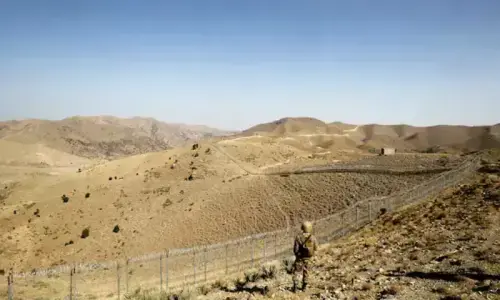
Kabul’s allegation that Pakistan army has established illegal check posts on its territory makes little sense under the prevailing conditions on the Afghan side of the Durand Line, where some 6,000 US marines are busy searching for the remnants of the Taliban and Al Qaeda operatives. Kabul is fully aware of the fact that at places in the border region US and Pakistani troops conduct joint operations in search of fleeing or hiding Al Qaeda and Taliban militants. This being so, it is surprising that Pakistan army’s action in the porous border region should have come in for such harsh criticism. The remnants of Al Qaeda and the Taliban do pose a common threat to both Pakistan’s and Afghanistan’s peace and internal security. President Karzai has tried to mitigate the effect of this unpleasant happening by expressing his shock over the attack on the Pakistan mission, saying that “those who committed this act are the enemies of friendship between Afghanistan and Pakistan.” However, the incident should induce both sides to do a spot of introspection and try to move forward on a new path of good neighbourly and fraternal relations. But, while doing so, it is important that both Islamabad and Kabul rein in those elements on either side which have been responsible for creating bad blood between the two countries. President Musharraf should see to it that Pakistan’s intelligence agencies do not get involved in Afghanistan’s internal tribal rifts, and President Karzai should hold in check his Northern Alliance ministers, who make no secret of their hostility towards Pakistan.
Nepra’s indictment
NO one will agree with the National Electric Power Regulatory Authority’s forceful indictment of the Karachi Electric Supply Corporation more than the people of Karachi whom the KESC is supposed to serve. For decades, the KESC has tormented the people of Karachi by sheer incompetence, gross mismanagement and corruption. In a document detailing the malaise afflicting the utility’s management and operations over the years, Nepra virtually despairs of the possibility of any significant improvement in the KESC’s performance under the present management pattern. It speaks of a “marked deterioration” in the KESC’s performance in spite of the induction of army personnel as top managers over the last five years. In its view the utility is unable to generate new revenues for reasons of heavy line losses and pilferage. Reacting to the KESC’s plea for a rise in power tariffs, Nepra says the power corporation’s financial condition has reached “an unsustainable level” and that power shortage, currently at 520 megawatts, was likely to go up to 1,000mw within the next three years. What is more important about the Nepra document is the truth it speaks about the army’s role in managing the KESC affairs. The army, it says, has failed to bring about any “significant improvement” in its quality of service to the consumers. This fact is pointedly brought out by the fact that since its induction into the administration of the KESC in 1999, the utility’s losses have “more than doubled” — from seven billion rupees these have risen to Rs 16 billion.
The army’s intrusion into civilian affairs at a national level is a subject unto itself. But its failure to improve the power supply position, despite the great hype accompanying its induction in 1999, serves to highlight the utter futility of the army dabbling in civilian affairs. Two powerful arguments result from the Nepra document. First, the army has only added to the KESC’s mess; second, there is no alternative to privatization of the power utility. The KESC is now synonymous with incompetence and apathy. The people of Karachi loathe its very name. They would heave a sigh of relief if this thoroughly incompetent utility is privatized so that a new, more dynamic management set-up, guided by a better sense of public responsibility, could give them uninterrupted power supply — something that people in other countries take for granted. As for the army, it is for its bosses to ask themselves whether the army can improve the situation countrywide if it cannot effect visible improvement in one civic agency and that too over a period of five years.
Laleh and Ladan
THE phrase “till death do us part” assumed a new and poignant meaning when the brave attempt to separate the 29-year-old conjoined Iranian twins ended tragically in Singapore on Tuesday. The two had spent three decades joined at the head, and it is difficult to realize how they went through life in that condition. When they finally decided to part, their lives ebbed out on the operation table. But shatteringly sad as the end is, the story of the twins is one of human endurance and courage. While alive, they displayed extraordinary courage and forbearance in the face of their physical condition; in agreeing to undergo an operation in which they knew the odds were stacked against them, they personified the human quest to explore new frontiers. The doctors who undertook to perform the daunting operation are also part of this story of courage. They knew that the eyes of the world were upon them and failure would lead to despair, yet they went ahead. In the end, what will remain etched in memory for a long time is the picture of the twins repeatedly published in newspapers. Both Laleh and Ladan looked irrepressibly cheerful. And full of hope. They may have taught some of us how to face adversity.