0
0

Hastening slowly for talks
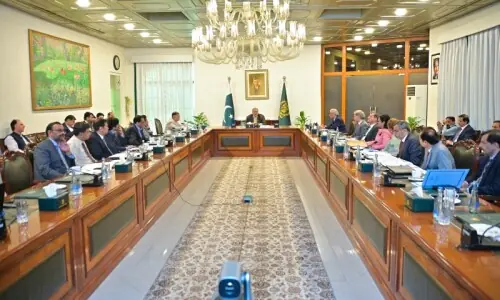
WITH Prime Minister Atal Behari Vajpayee’s offer of a resumption of talks with Islamabad and Prime Minister Zafarullah Jamali’s telephone call to him inviting him to visit Pakistan, the tensions between the two countries are beginning to decrease.
It would be a mistake, however, to believe that the task of normalization is going to be easy or rapid. There is no indication yet as to when, if at all, a visit to Pakistan by the Indian prime minister will take place. India’s official statement about the possibility of Mr Vajpayee’s visit to Pakistan, which, incidentally, has been due since the Agra summit (July 2001) is remarkably vague.
An Indian official spokesman has merely said that the idea of Prime Minister Vajpayee visiting Pakistan had figured “in a general sort of way” during the telephonic conversation between the two Prime Ministers but “the idea was not pursued by either side.” If the implication is that a formal invitation has not been extended, yet, this, has since been delivered to the India’s charge d’affirs in Islamabad.
In any case, the Indian prime minister’s sudden decision to want to reopen talks with Pakistan, after a lapse of about 22 months since the Agra summit, is regarded by many with scepticism. They believe that the offer of talks may well be ploy — rather than a change in policy — armed at appeasing the Kashmiris who expect to be associated with any India-Pakistan talks on the future of their state.
Significantly, Mr Vajpayee made his initial offer of talks to Pakistan and the Kashmiri people while addressing a public rally in Srinagar on the 18th of last month. However, he followed it up with a formal statement in the Indian parliament in which he proposed the lifting of the ban on overflights and restoration of full diplomatic relations between the two countries.
In spite of the damper of an end to “cross-border terrorism” contained in Mr. Vajpayee’s statement in the parliament as a condition in talks, there has been much progress since Mr Vajpayee’s speech in Srinagar. A former Indian foreign secretary calls it a fast moving scenario. Prime Minister Jamali has responded by offering an unconditional dialogue with India and proposing a series of confidence-building measures.
These include the release of a large number of Indian fishermen held in Pakistani prison and proposals for restoration of air, bus and train links, exchange of sports teams and full resumption of diplomatic relations. He has also stressed that the people of Pakistan and India are not at war with each other and they must be able to move freely between the two countries. Significantly, the agenda offered by Mr Jamali for bilateral talks was drawn up in consultation with all political parties, including the parliamentary opposition.
However, it has to be realized that progress towards fuller normalization between India and Pakistan could be exasperatingly slow and halting. It will need to be preceded by a great deal of quiet, behind-the-scene diplomatic moves and a whole lot of off-the-record exchanges and even perhaps, the undeclared involvement of some friendly countries doing the prodding and nudging needed to ensure progress. Deep distrust between the two sides remains among the major obstacles in the way of steady improvement of relations.
It will perhaps be a long time before anything like the relationship that existed before December 2001 (when there was a terrorist attack on the Indian parliament house in New Delhi) can be restored.
A matter of utmost concern has been the deepening of prejudices arising out of religious and cultural differences. The rise of religious extremism on both sides has put a premium on fanaticism and political militancy in the name of religion. The so-called jihadis, who were involved in the civil war in Afghanistan and the unrest in places like Chechnya later tuned their attention to the disturbed territory of Indian occupied Kashmir. Whatever the extent of their involvement there, it has given a twist to the Kashmiri people’s freedom struggle which in fact was never intended.
On the other hand, the Hindutva elements in India have been increasingly resorting to violence against Muslims and other religious minorities, rekindling the fires of communal hate and intolerance. Indeed, if the Hindutva fanatics have their way, they would see to it that India does not enter into any kind of dialogue or peace negotiations with Pakistan. The militant leaders of Shiv Sena and Rashtriyaswayam Sevak Sangh have warned Mr Vajpayee not to go ahead with his peace initiative. However, so far both India and Pakistan have remained firm on their resolve to resume bilateral talks.
A tentative agenda for talks seems to be taking shape. In substance, Mr Vajpayee has not attached any pre-conditions to his proposal for the resumption of talks with Pakistan. Mr Jamali has also made it clear that he will not attach any conditions to his offer of a dialogue with India. He has indicated that Pakistan would want to resume talks with India at the point where they had been “left off at Agra.”
At his press conference on Tuesday, Prime Minister Jamali made it clear that although Pakistan had by no means changed its position on the UN resolutions on the Kashmir issue, he stressed that his side was prepared to show flexibility during the proposed talks with India..
This is a realistic approach to the matter. Flexibility can break the deadlock on Kashmir. The UN resolutions are not like holy scriptures; they did not become a hurdle in the six months long India-Pakistan negotiations on Kashmir in 1962-63.
It has also to be understood that the ground realities in Kashmir have undergone a sea change since the UN resolutions were adopted in 1948-49. The new realities have to be taken into account in any search for a way out of the Kashmir imbroglio. In any case, the social, economic and political progress of the people of South Asia should not be held hostage to a set of resolutions adopted more than four decades ago.
What is important is to work towards what President Musharraf outlined in an interview to a foreign TV representative the other day. He categorically said that once stability had been achieved in India-Pakistan relations, two countries could start thinking in terms of reduction in armed forces and a regime for denuclearization. These issues concern not only India and Pakistan but the whole region and rest of the world.
Putting a lid on spam
MORE than doubling in volume each year, the clutter of come-ons, get-rich-quick schemes and obscenity known as spam, once a mere annoyance, has become a serious threat to US commerce. Fighting the flood of messages costs US corporations nearly $9 billion and accounts for at least $4 billion in lost productivity each year.
No one who understands how easy it is to send spam is under the illusion that any one law could eliminate it. The anti-spam law that Virginia approved last week, however, takes a big step beyond tsk-tsking. It will let prosecutors bring felony charges (including forfeiture of assets and up to five years in prison) against the most egregious violators: those sending more than 10,000 spam messages in a single day.
US Rep. Zoe Lofgren, D-Calif. is to introduce the most promising, if imperfect, solution to date: legislation that requires marketers to label spam and offers a bounty to the first person to track down a spammer who violates the labelling requirement. People who trace the offending e-mail to its source, identify the sender and provide proof to the Federal Trade Commission would receive a reward amounting to 20 percent of any civil fines the agency collects.
Lofgren crafted the bill with Lawrence Lessig, a prominent law professor at Stanford, who predicts that just as people tracked criminals in the Old West to win bounties, plenty of “technically qualified and eager people” would jump at a chance to track down spammers for a generous reward.
Lofgren’s bill will get a hearing only if one is scheduled by the chairmen of two key House panels, the Energy and Commerce Committee and the Judiciary Committee. Those legislators, Reps. W.J. “Billy” Tauzin, R-La., and F. James Sensenbrenner Jr., R-Wis., need to hear from valued constituents such as the thousands of small and medium-sized businesses that have found their e-mail servers unable to cope with the growing volume of spam.
Spammers often claim that any constraints on them would undermine the free spirit of the Internet.—Los Angeles Times
Some thoughts on Muslim societies’ predicament
THE case for invading Iraq is at best dubious on both moral and legal grounds. The right to pre-emption is not within the accepted norms of one’s defence, hence severely restricted in international law. Indeed, it is abused so often. A bully — especially if it is the only one in town with incontestable power — can always strike the vulnerable, safe in the knowledge that he/she will not be accountable for the hectoring. Incidentally, no credible evidence has been found for the weapons of mass destruction in Iraq and the regime’s links to terrorist groups.
The excuse that this intervention was for the “regime change” is equally untenable since there is no objective test for differentiating between bad and good regimes: one can always pick and choose subjectively given the necessary means and the will to change. Hypocrisy is so transparent in the approval and disapproval of the existing regimes. A variety of motives, with varying degrees of credibility, have been suggested for the invasion of Iraq, including pursuit of national economic interest, imperial domination, freedom for the Iraqis, and even “manifest destiny”. One can choose according to one’s predilection.
In a unipolar world, with almost unprecedented economic and military power possessed by the United States, similar interventions are likely in other countries as well. This looks like a new face of imperialism for some time to come with slogans to suit it: globalization, democratization, rogue states, war on terror, and weapons of mass destruction.
My primary interest here is neither to condemn the United States — it has been rightly condemned by millions — nor speculate the reasons for its invasion of Iraq. My focus, instead, is on the state of societies, Muslim societies of the Middle East in particular, that the United States is most interested, as it seems, in reordering or reshaping. The geographic notion of the Middle East used here includes all of the Arabic-speaking countries, Turkey, Iran, Afghanistan, and Pakistan. The basic hypothesis I propose is that the major causes of the predicament of Muslim societies today can be found in their own history and contemporary social and political order. It is too simplistic, and a distorted view of reality, to lay the blame largely, if not entirely, on external factors — that there is a conspiracy in the West to keep the Muslim societies weak and subservient. Maybe there is. The important point is that there is something terribly wrong in these societies that makes them vulnerable to foreign interventions. It needs a critical and thorough examination. In this discussion, my aim is to make a modest contribution to this end. Let me first make some general observations that are relevant to the issue under examination.
* While it is true that most Muslims share a lot of history, both recent and distant, they are deeply divided. The divisions are based on a number of factors, including differences in the interpretation of faith (sunni and shia), ethnicity (Arab and non-Arab), standard of living (Afghanistan and Saudi Arabia), and the socio-political order (Iran and Turkey). In several countries, Islam is not the glue that binds people together; ethnic, tribal, caste, and kinship loyalties are far more powerful in people’s relationships. The concept of Muslim ummah in its contemporary use is devoid of substance. The Organization of Islamic Conference (OIC) and the Arab League demonstrate this point well.
* The economic and social conditions in most Muslim societies are far inferior to those in western societies. In some countries of the Middle East, where economic conditions have improved significantly mainly because of the oil revenue in the last thirty years, the political rights of individuals are greatly restricted, even more so than in some of the economically less developed Muslim societies. These restrictions reflect the repressive nature of the regimes, whether secular or religious in their claims.
* Generally a vast majority of the population in these societies enjoys little freedom to express dissent that is deemed to threaten the interests of the power elite, no matter in what form the authority is exercised. In some societies, a strong cult of personality — Ataturk in Turkey, Nasser in Egypt, Assad in Syria, Saddam Hussein in Iraq, and Khomeini in Iran — is nurtured to perpetuate the rule of one person or party. The ethnic and religious minorities are subjected to both legal and extra-legal discrimination and persecution. Almost every Muslim society, no matter how it is labelled, is ruled by a small group of self-appointed custodians of one ideology or another with little or no room for rule of law.
The laws governing these societies are anachronistic and capricious — they deny basic human rights and individual liberties — and, even when they seem to be reasonable, they are applied without due process or fairness. These conditions exist in both the nominally secular and theocratic (religious) states. Turkey falls in the first category and Saudi Arabia in the second.
* The contemporary political and social orders in most Muslim societies reflect two competing views. Both of these have evolved in response to the rise of and domination by the West, which includes the former colonial powers of Europe and the United States. The secularist view, in its extreme form found in Turkey, is that society must be governed not by divine laws but by laws made by humans, subject to change according to the needs of time and space. The divine laws should be left to guide one’s private life. The opposite view is that the laws of God are eternal and must be the basis for guidance of both private and public life. This view is the guiding principle in the states of Iran and Saudi Arabia.
The problem in this view, however, is that the divine laws are as much subject to different interpretations as the laws made by humans. The secularists take their cue from the western experience and the Islamists base their claim on faith in the eternal character of divine laws and their interpretation of the early history of Islam. The Islamists’ view is nurtured by the failure of the existing political order — which in many countries is dominated by a secular but corrupt elite — to provide security and protect basic rights, deliver justice, create proper incentives for economic growth, and adopt policies that reduce poverty. It seems that too many young people are unhappy with the status quo, and are attracted to extremist causes or ideologies.
* Muslim societies have made very little contribution to science and technology since about the end of 14th century. Their superiority in the Mediterranean ended in the 15th century and their decline was quite obvious by the time Reformation started in Western Europe in the early 16th century. The roots of this decline and fall of Muslim societies are found in the 12th century when the Muslim civil and religious elite abandoned the right of relatively free discourse and innovation on important issues of religion and state. The general policy of tolerance, even encouragement, to intellectual pluralism followed for about three centuries — from 9th to 11th century — was replaced by intolerant and repressive measures used by successive rulers who were often supported by the custodians of religion. The anti-intellectual and self-serving interpretation of the faith and sharia became an integral part of the political order of the Muslim rulers and dynasties.
A major lesson of history is that most human beings care very much for their personal freedom, a notion that implies simultaneously rights and corresponding responsibilities. Humans are in a constant struggle against the natural and social barriers that impede their progress to achieve this end. There are times when they might make a trade-off with something else. But over the long haul they tend to return to fight for their right to freedom. We also know from history that individual freedom, to express opinion (dissent), form associations, own property, and engage in activities for personal gain and public good, has been a major source of economic and social progress in societies.
It is also a fact that most of the progress observed in the last two centuries is unprecedented in history and its roots can be found in the age of Enlightenment following the Reformation in Western Europe. This age was marked by revolutionary changes in the social and political order of these societies, shifting the centre of power from church and kings to the masses. It liberated people from the clutches of unrepresentative or unaccountable rulers and made religion a largely personal affair. Good historical accounts of this transition from servitude to freedom are readily accessible.
Similar experience was not shared by the people in Muslim societies until the introduction (penetration) of western colonial culture, capital, technology, and goods on a large scale in the 18th and 19th centuries. Muslim societies went into a state of deep slumber, nay decadence, in the 14th century, a time when societies in Western Europe were showing the first signs of Renaissance. The accumulated knowledge of the Greeks and Muslims passed to the European monasteries and universities, whereas the Muslim societies started the long haul of dynastic and despotic rule with little or no taste for intellectual freedom and search for knowledge. Muslim scholarship was redirected to the narrowly defined fields of inquiry, following the established (orthodox) traditions.
Madrassahs were no longer providing a healthy environment for the inquisitive mind; revelation and tradition became the only sources of knowledge and social behaviour. The Muslim masses were left at the mercy of the feudal, tribal, and religious leaders without literacy or power. All of their guidance, in fact direction, in the affairs of religion and state was provided by the same groups of elite.
The colonial state of Muslim rulers behaved as a predator, usually fleecing the populace at home and in the colony for generations. In addition, the constant internal and often violent struggle for succession plagued the dynastic rule and sapped much of the potential energy and resources of society. The dynastic rule had its roots in the early Islamic period and with time received much support from the religious, civil, and military elite according to the circumstances of time and place. The rulers acquired legitimacy usually by force and bribery.
The history of Muslim societies from the fall of Abbasids in Baghdad in 1258 to the mid-19th century is dominated by the dynasties of the Mamlukes, Seljuks, Timurids, Ottomans, Mughals, and the petty Khans of Central Asia. Each of these dynasties, buttressed by mercenary armies, in its own way contributed to the downslide of Islamic civilization since most of its energy was used for survival or expansion of its rule. The institutions of higher learning decayed and the Muslim masses were denied the right to be free in their homes, neighbourhoods, and communities. The ruler’s state dominated the daily life of Muslims in almost all matters, ranging from the temporal to spiritual. The ruler represented in his person the legislative, judicial and administrative authority that was not allowed to him in Islamic or any other civilized law.
The patriarchal regime at the household level complemented the structure of the absolutist state: females were denied even those rights that they had achieved in the early period of Islam. The unravelling of the dynastic empires in Muslim societies started in the 18th century, leading to the emergence of petty regional rulers usually at war against one other. There were clear signs of exhaustion and rupture even in the Ottoman Empire by the early 19th century. The attempts to reform the civil and military structure were both incoherent and feeble.
To be concluded