2
2

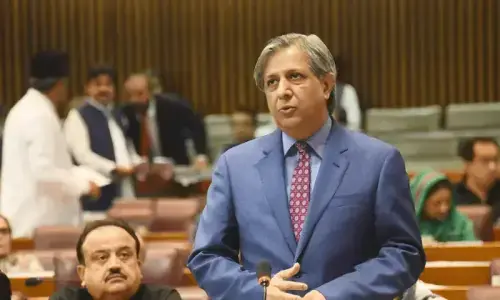
ON Monday, US Secretary of Defence Chuck Hagel came to Islamabad and essentially warned that disruptions of the Nato supply route through Pakistan could have repercussions in Washington that may imperil US assistance to Pakistan. Yesterday, Prime Minister Nawaz Sharif claimed his government is working urgently to address the terrorism threat inside Pakistan. Also yesterday, parliament passed a unanimous resolution calling upon the government to end drone strikes inside Pakistan. Three small episodes in the span of 24 hours, but each linked to the broader problem in Pakistan-US ties. Much is said, sometimes about convergences, sometimes about disagreements, by both sides, but neither side is willing to do what is necessary to stabilise a problematic but crucial relationship.
Start with Mr Hagel’s veiled threat. In essence, the US defence secretary has warned that domestic politics in Pakistan ought not to get in the way of American and allied countries’ military interests in Afghanistan over the next year. The PTI may have appropriated an area of foreign policy and taken unilateral decisions that cannot be defended on the basis of law or convention, but there’s a clear political context — drones and their unpopularity inside Pakistan. Killing Hakeemullah Mehsud in North Waziristan and trying to kill a senior Haqqani Network leader in Hangu was the US demonstrating yet again that it continues to put the military and intelligence cart before the political and strategic horse. The drone strikes have further inflamed anti-US sentiment in Pakistan, making it even more difficult for moderate political forces here to find a way to balance both domestic and international pressures.
Then again, it is not as if the government has any clear policy on militancy to begin with. Mr Sharif’s claim that his government is working on a ‘war footing’ to end terrorism is scarcely credible. Meanwhile, parliament exemplified the problem with the approach to fighting militancy in the country: lash out at drones; speak only in muted voices, if that, about the terrorists and militants who stalk this land. So, to the extent a difficult situation can be simplified, it appears to come down to this: the US wants to kill people on Pakistani soil in drone strikes and gets upset when Pakistanis react to those killings; Pakistan condemns the US for its drone strikes but cares little about the problem that has brought the drones over Pakistani airspace in the first place — terrorists and militants. It’s hardly a recipe for stability or mutual respect, but neither side appears willing to bridge the gap.