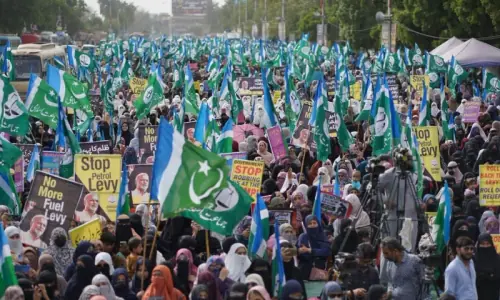
ISLAMABAD, Dec 4: Pakistan was included in the category of ‘extreme risk’ countries in the annual ‘Human Rights Risk Atlas 2014’ released by a global analytical organisation on Wednesday.
Among the highest risk countries are Pakistan (fourth globally), Afghanistan (sixth) and Myanmar (eighth), according to the atlas published by UK-based Maplecroft.
The atlas shows that since 2008 there has been an unprecedented 70 per cent increase in human rights violations globally, and the number of countries classified as ‘extreme risk’ states has increased from 20 to 34.
In Bangladesh, ranked 17th, and India, 18th, poor legal and regulatory frameworks contribute to a lack of access to remedy and pervasive labour rights violations.
Among the top 10 extreme risk countries, Syria is on the top. Included in this group are Sudan, Congo, Somalia, Afghanistan, Iraq, Myanmar, Yemen and Nigeria.
Workers’ protections continue to deteriorate in low-cost sourcing countries, particularly in Asia, and the atlas reveals worsening working conditions in Pakistan, Bangladesh, India, the Philippines, Indonesia and Vietnam.
Poor working conditions, including widespread lack of enforced health and safety standards, endanger the lives of millions of workers. A lack of awareness among unskilled workers, as well as weak governance and high levels of corruption undermine the protection of human rights.
The role of security forces in violent crackdowns within growth economies has been a key driver in the rise of human security risks. This trend is particularly evident in growth economies, such as Colombia, Peru, Brazil and Turkey, where violent repression is characterised by the suppression of protests, which sometimes include arbitrary arrest and detentions and extrajudicial killings.
Restricting free speech and information enables repressive governments to act within a climate of impunity, where media scrutiny and public dissent can be quashed and where justice or ‘access to remedy’ for victims of violations is inaccessible.
In many of the countries where crackdowns by security forces are more frequent, their score in Maplecroft’s Freedom of Opinion and Expression Index has also deteriorated.