NEW YORK: The prime ministers of India and Pakistan agreed Sunday they need to stop the recent spate of attacks in the disputed Kashmir region in order for peace talks to advance, a senior Indian official said.
They also both accepted invitations to visit each other's countries, but no dates were set.
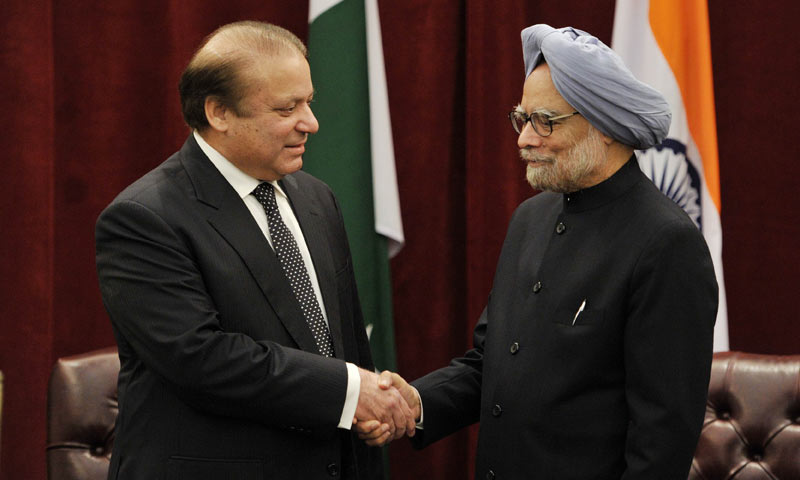
Indian Prime Minister Manmohan Singh and Pakistan's Nawaz Sharif met for just over one hour at a New York hotel on the sidelines of the UN General Assembly.
It was their first face-to-face meeting since Sharif was elected in May.
India and Pakistan have fought three wars, and relations between the nuclear rivals have been strained since the 2008 Mumbai attacks blamed on Pakistan-based militants that killed 164 people in India's commercial hub.
This year, a renewed spate of violence has threatened a decade-long cease-fire on the Kashmir frontier.
Indian National Security Adviser Shivshankar Menon called Sunday's meeting useful and constructive. He said that Singh and Sharif had tasked senior military officers to find a way to shore up a decade-long cease-fire along the disputed frontier in Kashmir, known as the Line of Control.
''They were both agreed that the pre-conditions for forward movement in the relationship which they both desire is an improvement of the situation on the Line of Control where there have been repeated cease-fire violations,'' Menon told reporters at a briefing.
''Our overall impression of the meeting was that it was useful because it provided an opportunity for high-level contact on issues that are troubling the relationship,'' he said. ''We will now see how both sides take it forward in the next few months.''
Pakistani officials were briefing reporters later Sunday.
On Thursday, twin attacks by suspected separatist rebels on Indian security forces killed 13 people in the Indian-held portion of the Himalayan region, an attack that the top elected official there said was aimed at derailing the meeting of Sharif and Singh in New York.
In comments Friday at the General Assembly, Sharif called the meeting a chance for a ''new beginning'' in relations. Singh had downplayed expectations.
At the meeting, Singh raised the issue of terrorism emanating from Pakistan and reiterated the need for effective action against perpetrators of the Mumbai attacks, Menon said, adding that Sharif said that was Pakistan's intention.
Leaders of India and Pakistan last met a year ago. Pakistan's then-President Asif Ali Zardari met Singh during a visit to India in April 2012.
He was the first Pakistani head of state to visit the country in seven years. The two also met in August 2012 on the sidelines of a summit in Iran.
That progress has been set back by the upsurge in violence in Kashmir, but the need for peace is intensifying.
The impending US military withdrawal from Afghanistan, where India and Pakistan have competing interests, adds new uncertainty to a region increasingly threatened by militancy.