Stressing with the disclaimer that Madras Café is a work of fiction, Shoojit Sircar’s human-drama of politics, rebellion, genocide and spy-games adapts Indian Prime Minister Rajiv Gandhi’s assassination plot, and the Sri Lankan civil war with sweaty palms and a gawky breakneck pace. And yet, for all its clumsy footing, at times, half-intelligent writing, it is engaging.

It opens with John Abraham as Vikram Singh, in a scruffy beard, waking wide-open in an unkempt bed. Like most war veterans he is plagued by nightmares. His next step, though, is baffling, as he sits at a Church and narrates the film to the padre – and of course, us.
The year is 1990 and Vikram is a Major with the Indian armed forces, with a proficiency in covert ops for the Research and Analysis Wing (that’s RAW for the uninitiated). Vikram’s task is to sneak into Jaffna and break the rebel militancy that’s has substantially increased its foothold in the region.
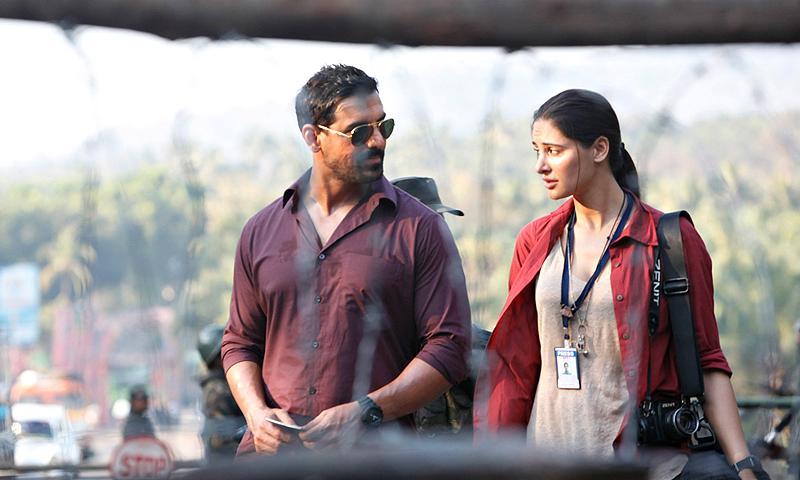
On face value, Vikram’s mission is simple (though, I doubt any war mission actually is simple): infiltrate, sniff out sources – which include trifling assistance from a war correspondent (Nargis Fakhri) – and face an obligatory double-cross; though, that one we see coming way before Vikram does.
And that’s one of the snags in Madras Café. It is predictable – and perhaps more scared than it lets us believe.
Events, names are tinkered to stay free from unwarranted uproar (which didn’t work ), and which doesn’t feel right, especially because Vikram and co. are in the middle of an actual slice of history.
Mr. Abraham, also the main producer of Madras Café, is fine as he prods though with gruff looks and minimalist acting skills, moving from scenario to scenario without any emotional heft. We learn early that Vikram’s wife (Rashi Khanna) doesn’t know about his covert operations and that the film’s other leading lady, Ms. Fakhri, is there because, well, she looks good in front of the rest of the war-torn backdrops.

As long as we’re talking characters, there are two in Madras Café that warrant a mention: Prakash Belawadi and Siddharth Basu. The former, almost sinking the ship with his rough theatrics, is Vikram’s on-the-field superior. The latter, a natural and a god send, is the intelligence department’s head who appears to either argue with hard-headed state officials or push Vikram deeper into the mission.
Other than these two, the rest of the characters, inspired by real-life people – including an unnamed ex-Prime Minister, posing as Rajiv Gandhi – are McGuffins, whose only real relevance is to move the story towards its climax.
Slickly photographed and precisely cut (with very natural production design to boot), Mr. Sircar grounds the motion picture in realistic warfare scenarios with undue, breathless energy. The on-the-clock screenplay zips, zigs and zags through Sri Lanka, India and an international port or two, almost as if its tail is on fire (considering that it’s the early 90’s, watch for a few of the latest automotives when Mr. Abraham goes to Bangkok).
The rapidity keeps the interest alive, I’ll give it that. But that’s just about it.

For all its speed and embedded seriousness about global conflict, the nature of war, consequences and international trade, Madras Café lack of braves turns it into mellow spy-thriller. And trust me, the words “mellow” and “spy-thriller” do not gel.
“Madras Café” is released by Viacom 18 Motion Pictures.
The film stars: John Abraham, Nargis Fakhri, Rashi Khanna, Siddharth Basu.
Directed by Shoojit Sircar; Produced by John Abraham; Viacom 18 Motion Pictures; Rising Sun Films; Ronnie Lahiri; Written by Somnath Dey, Shubendu Bhattacharya, with dialogues by Juhi Chaturvedi. Cinematography by Kamaljeet Negi; Editing by Chandrashekhar Prajapati; Production Design by Vinod Kumar and Music by Shantanu Moitra.
The film is rated U/A, for grim reality, war-torn country-sides and those few bruises appear that appear on Mr. Abraham.