



 2
2

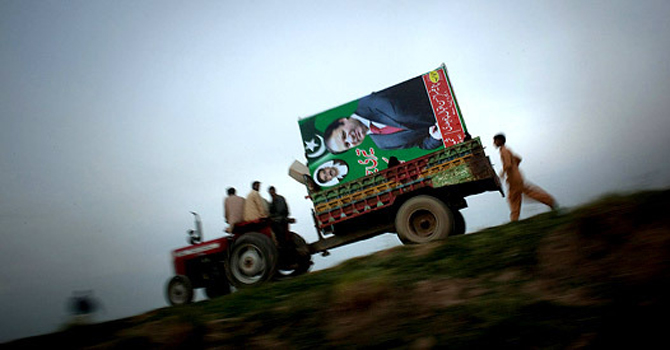
Ask anyone, whether it’s a jaded small-town resident or a first-time voter in a metropolitan city, and the mood seems the same: there is little excitement about the May 11 election.
Infighting between politicians, an inordinate delay in announcing candidates and the palpable fear of terrorist attacks has overshadowed what should have been one of the most interesting elections in recent history.
Till very recently, there was little fervour in Lahore’s Anarkali Bazaar. Shah Brothers, a store that sells a wide range of posters, had disappointing sales to report. “We’ve only sold eight to 10 so far,” says the shopkeeper, as he shows off his collection of posters of Nawaz Sharif, Benazir Bhutto and Imran Khan. “You can’t even tell that there’s an election coming up.”
Few people could name a candidate from the constituency, and mused instead about names they’d seen on posters or the incumbents from 2008. At the newly opened Al Hijaz Printers and Advertisers in Anarkali — an extension of a store selling scientific equipment — Mohammad Nasir Chaudhry says that he’d had “no orders so far” although “I thought we should start this business for the elections since there’s usually a rush on them for about 15 to 20 days.”
On the candidates’ side, though, as the campaigning approaches the last stretch, spending has picked up. Some political parties have bought airtime on television networks to run ads, replete with soundtracks provided by singers including Rahat Fateh Ali Khan.
Yet not everyone has that kind of money to spend.
In Karachi, several candidates are relying on the support of their extended networks and parties to fund their campaigns. Sania Naz, for example, is a first-time contender running on a PPP ticket from Lyari and is backed by the Uzair Baloch-led People’s Amn Committee. “We are going to win on the basis of the people here,” she says. “People are contributing Rs100 each and we are getting donations from supporters and affluent long-time residents of Lyari. Uzair bhai also has a big share in this.”
The PPP-Shaheed Bhutto’s Ghulam Hussain Khwaja, contesting the NA-253 Karachi-XV seat, says that funding for his campaign has come from personal resources and in-kind donations. Corner meetings are organised by supporters in the constituency. “We don’t have to spend money,” he says. “There are personal resources, as well as party workers. Someone gets flags made, another gets Panaflex signs made, another makes the pamphlets. Our meetings don’t have food or chairs, we sit on the floor.”
Khwaja says that he has had around 20,000 pamphlets prepared and that it costs Rs750 to print a thousand copies. The pamphlets include the party’s election symbol, the party manifesto and images of the party’s founder, the late Mir Murtaza Bhutto, and current head Ghinwa Bhutto.
The MQM’s Syed Ali Raza Abidi is also making his electoral debut and is the party’s candidate from NA-251 Karachi-XIII. His campaign is expected to kick off now that the MQM has announced its candidates, but he has been assured by the party that they will be handling all expenses.
“On the party level, they will be arranging for finances and for the banners or cards and items that have my name on it,” he explains. “The money for it will be taken from the account [set up for the candidate] that they will be putting money into. The party will be paying vendors for supplies of decorations and the candidates’ corner meetings etc. The party has not asked the candidates for a single rupee,” he adds. “They even give me money for diesel if I need to travel.”
But Abidi also notes that the Rs1.5 million cap on election-spending for National Assembly seats is too low and should be raised. He feels that the limit makes sense because violating the rule would help in the disqualification of candidates after the elections and, he says, spending does need to be checked. “But the limit should be increased,” he says. “With such competition and all these other parties capturing the electronic media and print ads — how will you compete with that? How are these parties going to justify this spending?”
The Election Commission of Pakistan (ECP) has also called for a strict enforcement of the code of conduct and barred political parties from transporting voters to and from polling stations. While this doesn’t hurt the MQM’s middle — and upper-class urban base — that has access to public and personal vehicles, as well as the MQM’s own organisational structure’s resources — this is a challenge for other parties whose voters aren’t rich or are in the rural areas. “The ECP has said that it will arrange for voters’ transportation instead,” Khwaja says. “We are relying on that.”
Abidi and Naz also realise that contesting an election isn’t a poor man’s game. “It’s a losing proposition for any candidate,” says Abidi. “Just organising food, drinks, decor and security for a thousand people can easily cost up to Rs500,000 — and I know this because I’m in the business.” (He runs the popular Karachi restaurant, Biryani of the Seas.)
“It would have been very difficult for me to contest,” acknowledges Naz when asked if she would have run for elections without the financial backing she has garnered. “I’m from a poor family, and for someone like me, you don’t have money for large rallies, banner or flags. I am fortunate to have such good people and a committee of elders supporting me.”




























