0
0

KARACHI, June 9: It is time that the Sindh High Court announced its decision in the case relating to the devolution of public health facilities to the Sindh government because prevailing uncertainty is causing a great deal of inconvenience to poor patients especially at the Jinnah Postgraduate Medical Centre (JPMC), doctors and a top health official representing the Sindh government have said.
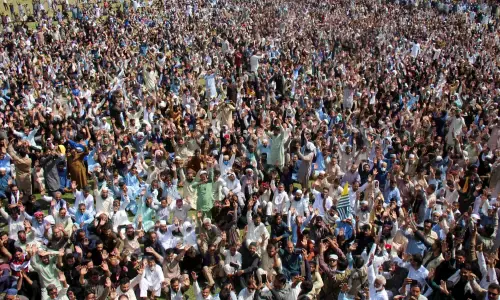
They were speaking to Dawn in connection with ongoing agitation at the JPMC where the situation could not be normalised even after a week as now protests are being staged at the hospital for reinstatement of two directors, who were earlier removed following agitation by a group of medical staff.
The ongoing protests at the hospital has so far claimed lives of three patients and injuries to two doctors, besides causing a great deal of inconvenience to thousands of patients.
Voicing their concerns at the recent developments at the health facility, JPMC doctors, who wished not to be named, said that the vast majority of health professionals working at the hospital wanted that the status quo created by the pending court decision was ended immediately.
“Right now, the hospital’s as well as our future hangs in the balance. The hospital had got a stay order against its devolution more than two years ago but there is no sign that the matter will be decided any time soon,” a senior doctor working at the orthopaedic department said, adding that during these two years patients and the medical staff had suffered a lot because there had been no new appointments, nor replacement of retiring employees (or in case of death) and promotions.
The prevailing status quo was more damaging to junior doctors who had no representation at the top administration level, he added.
The most unfortunate outcome of the frustration building up for two years was an increased polarisation among the medical staff — one group supported the former directors that remained at the helm for many years and was now protesting for their reinstatement while the other group wanted the hospital function under the provincial government so that their day-to-day issues were sorted out, they added. “Both groups, however, are indifferent to the plight of poor patients who have nothing to do with politics or devolution,” one of them said.
The situation could continue if the court continued to delay giving a clear-cut message, they added.
“The past two years have shown us that the status quo could not work. It does not matter to us whether it is the federal government or the provincial government governing us as long as our interests are protected. This means that we want assurances in writing over job security, seniority, transfer and promotions,” they said.
Dr Seemin Jamali, former joint executive director of the hospital, severely criticised the doctors’ group that protested a few days ago that led to the removal of the hospital’s top leadership.
“They didn’t hold any meetings with us or gave any charter of demands. It is a group of hooligans,” she said.
She also flayed the government for her transfer from an administrative cadre to a teaching cadre.
Regarding employees’ grievances, she said that the former administration had written many letters to the Sindh government that included the chief minister and the secretary of health regarding appointments, promotions, release of 20 per cent deputation allowance and raise in basic pay. No official attention, however, was given to the hospital needs.
“We even asked for hiring contractual employees, but there was no positive response. We have filed another petition on these matters a month ago,” she said, adding that the hospital was facing immense financial problems since the provincial government had become the authority to release funds for the hospital.
Rejecting the allegations of lack of cooperation on the part of the provincial government, health secretary Dr Suresh Kumar said that no letter had been sent to the department regarding the issues the hospital had been facing for two years and it was only when doctors protested against the administration that he came to know about the situation.
“Although the court has ordered status quo, the government could still help after seeking legal opinion. All issues could have been sorted out if they had just come and talked but there was no initiative,” he added.
The provincial government, he said, would do everything to secure employees’ future under the law. The government had been following the court’s order and there had been no interference in hospital affairs so far.
“I think the court decision is desperately needed to end ambiguity. Besides, the president has also recently issued an ordinance according to which federal employees on deputation would now work under their respective provincial governments where they are posted,” he said. —Faiza Ilyas