1
1
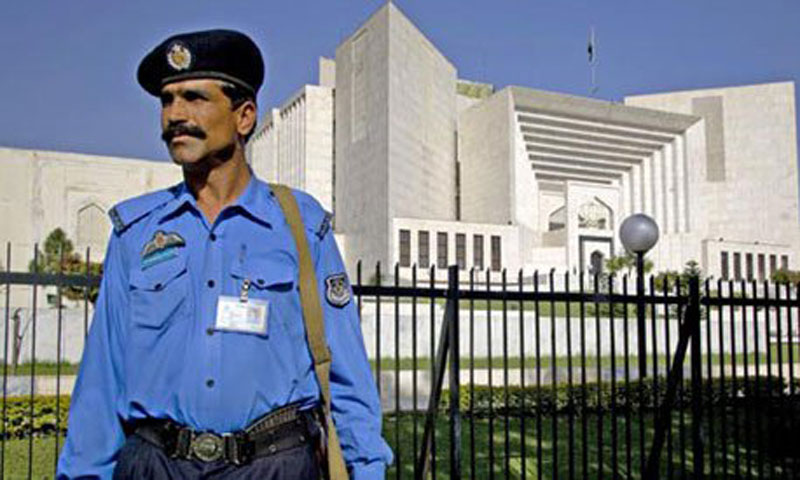

ISLAMABAD: Ten days after ordering removal of retired Admiral Fasih Bokhari from the post of chairman of the National Accountability Bureau, the Supreme Court said in its detailed judgment on Friday that even an ordinary citizen who did not hold any public office could be tried under the National Accountability Ordinance (NAO) 1999.
“We hold and declare that the provisions of NAO are applicable even to a person who is not holder of a public office,” said the 42-page verdict issued by a three-judge bench comprising Justice Anwar Zaheer Jamali, Justice Asif Saeed Khan Khosa and Justice Amir Hani Muslim.
Authored by Justice Asif Khosa, the judgment explained that the NAO had the jurisdiction to try any person who had not even aided, assisted, abetted, attempted or acted in conspiracy with a holder of a public office.
“It is clarified that a stand alone private person can be proceeded against under the ordinance if other conditions mentioned in the NAO in that respect are satisfied,” the order said.
The court issued the judgment on a number of appeals and petitions moved by people who were either proceeded against under the NAO or those who claimed that they did not come under the jurisdiction of the ordinance because they did not hold a public office.
These two features in these appeals and petitions, the verdict said, gave rise to a common question whether or not provisions of the NAO applied to a person who was not holder of a public office.
“Thus before taking up these appeals and petitions for decision in terms of their individual factual and legal merits we have decided to resolve and answer the said common question in the first instance and have heard the arguments of the learned counsel for the parties regarding the said issue,” the verdict said.
The court ordered its office to fix all the appeals and petitions for hearing before appropriate benches for a decision on the basis of their individual factual and legal merits.
The verdict said that the perils of corruption in a society were far greater than the hazards of narcotics. Besides by virtue of Section 3 of the NAO 1999 which asked about the implementation of the law in the entire country, including Fata and Pata, the ordinance would have an overriding effect on any other law in force for the time being, it said.
The court also answered the arguments suggesting that the NAO provisions were very stringent, harsh and oppressive in matters of transfer/withdrawal of cases, bail, remissions, freezing of property, transfer of property, presumption of guilt, higher sentences and disqualifications.
The court noted that all such aspects of the NAO had already been taken up in the 2001 Khan Asfandyar Wali case in which constitutional validity of different provisions of the ordinance was affirmed.
In that verdict the apex court had held that stringent provisions of the NAO were identical or similar to many provisions which already existed in many other statutes, including the Control of Narcotic Substances Act 1997, the Establishment of Office of Federal Tax Ombudsman Ordinance 2000, the Anti-Terrorism Act 1997, the Banks (Nationalisation) Act 1974, the Offences in respect of Banks (Special Courts) Ordinance 1984, the Anti-Narcotics Force Act 1997, the Conciliation Courts Ordinance 1961, the Criminal Procedure Code 1898 and the Employment of Children Act 1991.
The court also found that such provisions of the ordinance were quite justified in view of the gravity of the menace of rampant corruption which the ordinance was meant to tackle.