0
0
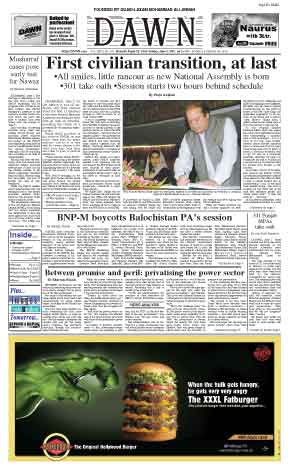

ISLAMABAD, June 1: On the surface, it was all cordiality and little rancour about the May 11 elections as the new elected National Assembly was formally born with an oath on Saturday, heralding the return of a potentially thumping rightist rule.
Nawaz Sharif, president of the victorious PML-N, sat only inches away from the prime minister’s seat he is to take with his certain election to the office four days later after more than 13 years of political wilderness.
“Prime minister Nawaz Sharif”, his supporters packing the visitors’ galleries chanted repeatedly during more than two hours of the sitting marking the start of a five-year term of the country’s 14th lower house.
With PML-N emerging as the largest party in the 342-seat house and going beyond the simple majority with several independents joining it, Mr Sharif is set to be elected on Wednesday as leader of the house to become the first Pakistani to take the prime minister’s office for the third time, after his two ill-fated terms in the 1990s were cut short, first by a political intrigue in 1993 and then by an army coup in 1999.
It was a completely transformed house that took oath on Saturday, with the PML-N gaining the majority from its second position in the previous house, in which the PPP was the largest – but much short of simple majority – that governed for five years in coalition with both former friends and foes, including some months together with the PML-N, becoming Pakistan’s first elected government to complete its full constitutional tenure under a civilian set-up.
Behind the smiles and pleasantries, while PML-N members seemed to be brimming with joy and those of the PPP looked out of sorts because of their party’s humiliation at the hands of what its assassinated leader used to call in the 1990s as “remnants of Ziaul Haq”.
Many of them are in victors’ list, from pro-business Nawaz Sharif downwards, committed to right-wing policies.
NO RANCOUR: Unlike the bitterness between the political rivals seen in the 1990s, and despite the PML-N and the Pakistan Tehreek-i-Insaf, the newly emerged third force, snatching all but a couple of seats the PPP had won in the PML-N powerbase of Punjab in 2008, both the PML-N and PPP showed an unusual cordiality during the oath taking, with Mr Sharif and PPP’s would-be opposition leader Khurshid Ahmed Shah taking turns to go to each other’s desks to shake hands in the beginning of the proceedings and after signing the roll of members.
While Mr Sharif received the day’s loudest applause by desk thumping by party colleagues and allies and clapping in the galleries, Mr Shah, who has been a popular trouble-shooter in the previous house as the PPP chief whip, was applauded apparently by all sections of the house and a solitary “Jeay Bhutto” slogan from a gallery when he was called upon to go to the rostrum to sign the roll.
So was outgoing Speaker Fehmida Mirza when she signed the roll in Urdu alphabetical order after administering a combined oath to 301 lawmakers – out of a total of 314 who were invited. Several newly elected members have to vacate one of two or more lower house seats won by them, or vacate a National Assembly seat to opt for one in a provincial assembly, elections for nine constituencies are still to be held and a decision about 10 reserved seats for women from Punjab is still awaited.
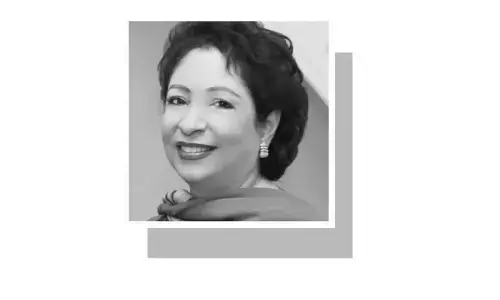
And it fell to the lot of Dr Mirza, who became the Islamic world’s first female parliamentary speaker when elected to the office in 2008, to earn a unique honour also in administering – and, at the same time, herself taking – the oath by reading out the Urdu text of the oath with feminine gender like “halaf uthati hoon” (I take the oath) or “… karoongi”.
In all previous assemblies, oaths were administered either by a male speaker or a senior male member of the house.
Notable absenters from the ceremony were PTI chairman Imran Khan, who is still convalescing in Lahore from serious injuries he suffered in a fall during an election campaign rally, his party vice-chairman Shah Mahmood Qureshi and Jamiat Ulema-i-Islam chief Maulana Fazlur Rehman.
Imran Khan was elected from three constituencies, but his party announced on Saturday that he would retain his seat from Rawalpindi and vacate the remaining two from Peshawar and Mianwali, while PTI president Javed Hashmi, elected from two constituencies, would retain the seat in his home town of Multan and quit the one in Islamabad.
The oath-taking, which began nearly two hours late because of a PML-N parliamentary party meeting, was held amid strict security around the parliament house, which saw a traffic jam near the building because of a rush of visitors, who also overcrowded the house galleries.
Before adjourning it until 11am on Monday, the speaker reminded the house of the schedule for the election of a new speaker and deputy speaker by secret ballot, which she will oversee on the same day, for which nomination papers must be submitted to the house secretary by 12 noon on Sunday.
The prime minister’s election, on Wednesday through what is called division in parliamentary parlance requiring house members to openly go to different lobbies to record their votes, will be overseen by the new speaker, with 2pm on Tuesday being the deadline for submitting nominations.