0
0

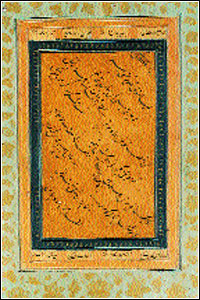 KARACHI, May 11: The National Museum of Pakistan has put on display a 222-year-old specimen of calligraphy as the object of the month, says a press release.
It adds that calligraphy invariably leads back to Hazrat Ali, and in the late 15th century, Sultan Ali Meshidi, the famous master of Nastaliq Sultan Ali, who claimed that the “renown of my writing is due to the name of Ali”.
The press release says calligraphy in the Muslim world is regarded as the miracle of Islam which developed in a brief span of time into a highly well-proportioned, highly refined styles of superb beauty. Kufic used for Quran’s copies, is the Liturgic script. There are few copies of the Quran or fragments preserved in the museums and libraries which date back to Caliphs period as is claimed by the proud owners.
“The development of truly beautiful, well-measured script is connected with the name of Ibn-Muqla, a native of Shiraz, who served several times as minister, in different courts of the Abbasid dynasty, developed the cursive scripts by proportions of the letters,” it says.
The press release says that Ibn-i-Bawwab added some elegance to the rules of Ibn-Muqla. The copy of the Holy Quran transcribed by him in the year 1000 AD is a remarkable peace of writing, particularly the long swinging curves at the final round letters.
Nastaliq, in which the object of the month is transcribed, is the bride of Islamic styles of writing. In this style, the pen moves from the upper right towards a long, swinging left ending. It is certainly an ideal vehicle for poetic texts and the combination of poetry written in it.
The press release says that towards the end of the 15th century pages with pious sayings or with pithy quatrains were popular. The greatest master calligraphists of this style are connected with eastern Iran.
Mir Ali Haravi and Sultan Ali Moshadi, whose calligraphic specimens are housed in a proud collection of the National Museum, are the best among the Nastaliq calligraphers, it says.
The press release says that the specimen displayed at the National Museum contains Urdu poetry in superb Nastaliq. The text is decorated with the combination of fine poetry written in elegant Nastaliq and artistic borders. Blue floral border outlined in white. The date of the specimen is exactly 1797 AD.