Beyond the Salt Range
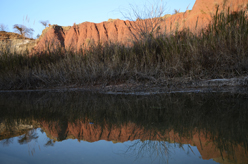
THE Soon Valley in the Salt range is Pakistan’s newest ecotourism hideaway in the offskirts of the Motorway, almost half way between Islamabad and Lahore. The scenic vistas along the Salt Range and around the Soon Valley area can be called the ‘grand canyons of Pakistan’.
I am among the lucky ones to have visited this new picturesque unexplored hideaway. After about an hour and a half’s journey on the Motorway from Islamabad, towards Lahore, we forked out on the left and followed the secondary road leading to Malot village, a small settlement famed for its old heritage remains since early 900AD.
The remains at the site consisted of two Shiva temples in a rather dilapidated condition, and said to have been built by the characters in the Mahabharata. It is interesting to note that some of the features on the façade of the temples have strong resemblance to Greek and Gandhara style of architecture and the red stone used in building these temples seem to have been rolled over to this area from distant places.
History tells us that Alexander and his troops passed through the Salt Range towards the Jhelum River and Raja Porus, on the very banks of the river, fought a fierce battle with the army of Alexander. Later, in sixth century AD, the kingdom of Singhapura, after the Mauryans, ruled over the Salt Range region and became a rich satrapy comprising large temple complexes like the one at Malot and Ketas, which is about 25 kilometres from Malot.
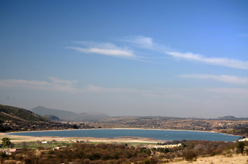
There is not much to see at Malot except for the two temple buildings on high ground that give a superb view of the surrounding Salt Range. We retrace the route back on the Motorway and crossed over to the other side of the road to enter Kallar Kahar and continued towards the Soon Valley, past the small hamlet over Kallar Kahar Lake.
Other than Kallar Kahar Lake, the Salt Range has four lakes, which are more than 400 years old in the Soon Valley, namely Khabbeki, Ucchali, Jhalar and Namal, located 800 metres above sea level. Ecology in each of the four lakes is distinct from each another and comprises marsh vegetation on cultivated land that makes the environment an ideal home for thousands of winter migratory birds.
Local legend has it that once upon a time, a weary traveller passing by Kallar Kahar asked for water. The local resident avoided giving it to him, lying that the water was too salty and unfit for drinking. And since that day, the water in the lake became salty!
Soon Valley spans 780 square-kilometres and is 56 kilometres long with an average width of 14 kilometres. Khushab is the capital and the Valley stretches from Padhra to Sakesar at its highest point above Uchhali Lake (1530 metres).
The Soon Valley boasts 60 species of flora, 13 variety of grasses along with plants, bushes and small trees, including sanatha, phullai and kau (wild olive), and there are also many pine and deodar trees in most areas. There are 36 species of resident birds, including hog-cuckoo, wood pigeon, tree magpie, forest sparrow and parrots can be seen. The core wildlife of the region includes wolf, jackal, hyena and the endemic Punjab Urial. The lakes are home to five varieties of indigenous fish.
The Awans are the original people in the Soon Valley. They are the descendents of the sons of Qutub Shah of Arab origin, settled here when Qutub Shah accompanied Sultan Mahmud Ghaznavi during his invasion of north India and Afghanistan. The other tribes in the area include Phatwal, Bhojo Khail, Sheral, Mianwaddal, Alyaral, Sher Shahal and Noor Khanal.
We drove about an hour and a half from the Kallar Kahar viewpoint and finally reached our final destination at the Kanhatti Camping site, which was serenely set amidst fruit orchard that grow oranges, besides other variety of fruits like apricot, apples, blueberry, lychee, plum and raspberry.
After we had explored the village surroundings, it was time for high tea that was followed by dinner at the campsite. Under a star-studded sky, we gathered by the campfire and listened to local legends narrated by our hosts.
The next morning at sunrise I forced myself out of the tent to experience the brilliant sight of the dawning of the new day. Soon after breakfast, we packed up and moved towards Uchhali, stopping by at vantage points with the views of Khabbeki Lake and the Soon valley panorama in the distance. The Pakistan Wetland Project Information Centre (PWP-IC) has its centre at Khabbeki and here we stopped for orientation on the area and refreshments.
Khabbeki Lake at Ramsar area was declared an International Water Conservation area in 1976. Pakistan Wetlands Programme of WWF-Pakistan has launched a comprehensive project for the conservation and protection of these important lakes. These lakes are rainwater reservoir formed in bowl-shaped grounds by the hills and form a significant part of wetland ecology. In winter, some of these six lakes provide an important winter haven for migratory birds. Greater flamingos, a variety of grebes, are native to the area and white-headed ducks (oxyura leucocephala) are found in the lake areas.
We continued towards Ucchali Lake, a paradise for ornithologists. You can hire a boat to go around the lake, which is a part of the 3,000-acre Uchali Wetland Complex — a protected area since 1966 and was designated a game reserve in 1986.
Time limited our visit to the other lakes. It was already late afternoon — time to hit the Motorway for the homebound journey. On the way, we stopped by a view point above Kallar Kahar Lake, and got off the vehicle for a brief walk up the stairs to a historic place called ‘Takht-e-Baburi’, meaning the ‘throne of Babur’, the first of the Mughal kings who travelled from Central Asia into the Indian subcontinent across the Salt Range. At this historic stage, Babur addressed his army on his invasion strategies. Babur had chosen the site because of the sweet water and sulphur springs nearby.
Next to this historic point is the tomb of a local saint. Also look out for peacocks that roam free in this area. According to an old belief, any person who captures a peacock has bad luck ruining his life; and perhaps it is due to this legend that peacocks thrive here in abundance.
We restarted our return journey, admiring the sweeping view of the lake and then on to the Motorway and were back to civilisation just after dark.




 0
0