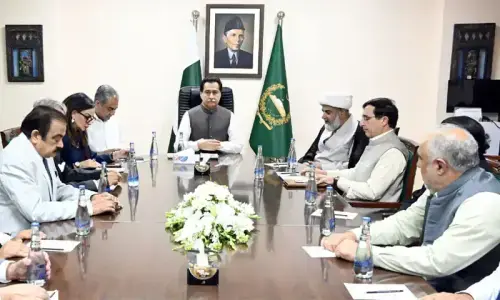
Approximately 44 per cent of all seats in the outgoing National and provincial assemblies were occupied by individuals who had relatives serving in previous assemblies, according to research carried out by the monthly Herald.
Taking 1970, the year of the first one man-one vote polls in the country, as its starting point, the Herald has identified 597 families that collectively account for approximately 3300 of the 7600-plus seats in the National Assembly, four provincial assemblies and the Senate that have been up for grabs over the course of nine general elections.
Of the identified dynasties, 379 are based in Punjab, 110 in Sindh and 56 in Khyber Pakhtunkhwa. Balochistan is home to 45 legislative dynasties while the Federally Administered Tribal Areas (Fata), with its relatively limited participation in electoral politics, is home to another 7 such families.
Three hundred and sixty five political dynasties were represented in the outgoing national and provincial assemblies of which more than a hundred also had members who sat in the assemblies of 1970.
According to the study, the percentage of seats occupied by the members of political dynasties has experienced minimal changes over successive electoral cycles, registering a minimum incidence of 37 per cent in 1977 and peaking in 1993 at nearly 50 per cent. Among the provinces, Punjab records the highest incidence of dynasticism at 50 per cent (in southern Punjab the number rises to 64 per cent), followed by Balochistan at 44 per cent. Sindh comes a close third at 41 per cent (within the province, the level of dynasticism in Karachi is less than nine per cent), followed by Khyber Pakhtunkhwa at 28 per cent and Federally Administered Tribal Areas at 18 per cent.
A dynasty, for the purposes of this study, is defined as a family with at least two members having served in the National Assembly, the four provincial assemblies or the Senate since 1970. Many of the identified families have been found to have more than the requisite two members active in electoral politics – former president Farooq Leghari’s family, for instance, has had as many as fourteen different family members elected to the country’s various legislative forums since 1970.
The family of Ghulam Mustafa Jatoi, founder of the National Peoples Party and acting prime minister of Pakistan in 1990, has had 11 of its members serve in various assemblies. In 2008, four of Jatois sons held, between them, two provincial assembly seats, one National Assembly seat and one Senate seat, granting the family simultaneous representation in all three legislative forums, a national record of sorts.
A significant number of the identified dynasties, particularly those comprising the landed elite, have been active in electoral politics since 1920, with many having played a role in the independence movement during the 1940s. A surprisingly large number, particularly those with a base in urban areas, also came to the fore in the years following 1970.
For a complete list of the 597 identified dynasties, pick up a copy of Herald’s pre-election special issue, out on news stands now.