0
0

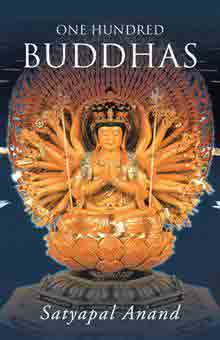
Satyapal Anand is a well-known poet of our times. I have been seeing his poems in different journals. But in the last month of the last year, I happened to meet him in Delhi at the occasion of SahityaAcademy’s Manto seminar. He was kind enough to give me his three collections of English verses. The one titled One Hundred Buddhas in particular attracted my attention. As I started reading the verses I soon found myself under their spell. The poems are steeped in Buddhist tradition. In them the great master is seen talking in his benign way to his bhikshus and to people in general.
Satyapal thus came across as a very different poet, possessed with a sensibility unknown to Urdu poetry. I grew curious about the man. To my benefit, at the end of the volume I found an afterword where he talks about himself. Under the caption “Who was Anand? Who is Anand?” he writes, “The first Anand was Buddha’s chosen disciple 26 centuries back; the second Anand is the present writer, who claims to be the first Anand’s [reincarnated self].”
Speaking briefly, Anand is known to us as the most prominent among the bhikshus, enjoying Buddha’s confidence, being the recipient of his teachings and acting as the liaison between needy people and Shakyamuni. Satyapal traces his lineage from this Anand. He says, “I was surprised to learn from an old cousin of my deceased grandpa that Anands were a tribe founded by a Bhikshu of that name. As a young man I vowed to find my lineage and whether or not I was in some way related to the original Anand.”
There are, as Satyapal tells us, no authentic details of Anand’s original tribe or village or how he became Buddha’s most trusted disciple. Nor is there any mention of what he did and how he died. But Satyapal researched based on what he had heard from his paternal grandfather’s cousin, who had heard from his father, and that father from his grandfather. According to them, Anand, while proceeding to Gandhara along with five other monks, stayed as a guest of a local chieftain of a tribe called Khokars. The chieftain’s daughter went up to Anand and bedecked him with a garland, meaning thereby that she has chosen him as her husband. So Anand married her, retired from his ascetic life and settled down with a lease of land from his wife’s father. The other four monks too married women from the same clan and settled there as tillers and traders. Thus a new subclass came into being, called Anands. But it chose to retain its links to the Khokar tribe.
“So,” says Satyapal, “my final discovery was that over 20 or more centuries ago, my original lineage had been attached to one of the five monks who chose to become Khokars. Hence my attachment with Buddhism. For years during this formative period I would often dream about monks
going from door to door, me being a part of the group of four or five.” He wonders, “was it an ordained part of my destiny that I would write poems in Urdu, Hindi and English about Buddhism”.
And so we have these poems. Satyapal tells us that the topics, motifs, threads, and themes for these poems have been taken from diverse material about Buddha’s life, including folk tales in India, Nepal, Bhutan, Sri Lanka, Burma, Japan, China and Tibet. The poet makes no claim of originality in thought and content.
The poems are divided into two parts, and in between are images of Buddhist icons and paintings.
Satyapal is trying to be humble when he says that he “makes no claim of originality in thought and content.” In fact, he is following in the footsteps of those poets and epic writers, a kathakar of ancient times, who after diving deep in the oral tradition of their times brought out what was valuable and gave it a new form.
In this book we find material that the writer has gathered from vast stores of folk tales in the Buddhist tradition and transformed into poems emanating Buddha’s wisdom. In the first part of One Hundred Buddhas we see Buddha engaged in dialogue with Anand and listening patiently to the problems he is faced with and replying in an amiable way.
In the second part, Buddha is seen talking to people, telling them about trees and birds who talk and while talking reveal secrets of life to those who understand their language.
As portrayed by the poet, Buddha comes alive to us as he speaks in his sweet gentle voice.