0
0

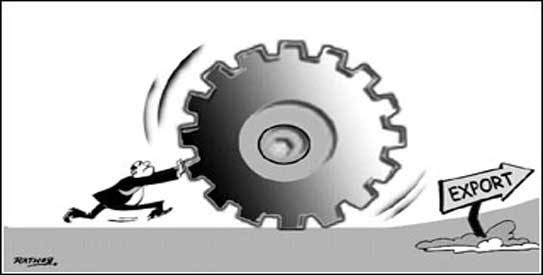
KARACHI: Businessmen and industrialists ruled out the possibility of achieving the export target of $95 billion in the next three years owing to lack of an ideal working environment and lingering political and insecurity situation.
The government unveiled on Wednesday a medium-term (2012-15) Strategic Trade Policy Framework, setting a cumulative export target of $95 billion for three years.
They expressed anxiety over the announcement of trade policy just few months ahead of general elections and moreover concerned over its future treatment by the new government. They further said that stakeholders were not consulted for this policy nor were their recommendations were taken into account.
President Karachi Chamber of Commerce and Industry (KCCI) Haroon Agar said that there is no infrastructure to support the export target and questioned how the caretaker set up and new government will handle it.
Chairman Pakistan Hoisery Manufacturers Association (PHMA) M Jawed Bilwani said that the export target is too big to achieve in view of the energy crisis and deteriorating law and order situation.
He said that the three years back the government announced textile policy with an export target of $25 billion. Some practical efforts were made in the first year on the decisions announced in the policy which improved exports.
However, after one year the government starting showing no importance. As a result, exporters have now been awaiting clearance of Rs17-18 billion in terms of various local levies for the last two years and in the meantime many units have packed up their business.
Chairman Korangi Association of Trade and Industry (KATI) Zubair Chahya said the export target seems unachievable.
“If the energy issues and law and order situation are addressed sincerely, then export can even easily cross $95 billion in the next three years. However, it is insecurity that hampers industrial production,” he said.
Chairman Site Association of Industry Dr Arshad Vohra said the export target is achievable if the government ensures an ideal business environment.
He said there is a dire need to bring down cost of production followed by uninterrupted gas and power supply at affordable rates.
He said that the government has not done enough to rescue the falling textile exports in the last few years.
Former Chairman Pakistan Bedwear Exporters Association (PBEA) Shabir Ahmed expressed surprise over ambitious export target without realising the ground realities relating to power and gas crisis, rising political and economic uncertainty and lawlessness.
“The current government has actually passed on the burden of already delayed trade policy and its ambitious export target to the new government which will continue to strive hard to even get closer to the impossible export target,” he said.
“Almost all the government departments have remained least bothered for the last few years in making any serious effort to boost exports and resolve the issues that hit business activities and exports,” Shabir said.
He said the government has failed to realise the falling textile export for the last few years. While recalling bedwear exports of $2.1 billion in 2006, he said exports fell to $1.6-$1.7 billion currently which should have been $2.6 billion now.
Our reporter from adds from Islamabad: Commenting on the second Strategic Trade Policy Framework (STPF) 2012-2015, Islamabad Chamber of Commerce and Industry (ICCI) president Zafar Bakhtawari said that the government should set realistic export targets by keeping in view the ground realities.
The country has missed the annual export target of $25.5 billion by $2billion and also witnessed a trade deficit of $21.27 billion during the last fiscal year 2011-12.
“The export target of $95 billion in the next three years seems very ambitious and much would depend on the facilitation that government will announce for industrial sector and also real implementation of announced action plan,” Bakhtawari said.Meanwhile, the Rawalpindi Chamber of Commerce and Industry (RCCI) president Manzar Khurshid Sheikh said that the business community has enormous concerns over the policy.
Addressing the RCCI members, he said that investors were reluctant to even visit these areas and asked the government to share its achievements of the previous three years policy.
The industrialists and traders also expressed concerns over heavy government borrowing which was leading to unavailability of cheaper credit to businesses.
However, the members of both the ICCI and the RCCI appreciated several points of the trade policy 2012-15 including the setting up of Exim Bank, promotion of services sector exports, provide mark-up support of 2.0 percent for future import purchase of machinery, establishment of Services Export Development Council and provision of ad-hoc relief of 3.0 per cent of FoB on the selected sectors.
Our reporter from Lahore adds: The Pakistan Industrial and Traders Association Front (PIAF) has welcomed the government’s decision to establish export-import bank and extend mark-up support to certain sectors of economy.
However, it termed the $95 billion export target ‘an ambitious one in the absence of electricity and gas’.
PIAF chairman Sohail Lashari said on Thursday that manufacturing sector has been the backbone of economy and for the revival of economic activities or to achieve targets it must be strengthened.
“It is a good omen that government has finally unveiled the three year strategic trade policy framework but it must give some roadmap for provision of gas and electricity,” he said.
He said that the business community was unable to understand how the export orders would be fulfilled when a large number of industrial units have already stopped functioning.
The PIAF called for immediately bringing down the mark-up rates to a single digit to support industrial sector.
The PIAF president said that the government must resolve the on going energy crisis and weakening law and order situation in the country.