5
5

Back in the 1950s there was a plethora of big American musicals performed on the London stage. ‘Annie Get Your Gun’ and ‘Oklahoma’ were the most popular. The songs from the shows were on everybody’s lips, young and old alike. “Don’t Fence Me In” was a particular favourite of mine. Perhaps because the idea of being ‘fenced in’ was anathema to me even as a child.
What does it really mean to be fenced in? It is something which changes the whole social order.
When I first visited the Kalash valleys in 1980, I was not aware of such considerations. Here before me was a pristine land of mountains, fertile fields, sweet smelling coniferous forests, running streams and shady meadows with a romantic alien tribe in residence. I was enthralled. It was as though I had travelled in time back to the distant past. Indeed I had.
Thirty two years ago things were much the same as 30 years before that. Nothing had really changed. The only noticeable change, perhaps, to a visitor of then and say in the 1950s, was in the dress of the men and that the Kalash had now begun to use money rather than just relying on barter system.
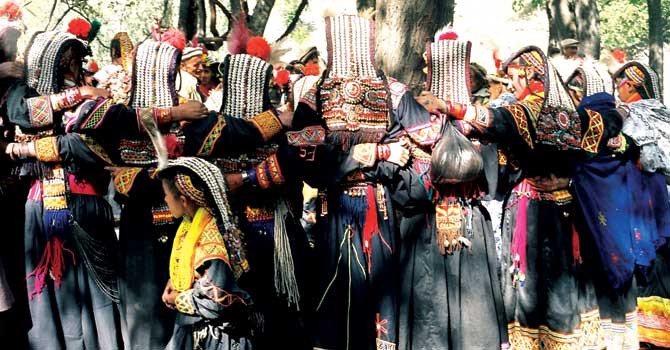
In the early 80s there were men of the older generation who still wore animal skins in winter and patti (goat skins) on their feet when climbing the mountains. Women still wore red moccasins on their feet until the ubiquitous plastic shoes took over.
Children still wore their older siblings old clothes, making them appear as if they had walked out of the pages of Dickens. As the men began to wear the Pakistani shalwar qameez, the women continued to use their long black robes, many of them still wearing the home spun dark brown.
With the coming of the first road into Birir, there came the merchants. Before that there were the traditional ‘organisers’ who trekked in with salt, and later sugar and tea; at that time, the people only consumed milk, wine and a herbal green tea prepared from herbs and grasses from the high passes. In those days there was generally only one crop per season — a type of quick growing wheat called Arien.
Vegetables consisted of beans, spring onions, mushrooms from the high pastures as well as rhubarb, pumpkins, tomatoes, and tree produce such as walnuts, apples, mulberries and grapes. Apricots and other fruits appeared to have been introduced at a later time.
Goats and sheep provided meat at celebration or funeral times. Chickens were a taboo in Kalash society and fish were not eaten from the rivers although trout were introduced in the river of Bumburet during the 80s-90s. Dogs were kept for security and to protect the herds.
When I arrived in Kalash in 1980, tourism had not developed. A few lone travellers like myself or anthropologists had ventured in, but that was all. The only accommodation available to these adventurous few, were dukans or private houses, plus the rest house in Birir and Bumburet and two rustic hotels in Bumburet.
There was no electricity, no sanitation, no drinking water, no health care facilities, no medicine, no taxis, just a chai khana and a village dukan in Birir, and a run down hotel in Rumbur.
In the 70s, a road was built high over the mountains to Bumburet and in the 80s it was rebuilt along the river from Ayun. The road opened in Rumbur in 1982. Roads always lead to change whether for better or worse. They are the proverbial double edged sword.
I had instantly fallen in love with the valleys. As such, my greatest desire was to help the people. In 1982, on my second visit, I was constantly approached to give medical assistance. I returned to the US, where I had lived during the 60s, and obtained medical training in NYC.
In 1986 I returned to Pakistan as a qualified emergency medical technician and worked as a ‘barefoot doctor’. In those days there were no fences. I roamed at will. I and my dogs knew every path, every irrigation channel in Birir. The people were friendly and hospitable, but most were very poor.
I found the diet difficult to deal with, although with time, I began to enjoy certain things — tasili bread (thin pancake-like wheat bread) dipped in animal oil for example. Goat’s cheese was a rarity, but buttermilk and yoghurt were delightful. Chai and walnut bread was my favourite meal and one of the most sustaining. Rice was a luxury which I brought in from Chitral.
The rocks were my latrine and the river my bathroom, as was the case with everyone else in the valleys.
This had to change. All those who accused me of trying to keep the Kalash back, and put them in a cage, could not be more wrong. I, with my NGO, registered in 1993, brought water pipelines and sanitation to the valleys.
Life began to change. Government Kalash schools opened. More hotels started up in Bumburet. Beautiful meadows began to disappear. Probably the real nail in the coffin in Bumburet was the building of the PTDC hotel on one of the most beautiful meadows in the valley. It was built in spite of petitions by the people for it not to be constructed. The Kalash have been exploited from time immemorial.
With the coming of NGOs like ours and AKRSP and then the Greek Volunteers, the inhabitants found jobs as labourers, masons and j-wire makers. The building of hotels in Bumburet gave employment for cooks, waiters and chowkidars. Tourism became the second main source of income for the valley people after agriculture.
Life continued to change in small imperceptible ways. People stopped making stools made from walnut and animal hide. No one had the time. It was easier to buy plastic chairs from the bazaar in Chitral.
Taxi jeeps started up making it easier and cheaper for people to reach Chitral. With the Afghan war against Russia stealing the headlines, Pakistan was also put on the map for aid agencies. Second-hand clothes found their way to the markets in Chitral.
Then suddenly, with the missile crises during the Clinton years, tourism came to an almost sudden stop. Although tourism had begun to have a negative effect (especially from Punjabi students who desecrated graves and behaved badly towards the women), this fledgling industry had given the people a chance to start to come out of their poverty.
Gradually, during the 90s, tourism crept back up again, only to be smashed yet again after the 9/11 debacle.
The NGOs continued to work, promoting health care and education. After the terrible floods of 2010 and the advent of the World Food Programme, the Kalash valleys have now come to the notice of organisations like the Red Cross and Red Crescent.
Now the people are concerned for the education of their children. They are realising that the future of their culture and ethnicity depend on the education of the next generation. Also, as the death knell of the forests is sounding, the inhabitants of the valleys, both Kalash and Muslims, are beginning to realise that with climate change and the disappearing of their forests, due to smuggling and the timber mafia, the future of their land hangs in balance.
Their way of life is irrecoverably changed. As at the beginning of the 19th century in Britian, when landlords were allowed to fence in their lands, the communal way of life is disappearing. Everyone’s desire to fence in their fields, denying the right of way for people to pass through, is also having a negative impact on the environment. Pesticides and chemical fertilisers are upsetting the biodiversity and killing off the bees.
As the Kalash enter into the main stream of life and gain material benefits, they also lose much that gave them a more tranquil and pastoral existence.