0
0

GOOD news from Africa: after two decades of bloody anarchy, Somalia is finally on the mend. There is something resembling a government coming into being in Mogadishu, with much help from African Union troops — although the country’s most popular comedian, Abdi Jeylani Marshale, famous for his parodies of Islamic militants, was assassinated in broad daylight a week ago.
Bad news from Africa: the situation in Mali is awful. The military coup in March that opened the way for Tuareg tribalists and Islamist extremists to seize the northern half of the country isn’t really over. The ignorant and brutal young officers who made the coup are blocking the arrival of 3,000 African Union troops, Mali’s only hope of ever regaining control in the north, because it would undermine their own power.
News about Africa that you don’t know whether to cheer or deplore: the major foreign aid donors have finally got fed up with Rwanda’s endless military meddling in the Democratic Republic of Congo. The United States has announced a cut in military aid, and Britain, Germany and the Netherlands are delaying payment of civilian aid, until Rwanda’s president, Paul Kagame, stops backing a rebel Tutsi militia in his country’s Congolese neighbour.
Everybody sympathises with Kagame’s attempt to rebuild peace and prosperity in Rwanda after the genocide that killed about half of the country’s Tutsi citizens. Everybody understands why he worries about Hutu militias in the eastern Congo. But he has to stop backing murderous Tutsi militias there, and using them to loot Congo’s mineral wealth. (On the other hand, don’t destabilise Kagame’s rule too much or the genocide might resume.)
Too many names, too many places, too much news. Even Africans cannot keep up with the news about their own continent. Is Africa going forwards, sideways, or nowhere at all? Indeed, is Africa any more than a geographical term?
The surfeit of news is inevitable in a continent that contains half a hundred countries. The sense of chronic crisis and chaos is due to the fact that in such a news-rich environment, the bad news will always jostle the good news aside. And yes, there really is an Africa about which you can usefully make large generalisations.
First, the entire continent is finally growing economically. Many African economies stagnated or even went backwards in the first three or four decades after decolonisation, but now there is real growth. Local disaster areas remain, of course, but over the past decade the gross domestic product of those 50 countries has grown at an average rate of five per cent.
Manufacturing production in Africa has doubled in the past 10 years. Seven of the world’s 10 fastest-growing economies are in Africa. The growth is starting from a desperately low base, in many cases, but the magic of compound interest means that a five per cent growth rate will double the size of the economy every 14 years.
So there really is hope that most Africans can escape from poverty in the next generation — but on one condition. The birth rate is declining in most countries, but it must fall faster. The 2008 UN projections saw Africa doubling its population to two billion by mid-century, even assuming that the current gradual decline in African birth rates continues. That means an average population growth over this entire period of almost two per cent a year.
If the economy is growing at five per cent and the population is growing at two per cent annually, that only leaves room for a three per cent growth in average income. That means a doubling time of about 23 years for African average incomes, so let’s assume that they triple by 2050. That’s not enough.
African average incomes now are so low that tripling them would still not create the degree of prosperity and security that people in other continents are coming to expect. Worse, it would not give African governments the resources to cope with the huge damage that climate change will do to the continent.
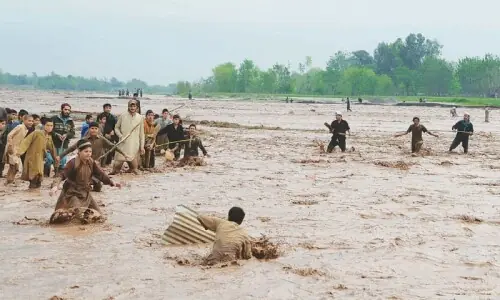
The impact of global warming is worst in the tropics and subtropics: huge floods and semi-permanent droughts will become almost routine in these areas. Africa will suffer more than anywhere else, because it is the only continent that is almost entirely in the tropics and subtropics. Feeding the population will become a major problem.
There is enough potential cropland in Africa to feed twice the current population in the present climate, but it’s far from clear that this will remain true in a two-degree-warmer world.